Farm produce goes online, opening wider market access

With abundant agricultural resources, localities across Vietnam have favourable conditions to expand markets through e-commerce.

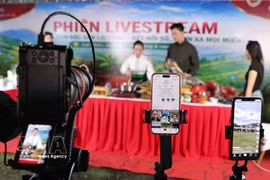
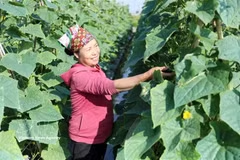
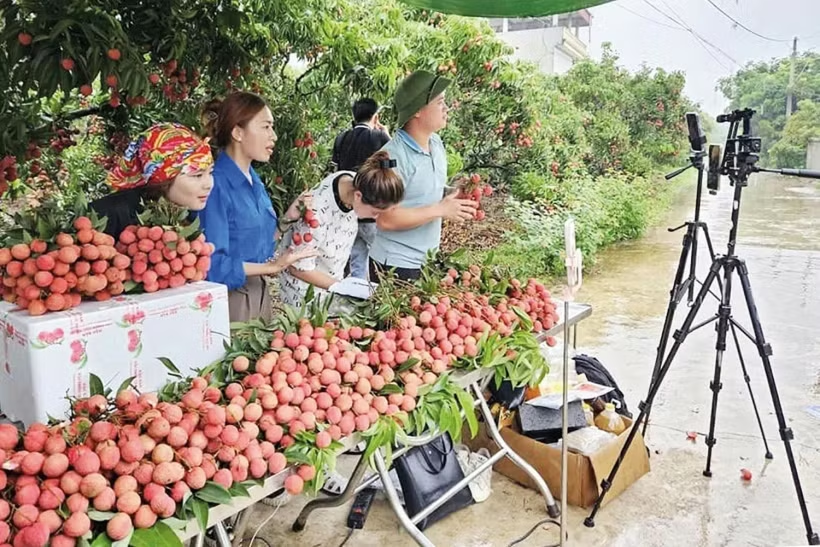
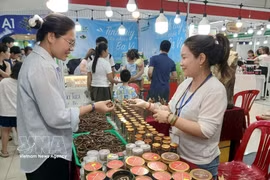
Livestreams, videos and social media are becoming “online stores” that connect farm produce directly with consumers. (Photo: thoibaotaichinh.vn)

Hanoi (VNA) - Livestreams, videos and social media are increasingly serving as “online shops” that connect agricultural products directly from farms to consumers. Bringing farm produce into the digital marketplace not only broadens sales channels but also enables producers to promote their products, build brands and gradually master new ways of doing business.

From farms and fields to consumers through livestreams

With abundant agricultural resources, localities across Vietnam have favourable conditions to expand markets through e-commerce. Many producers have turned to Facebook, YouTube, Shopee and TikTok Shop to showcase and sell their products, with online sales increasingly demonstrating strong potential.

In Hanoi, the communes of Da Phuc and Hoa Xa have organised livestreams to promote and sell OCOP (One Commune One Product) items and local farm produce. A livestream in Da Phuc sold out 2,000 eggs from cordyceps-fed hens, 40 bags of lotus-scented tea and 11 litres of honey, generating 20 million VND (760 USD) in revenue. Meanwhile, a livestream in Hoa Xa featuring lotus tea, melons, rice, longan, guava and other farm products attracted more than 30,000 views and shares.

In Bach Thong commune, Thai Nguyen province, local officials joined livestreams to sell orchard produce. More than 2,000 melons from a local household were ordered by customers in a single morning.

Notably, on August 7-8, Hung Yen’s longan and other signature agricultural products were promoted and sold via TikTok livestreams. The first session on the evening of August 7 attracted more than 15,000 views, 50,000 interactions, and nearly 500 orders. Many KOLs (Key Opinion Leaders), KOCs (Key Opinion Consumers) and content creators, including Master Chef Minh Nhat, joined local producers, cooperatives and businesses. The initiative reflects a strong shift from conventional trade promotion to more effective use of digital platforms and e-commerce.

The experience of Nguyen Trieu plant nursery in Vinh Long province illustrates the potential of online sales. Owner Nguyen Pham Xuan Trieu said e-commerce has become the nursery’s main sales channel since 2019. It now offers around 150 products on Shopee and TikTok Shop. From just 5-10 orders a day initially, the business has recorded as many as 1,000-1,200 orders per day after investing in content production, livestreaming and product promotion.

Building an e-commerce ecosystem for farm produce

Experts say listing products on e-commerce platforms is only the first step in digital transformation. For businesses, cooperatives and households in rural areas, real value emerges when online presence translates into orders, revenue and expanded markets.

Nguyen Minh Duc, Deputy General Secretary of the Vietnam E-commerce Association, said digital platforms enable producers to reach customers nationwide and provide opportunities to tell deeper stories about their products, localities and production processes. Regular videos and livestreams can also strengthen engagement, build trust and establish local brands.

However, sustainable online sales require more than simply closing orders. Product quality and information, packaging, delivery, taxation, invoices and consumer rights must all be ensured, added Duc.

Phan Ai Chau, a senior customer manager at Nina Ecom Centre, said the effectiveness of a livestream depends not only on the number of orders but also on content preparation, product knowledge and the ability to convey the story behind each product. When these skills are mastered, livestreaming can become a powerful tool for building trust and expanding markets./.
See more

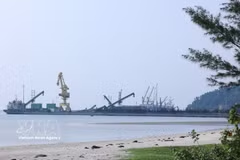
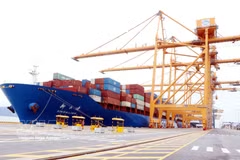
Activities in Chan May Bay, part of the Chan May–Lang Co Economic Zone in Hue city. (Photo: VNA)

Hue steps up investment drive in Chan May–Lang Co Economic Zone

Covering more than 27,000ha, the Chan May–Lang Co Economic Zone is emerging as a key economic, urban, industrial and eco-tourism centre in southeastern Hue, with functional areas dedicated to seaports, industry, non-tariff activities, urban development and tourism.

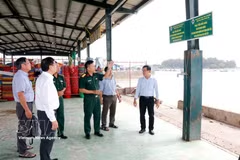
The Ministry of National Defence's inter-agency inspection team visits La Gi Fish Port in Phuoc Hoi ward, Lam Dong province. (Photo: VNA)

Lam Dong's IUU fishing prevention efforts inspected

According to the Lam Dong provincial IUU Fishing Prevention Steering Committee, all 8,177 fishing vessels measuring at least 6 metres in length have been registered and updated in the national fisheries database VNFishbase.

A member of Minh Quang Cooperative in Hung Yen province works on a farm. (Photo: VNA)

Vietnam aims to link half of farm cooperatives with enterprises by 2030

The Ministry of Agriculture and Environment will promote links between cooperatives, enterprises, science and technology organisations and other economic entities along with carrying out programmes to develop concentrated agricultural, forestry and fisheries raw material areas and enhance value chain production.

The night-time economy is increasingly seen as an important avenue for Vietnam’s tourism sector to extend visitors’ stays (Photo: VNA)

Revitalising growth momentum for night-time economy

The night-time economy has moved beyond being merely an add-on service to become a new growth driver for tourism. Night-time activities can “awaken” familiar heritage spaces and breathe new life into them. Art, light and music experiences after dark can create distinctive attractions while meeting the desire of middle- and high-end visitors to explore cultural depth.

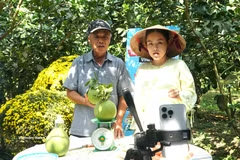
A livestream session promotes green-skinned pomelos grown in Cho Lach commune, Vinh Long province. (Photo: VNA)

E-commerce reshapes rules of game

Once fixed fees, payment fees, infrastructure charges and service packages are included, sellers may have to spend around 24.5-27.6% of their revenue on platforms. The figure shows that the era of easy selling and low costs in e-commerce has officially come to an end.

Ho Chi Minh City targets third-quarter growth of over 11% (Photo: VNA)

Ho Chi Minh City targets third-quarter growth of over 11%

Ho Chi Minh City will continue to implement drastic measures to achieve double-digit growth, targeting GRDP growth of at least 11.07% in the third quarter of 2026, 9.43% in the first nine months and 12.3% in the fourth quarter, with a view to completing the full-year goal of 10% or more.

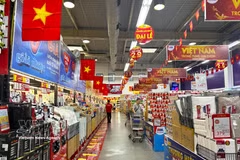
MM Mega Market An Phu supermarket in Ho Chi Minh City is brightly decorated for the National Day holiday. (Photo: VNA)

Domestic consumption up over 13%, tourism continues strong growth

The total retail sales of goods and consumer service revenues in August were estimated at 679.8 trillion VND (26 billion USD), up 1.6% from the previous month and 14.9% year-on-year. In the January-August period, the figure reached 5.24 quadrillion VND, representing a 13.3% increase year-on-year.

A production line of Onaga Co., Ltd. (Japan) at HANSSIP (Photo: nhandan.vn)

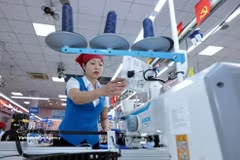
Hanoi moves to maintain appeal to FDI inflows

In the first eight months of 2026, the capital city attracted more than 3.7 billion USD in FDI, equivalent to 83% of the plan set for the year. Newly registered FDI exceeded 572 million USD across 450 projects, up 175.78% in project numbers and 209.46% in capital compared to the same period last year. Additional registered capital topped 492 million USD, while capital contributions and share purchases exceeded 2.6 billion USD.

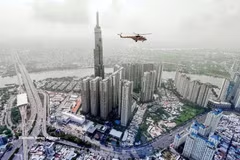
Saigon Marina IFC is the first private-sector project contributing to realising the goal of developing the Vietnam International Financial Centre in Ho Chi Minh City. (Photo: VNA)

VIFC offers various opportunities to attract forein investment

Turning the VIFC into an effective channel for international capital will require clear rules, quality projects and strong connections between investors and domestic businesses. Meeting these requirements will be key to transforming investor interest into concrete capital flows and investment projects in Vietnam.

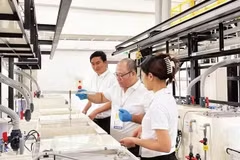
Production line at Yadea Vietnam’s smart manufacturing plant, which has an investment of more than 100 million USD, in Tan Hung Industrial Park, Bac Ninh province. (Photo: VNA)

Development model for new era – An inevitable trend

International organisations broadly agree that shifting the growth model from reliance on traditional factors toward technology and innovation is no longer an option for Vietnam, but an imperative of the times.

At a commune administrative service centre in Hung Yen province (Photo: VNA)

Government determined to cut administrative procedures to drive double-digit growth

Resolution No. 258/NQ-CP, dated August 31, 2026, calls for substantive and comprehensive reform, with a focus on maximum cuts and simplification of administrative procedures and business conditions. It also seeks to shift management from pre-licence inspection to post-licence inspection based on risk management, while strengthening real-time, data-driven oversight and putting people and businesses at the centre of public services.

(Illustrative photo: VNA)

Vietnam eyes entry into 40-billion-USD Southeast Asian CCS market: experts

A clear, transparent and stable legal framework would not only enable Petrovietnam to play a leading role in new energy development but also strengthen investor confidence, encouraging both domestic and foreign enterprises to invest, transfer technology and cooperate in developing large-scale CCS projects.