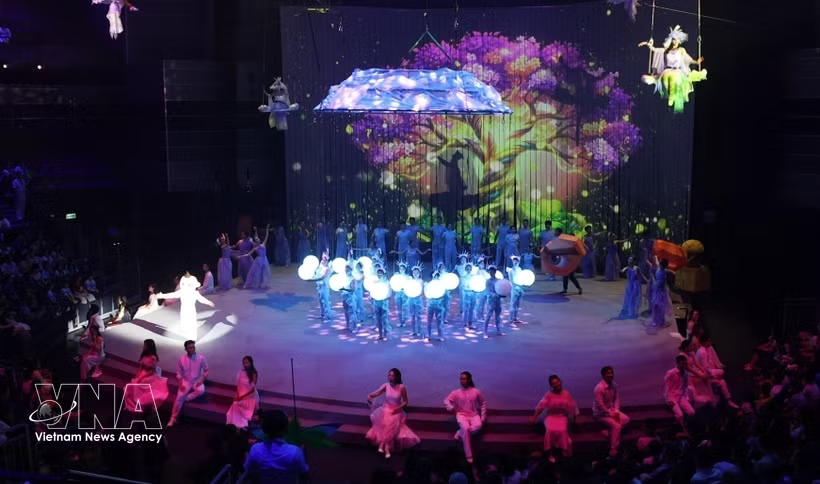
Hanoi (VNA) - The night-time economy is increasingly seen as an important avenue for Vietnam’s tourism sector to extend visitors’ stays, boost spending and enhance destination appeal. However, turning the night into a genuinely attractive part of the travel experience requires distinctive products, appropriate planning and more flexible operating mechanisms.
Filling night-time gap
According to Nguyen Tien Dat, Vice Chairman of the Hanoi Tourism Association and Director of AZA Travel, for years, visitors to Vietnam have mainly explored scenic attractions, historical sites and cultural experiences during the day. Once night falls, however, entertainment, leisure and shopping options become relatively limited, leaving visitors with few places to go, few things to do and, importantly, few opportunities to spend.
International experience from leading Asian tourism hubs such as Thailand, Singapore and Hong Kong (China), as well as major European cities, shows that night-time economic activities can account for 30-50% of total tourism revenue. Developing the night-time economy is not simply about keeping services open later, but represents a strategic shift from focusing on visitor numbers to improving service quality and increasing spending and length of stay per visitor.
A major bottleneck for Vietnam’s tourism sector is the shortage of high-quality, diverse night-time products with distinctive local characteristics. At most destinations, night-time activities remain centred on familiar models such as night markets, pedestrian streets and food streets. Meanwhile, international visitors and higher-income segments are increasingly seeking local cultural performances, large-scale immersive shows, premium entertainment, duty-free shopping and night-time wellness services.
In Hanoi, several night-time tourism products have been studied and introduced, initially attracting attention, including the “Sacred Night” tour at Hoa Lo Prison relic site, the “Decoding the Imperial Citadel of Thang Long” programme and experiential tours at Van Mieu - Quoc Tu Giam (Temple of Literature). However, their visitor numbers remain modest compared with the capital’s overall tourist arrivals.
Night-time food and entertainment activities are also still concentrated in the Old Quarter, with limited spillover into new urban areas and satellite centres. In other localities, night-time economic activities have initially been developed around natural advantages. Da Nang has established a relatively systematic chain of services to stimulate night-time tourism, featuring check-in spots, night markets and the Dragon Bridge’s fire- and water-breathing shows.
In Ha Long, Quang Ninh province, night-time services are increasingly linked to marine tourism through dinner cruises in the bay and beachfront bars combining music with sunset views. However, these models remain insufficiently interconnected and have yet to form a complete night-time economic ecosystem.
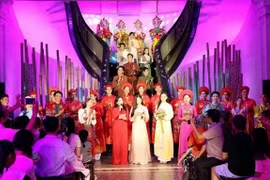
Remco Christiaan Vaatstra, General Manager of Oakwood Residence Hanoi and Lasong Hotel & Villas Sam Son, said the night-time economy has moved beyond being merely an add-on service to become a new growth driver for tourism. Night-time activities can “awaken” familiar heritage spaces and breathe new life into them. Art, light and music experiences after dark can create distinctive attractions while meeting the desire of middle- and high-end visitors to explore cultural depth.
Building comprehensive ecosystem
Experts say sustainable development of the night-time economy first requires appropriate spatial planning. Areas designated for night-time activities need careful consideration of activity density, noise, lighting, traffic and their proximity to residential areas, while ensuring convenient connections with urban centres, tourist attractions and accommodation facilities.
Operating hours should also be studied according to each area. In locations with appropriate planning and management, operating hours could be extended to meet visitors’ actual needs while ensuring security, public order and residents’ interests.
It is also important to facilitate business participation in investing in and developing new products. According to Dat, an effective night-time economic space should combine not only food and dining but also shopping, performing arts, entertainment, wellness and cultural activities. When multiple services are brought together in one area, visitors have more reasons to stay longer instead of ending their journey after dinner.
Vaatstra said night-time products should be diversified by combining culture, arts and entertainment, while accommodation spaces should also be leveraged to create additional experiences for visitors.
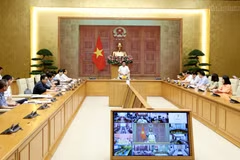
The development of the night-time economy is also benefiting from significant opportunities at the macro-management level. At a recent meeting on measures to boost tourism growth, Minister of Culture, Sports and Tourism Lam Thi Phuong Thanh stressed the need to turn cultural resources, heritage and digital resource data into tangible economic value, thereby opening up new development space and creating sustainable growth drivers for the sector.
The ministry has also identified the completion of breakthrough policy mechanisms for the night-time economy as one of its key solutions to be implemented in 2026./.