Vietnam, RoK promote strategic technological cooperation

Deputy Prime Minister Ho Quoc Dung proposed expanding joint research programmes, particularly in strategic areas where Vietnam has development needs, and KIST has strengths, including semiconductor integrated circuits, AI, batteries and energy storage, and biotechnology.

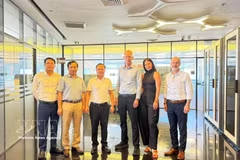
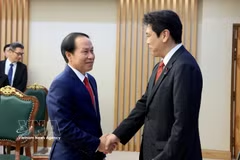
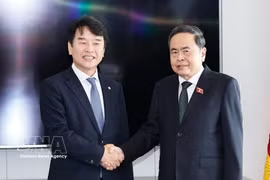
The Vietnamese delegation led by Deputy Prime Minister Ho Quoc Dung visits the Korea Institute of Science and Technology (KIST). (Photo: VNA)

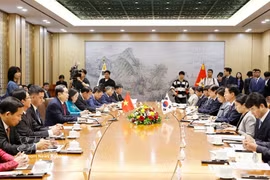
Seoul (VNA) – Deputy Prime Minister Ho Quoc Dung has called on the Korea Institute of Science and Technology (KIST) to expand cooperation with Vietnamese research institutes and universities in training and research, contributing to the development of products that address Vietnam’s major challenges and support its socio-economic development.

He made the request during a field trip to the institute on September 8, part of National Assembly President Tran Thanh Man’s official visit to the Republic of Korea (RoK).

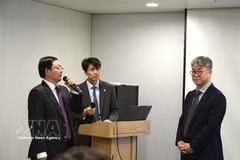
Established in 1966, KIST, the RoK’s first multidisciplinary government-funded research institute, is tasked with promoting research and technological development for industry and national development, KIST President Oh Sang Rok said.

KIST conducts basic and applied research in fields including advanced materials, semiconductors, artificial intelligence (AI), robotics, biotechnology and biomedicine, energy, environment and carbon technologies. It also carries out interdisciplinary research to turn research results into technologies applicable to industry.

Oh said KIST plays an important role in the country’s national R&D ecosystem, focusing on foundational and emerging technologies and interdisciplinary research. Cooperation with the Vietnam-Korea Institute of Science and Technology (VKIST) has produced positive results, with the two sides implementing various research programmes and planning to expand cooperation.

Deputy PM Dung said he was impressed by KIST’s 60-year journey alongside the RoK’s development. Recalling cooperation between the two countries to establish VKIST about a decade ago, he described the decision as a milestone that laid the foundation for bilateral research cooperation.

Dung also recalled his discussions with RoK Deputy PM and Minister of Science and ICT Bae Kyung Hoon in Hanoi in April 2026, when the science and technology ministries of the two countries, together with the RoK Ministry of Foreign Affairs, signed a Framework Master Plan for bilateral cooperation in science, technology and innovation.

He said the visit demonstrated the potential to turn agreements reached at government and ministerial levels into substantive programmes and projects involving research institutes, universities and businesses.

Vietnam hopes KIST will remain a strategic, long-term partner of Vietnamese research institutes, universities and the scientific community, he said, stressing that cooperation should go beyond ties between KIST and VKIST to serve as a bridge connecting scientists, universities and businesses of the two countries.

He proposed expanding joint research programmes, particularly in strategic areas where Vietnam has development needs, and KIST has strengths, including semiconductor integrated circuits, AI, batteries and energy storage, and biotechnology. Cooperation should focus on practical technologies and products capable of being tested and transferred to businesses, he added

He also called on KIST to continue supporting Vietnam, particularly VKIST, in training high-quality science and technology personnel by providing opportunities for young Vietnamese scientists and engineers to study and work in KIST research groups and laboratories alongside Korean scientists. Such cooperation would facilitate the transfer of not only knowledge but also research experience, organisational methods and a culture of innovation, he said.

The Deputy PM suggested that KIST strengthen the sharing and joint use of research facilities, laboratories and modern equipment with VKIST and Vietnamese partners, while the two institutes continue exchanging experience in research governance, selecting strategic scientific tasks, connecting with businesses and commercialising research results.

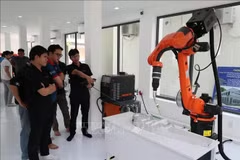
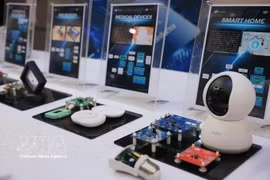
On this occasion, the Vietnamese delegation visited KIST’s Semiconductor Technology Centre, Quantum Technology Centre, AI and Robotics Institute, and Energy Storage Research Centre.

Dung highly valued KIST’s research capabilities and its strong orientation towards practical applications and commercialisation of research results./.
VNA

See more

Digital transformation brings economic benefits closer to businesses

Digital transformation brings economic benefits closer to businesses

In addition to streamlining processes and reducing the time required to complete administrative procedures, digital models are creating more opportunities for businesses, household enterprises and small traders to access information, adopt new payment methods, connect with partners and expand their markets.

Images are collected and processed at a satellite image receiving station. (Photo: VNA)

Vietnam, France explore new space technology cooperation opportunities

Building on the effectiveness of VNREDSat-1, Vietnam and France are continuing to promote cooperation in the next phase, including a proposal for VNREDSat-2. The two sides have discussed technological options, resources and an implementation roadmap, with a view not only to developing a new-generation satellite but also to increasing Vietnam’s level of participation and technological capabilities.

Using AI to search and process legal information (Photo: VNA)

Legal profession reshaped in age of artificial intelligence

In Ho Chi Minh City, digital transformation in the legal profession is not simply about introducing more technology into professional practice. It must also create ways of working that ensure technology serves people, while lawyers retain control and responsibility for the quality of legal services. This is particularly important in a metropolis with a large-scale economy and diverse legal needs.

Vietnamese youths learn about AI application scenarios at the China-ASEAN AI Application Cooperation Centre in Guangxi. (Photo: VNA)

China’s Guangxi fosters AI cooperation with Vietnamese localities

During his visit to China and Guangxi in April, General Secretary of the Communist Party of Vietnam (CPV) Central Committee and President To Lam expressed a desire to further expand cooperation between Vietnam, particularly border localities, and Guangxi in areas including AI.

Hanoi Market Surveillance officers inspect products showing signs of violations of regulations on product labelling, advertising and intellectual property. (Photo published by VNA)

Positive progress recorded in tackling intellectual property rights infringements

To raise public and business awareness while improving the effectiveness of preventing and dealing with infringements, the Ministry of Science and Technology will continue working with other ministries, sectors and localities to strengthen intellectual property protection and enforcement on a regular, continuous and sustained basis, with no prohibited areas or exceptions.

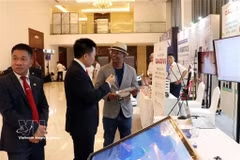
Delegates visit exhibition stands at the 2026 national quality and productivity forum in Ho Chi Minh City. (Photo: VNA)

Enabling institutions needed for science-technology to generate new productivity

The Government should shift from providing funding to creating enabling conditions by developing infrastructure, platforms, standards and markets, while coordinating the innovation ecosystem. Innovation and technology diffusion should also go hand in hand, particularly by bringing AI, digital and green technologies to small- and medium-sized enterprises as well as traditional sectors.

Prof. Dr. Nguyen Van Tam, Chair of the Department of Computer Science, Data and Artificial Intelligence at the Polytechnic Institute of Paris (IP Paris) (Photo: VNA)

Expert proposes global Vietnamese intellectual ecosystem to boost AI development

Prof. Dr. Nguyen Van Tam, Chair of the Department of Computer Science, Data and Artificial Intelligence at IP Paris, said the Political Bureau’s Resolution No. 23-NQ/TW, which elevates overseas Vietnamese to one of the country's important strategic resources, should be translated into practical mechanisms for deeper participation of OVs in the country’s scientific and technological development, particularly in artificial intelligence (AI).

The strategy pivots Vietnam toward AI research and development tied to economy-wide transformation. (Illustrative photo: VNA)

Vietnam approves AI strategy targeting regional hub status by 2030

The strategy pivots Vietnam toward AI research and development tied to economy-wide transformation. Instead of retrofitting AI into existing products and processes, the plan treats AI as a core capability from problem identification through design, organisation and operations.

A student at Thang Long Primary School in Hanoi attend an online class. (Photo: VNA)

Vietnam alliance steps up efforts to promote online safety, digital trust

Since its establishment, the Digital Trust Alliance (DTA) has expanded its membership and activities, with hundreds of applications to join recorded in the first six months of 2026. It aims to establish Digital Trust Clubs in all 34 provinces and cities and bring together around 1,000 members nationwide.

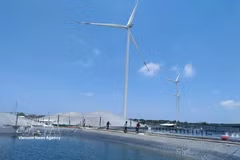
Hi-tech shrimp farming and wind power development in Thanh Hai commune, Vinh Long province (Photo: VNA)

Vietnam targets productivity-driven growth over cheap labour

A development model based on productivity, knowledge and technology requires long-term capital, a skilled workforce, innovation capacity, technology absorption and incentives for long-term invest. Therefore, Vietnam’s greatest challenge is moving from cost-based advantages to ones based on productivity, technology and added value.

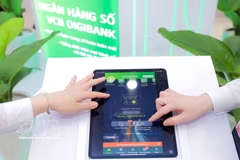
Vietcombank is one of the leading banks in digital transformation. (Photo: VNA)

Banking industry in AI era: When data becomes competitive advantage

In just a few years, AI has evolved from an experimental technology into an “assistant” for many banks, supporting everything from customer service, credit approval, and fraud detection to risk management. However, as the technological gap between institutions narrows, a new question is emerging: What will determine banks' competitive advantage in the AI era?