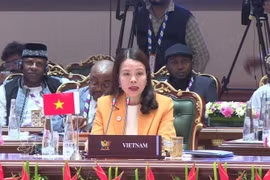
New Delhi (VNA) – Vietnam’s status as a BRICS partner country since June 2025 has opened an important new channel for multilateral cooperation, enabling the country to strengthen links with emerging economies and Global South countries while contributing to global development and governance.
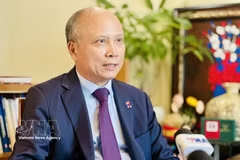
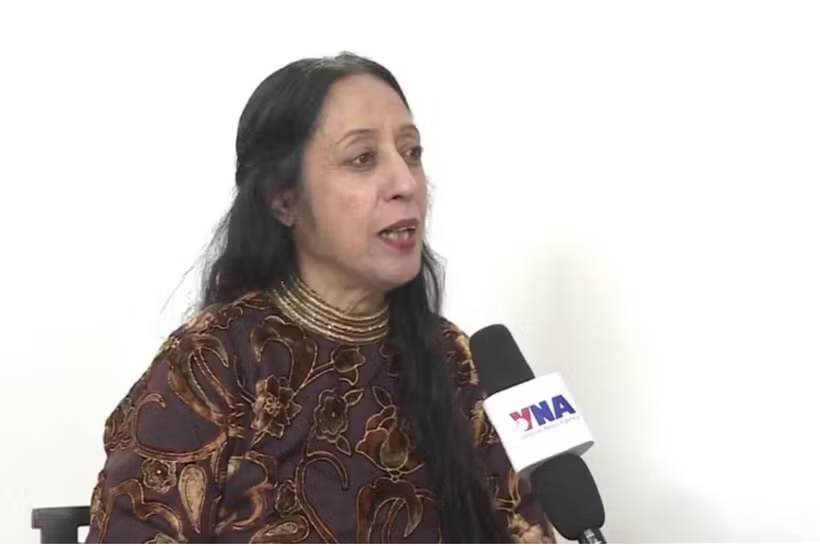
In an article published by Eurasia Review on September 8, Professor Reena Marwah of the University of Delhi, who is also Secretary-General of the Association of Asia Scholars, said Vietnam’s strategic geography and sustained economic dynamism make it a substantive addition to BRICS.
She noted that Vietnam’s economic transformation, deep integration into global value chains and growing role in Asia create areas of convergence and complementary interests with the BRICS cooperation agenda.
In 2026, under India’s chairmanship, BRICS is focusing on resilient supply chains, digital public infrastructure, local-currency payments, artificial intelligence, innovation, climate finance and reform of global governance, Marwah said. These areas provide opportunities for Vietnam to make use of its strengths as a partner country.
For Vietnam, its BRICS participation comes as relations with India have been elevated to an Enhanced Comprehensive Strategic Partnership. The joint statement between the two countries identified Vietnam as an important pillar in India’s Act East policy, its MAHASAGAR vision for comprehensive and mutual advancement in security and growth across regions, and its Indo-Pacific vision. India also reaffirmed its support for Vietnam’s role as a BRICS partner country.
The two sides stressed the importance of strengthening the voice and role of Global South countries in global governance.
Marwah said the combination of Vietnam’s rising position in Southeast Asia, its upgraded partnership with India and its BRICS partner status gives the country additional strategic options. BRICS can serve as a complementary channel for Vietnam to promote South-South cooperation, diversify its partnerships and engage more deeply in emerging areas such as supply-chain resilience, development finance, digital technology and green transition, she said.
At the same time, she advised Vietnam to use its BRICS role to complement existing cooperation frameworks. Maintaining a multi-alignment policy would enable Vietnam to diversify its economic, technological and security partners while preserving strategic autonomy and maximising national interests.
With India chairing BRICS in 2026 and promoting an agenda centred on resilience, innovation, cooperation and sustainable development, Vietnam’s participation as a partner country is expected to help strengthen links between BRICS and Southeast Asia.
As a highly integrated economy with extensive relations with both developed and developing countries, Vietnam can benefit from cooperation opportunities within BRICS while contributing its experience and voice to common issues of the Global South.
In the longer term, Marwah said Vietnam has the potential to play a deeper role in BRICS if the grouping continues to expand and strengthen its role in global economic governance. It should engage substantively in BRICS cooperation mechanisms while maintaining a balance among BRICS, ASEAN and other partners to consolidate its strategic position./.