Vietnam, Mongolia work to deepen bilateral ties in substantive, effective, sustainable manner

This is the second visit by a top Vietnamese legislator to Mongolia since the two countries established diplomatic relations in 1954, and the first official visit by NA President Man to Mongolia in his capacity. The visit demonstrates Vietnam’s high regard for bilateral relations and the important role of parliamentary diplomacy in the countries’ overall relations.

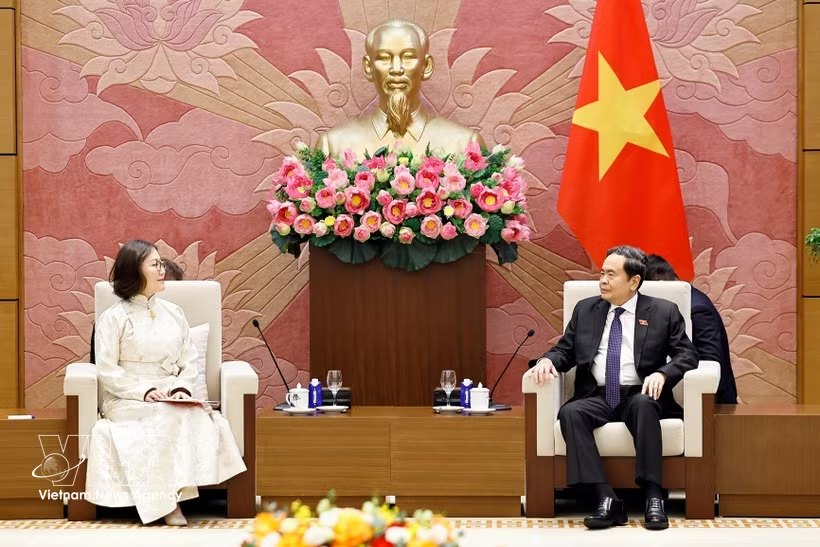
National Assembly President Tran Thanh Man (R) receives Mongolian Ambassador to Vietnam Ganbaatar Hulan in Hanoi on August 26, 2026. (Photo: VNA)

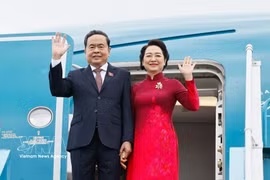
Hanoi (VNA) – Following the official visit to the Republic of Korea (RoK), National Assembly (NA) President Tran Thanh Man and his spouse, together with a high-ranking Vietnamese delegation, will pay an official visit to Mongolia from September 9-11, at the invitation of Chairman of the Mongolian Parliament Sandag Byambatsogt and his spouse.

This is the second visit by a top Vietnamese legislator to Mongolia since the two countries established diplomatic relations in 1954, and the first official visit by NA President Man to Mongolia in his capacity. The visit demonstrates Vietnam’s high regard for bilateral relations and the important role of parliamentary diplomacy in the countries’ overall relations.

Increasingly close, trusted political and diplomatic ties

Vietnam and Mongolia established diplomatic relations on November 17, 1954, with Vietnam being the first Southeast Asian country with which Mongolia established such ties.

In July 1955, Vietnamese President Ho Chi Minh led a Party and Government delegation on an official visit to Mongolia, laying the foundation for the development of friendship.

During General Secretary of the Communist Party of Vietnam Central Committee and President To Lam’s state visit to Mongolia from September 30 to October 1, 2024, the two countries agreed to upgrade their relations to a comprehensive partnership.

Vietnam and Mongolia have regularly supported and assisted each other in their national defence, construction and development, while maintaining close cooperation through Party, State and Government channels and people-to-people exchanges. Cooperation in politics, diplomacy, economy, trade, investment, agriculture and education has received attention and been promoted by leaders at all levels, expanding steadily and becoming increasingly substantive and effective, with practical results.

The two sides regularly maintain cooperation mechanisms, including meetings of the Intergovernmental Committee, political consultations, and security and defence cooperation, thereby strengthening mutual understanding and political trust and coordination at regional and international forums.

At regional and multilateral forums, the two countries continue to maintain close cooperation and regularly support one another, notably at the United Nations, the World Trade Organisation (WTO), the Asia-Europe Meeting (ASEM), the Asia-Pacific Economic Cooperation (APEC) forum, the ASEAN Regional Forum (ARF), and other regional organisations.

Significant room for further development across multiple areas

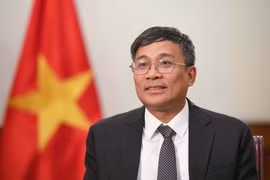
According to Vietnamese Ambassador to Mongolia Nguyen Tuan Thanh, the two economies are complementary and there remains considerable room to tap their potential.

Energy cooperation is emerging as a new pillar of economic ties between the two countries. Growing exports to each other’s markets, including livestock meat products exported from Mongolia to Vietnam, have contributed to steady annual growth in bilateral trade.

Two-way trade reached 155 million USD in 2025 and nearly 60 million USD in the first six months of 2026. The countries aim to soon reach bilateral trade of 200 million USD and increase it to 500 million USD in the near future.

Direct air links have also helped improve connectivity, facilitating trade, tourism and people-to-people exchanges. Businesses from both countries are being encouraged to explore opportunities in agriculture, food, energy, minerals, tourism, logistics and digital transformation.

Cultural and educational cooperation has continued to expand through cultural and art programmes, exchanges and the translation of literary and cultural works.

People-to-people and locality-to-locality ties are also becoming more active. Hanoi and Ulaanbaatar have established a twinning relationship, while Phu Tho and Tuv provinces and Dak Lak and Okhon provinces have also developed ties. The Vietnamese community in Mongolia contributes to bringing the two countries' people closer together.

Deepening Vietnam-Mongolia comprehensive partnership

Within the overall bilateral relationship, parliamentary cooperation has always played an important role. The two sides have agreed to strengthen cooperation between their legislative bodies, particularly closer coordination between specialised committees, groups of parliamentarians, young parliamentarians and women parliamentarians, as well as relevant subordinate agencies, in line with the framework of the comprehensive partnership.

The two sides also maintain cooperation and support one another at regional and international inter-parliamentary forums, such as the Inter-Parliamentary Union (IPU), the Asia-Pacific Parliamentary Forum (APPF) and the Asia-Europe Parliamentary Partnership (ASEP).

According to Party Central Committee member and Permanent Deputy Minister of Foreign Affairs Nguyen Minh Vu, through the upcoming visit by the top Vietnamese legislator, the two sides will strengthen exchanges and share experience in lawmaking and national governance, while contributing to promoting the implementation of high-level agreements.

The visit will also help expand cooperation at regional and international multilateral parliamentary forums, contributing to addressing common issues facing the region and the international community, including sustainable development, combating desertification, responding to climate change, peace and security issues, and protecting women and children amid the negative impacts of technology, as well as other non-traditional security challenges.

Meanwhile, Thanh said the visit will provide an opportunity for the two sides to engage in deeper discussions on areas with significant potential and room for cooperation, such as trade, investment, agriculture, energy, tourism, transport and climate change response.

During the visit, the two sides are expected to sign cooperation documents, creating a framework and impetus for stronger exchanges of experience in lawmaking, supervision and decision-making on important national issues, while enabling the parliaments to better promote their role in advancing bilateral relations./.

VNA
See more

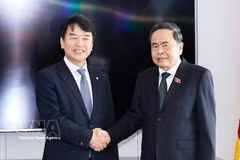
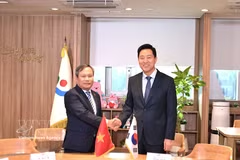
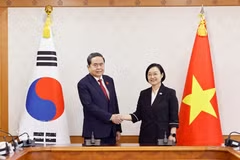
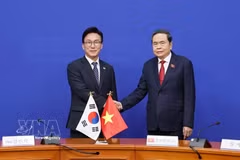
President of the Vietnamese National Assembly Tran Thanh Man (R) meets with Chairman of the Korea-Vietnam Parliamentary Friendship Group Moon Jin Seok in Seoul on September 8. (Photo: VNA)

NA President meets RoK-Vietnam Parliamentary Friendship Group chief

President of the Vietnamese National Assembly Chairman Tran Thanh Man said the Vietnamese delegation was the first foreign one to make an official visit at the invitation of NA Speaker of the Republic of Korea (RoK) Cho Jeong Sik, with representation from the Party, NA, Government and localities. Meetings with the RoK's NA Speaker and Prime Minister were highly successful and covered practical issues that fostered trust and opened specific cooperation avenues.

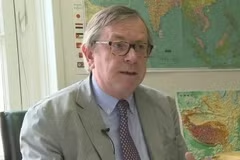
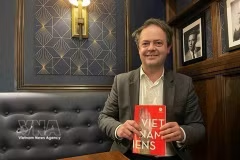
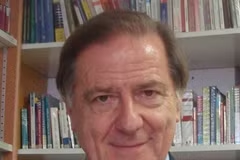
Hugues Tertrais, Honorary Professor at Paris 1 Panthéon-Sorbonne University and former Director of the Centre for Contemporary Asian History (Photo published by VNA)

Historical foundation, future momentum for Vietnam–France ties

The historical dialogue between Vietnam and France had at times been very tense, but this process helped the two sides understand and respect each other better. Greater mutual understanding built over time has created conditions for cooperation at many levels today, a French scholar has said.

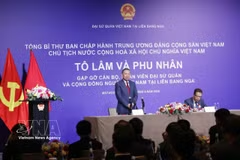
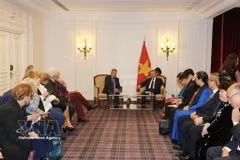
General Secretary of the Communist Party of Vietnam Central Committee and President To Lam and his spouse meet with officials and staff of the Vietnamese Embassy and representatives of the Vietnamese community in Russia in Moscow on September 7, (Photo: VNA)

General Secretary and President To Lam meets Vietnamese community in Russia

In particular, the Politburo recently issued Resolution No. 23-NQ/TW on overseas Vietnamese affairs, General Secretary and President To Lam, emphasising that in the time ahead, the Party and State will continue to improve institutions, and adopt comprehensive, open and breakthrough mechanisms and policies to connect with, attract and effectively mobilise the resources of overseas Vietnamese, particularly intellectuals, experts, entrepreneurs, scientists and young people.

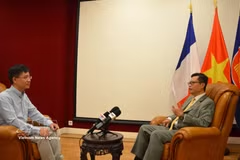
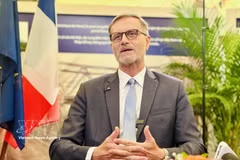
Vietnamese Ambassador to France Trinh Duc Hai (R) grants an interview to the Vietnam News Agency (Photo: VNA)

Fresh impetus for Vietnam - France cooperation on new journey

Vietnam-France relations have been nurtured over generations through historical, cultural, educational and scientific ties, as well as extensive people-to-people exchanges. Despite the ups and downs of history, the two countries have successfully built a relationship of friendship, equality and mutual respect, looking towards the future together.

Dr. Benoît de Tréglodé, Director (Africa - Asia - Middle East) at the Institute of Strategic Research (IRSEM) under the French Ministry of Armed Forces. (Photo: VNA)

Vietnam-France cooperation hoped to be expanded

Vietnam and France should also build a forward-looking, mutually beneficial partnership in which stronger economic and industrial ties serve as an indispensable foundation, said Dr. Benoît de Tréglodé, Director (Africa - Asia - Middle East) at the Institute of Strategic Research (IRSEM) under the French Ministry of Armed Forces.

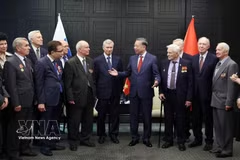
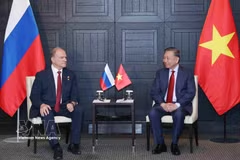
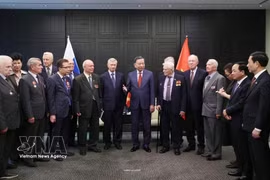
General Secretary of the Communist Party of Vietnam Central Committee and President To Lam (R) and Chairman of the Communist Party of the Russian Federation Gennady Zyuganov at the meeting in Moscow on September 7 (Photo: VNA)

Top Vietnamese leader meets Russian Communist Party chief

To deepen the two parties' ties at bilateral and multilateral levels, the top Vietnamese leader proposed both sides effectively follow the agreement on further expanding and deepening inter-Party relations, especially by increasing high-level delegation exchanges and promptly sharing information on each Party's key activities.

Party General Secretary To Lam (right) receives AAFV Chairman Nguyen Hai Nam during his visit to France in 2024. (Photo: VNA)

Top leader’s upcoming visit to renew vitality of Vietnam-France friendship

Chairman of the France-Vietnam Friendship Association (AAFV) Nguyen Hai Nam said the trip demonstrates that France is truly a special partner of Vietnam in Europe. France can serve as a gateway for Vietnam to access the European Union (EU), while Vietnam can be France’s entry point for deeper engagement with the Association of Southeast Asian Nations (ASEAN).

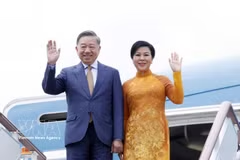
General Secretary of the Communist Party of Vietnam Central Committee To Lam and his spouse, Ngo Phuong Ly, arrive at Vnukovo international airport in Moscow on September 7 afternoon (local time). (Photo: VNA)

General Secretary and President To Lam begins state visit to Russia

As scheduled, the top Vietnamese leader will receive Chairman of the Communist Party of Russia Gennady Ziuganov, the Russian War Veterans’ Association and the Russia-Vietnam Friendship Association, and have a meeting with staff of the Vietnamese Embassy and representatives of the Vietnamese community in Russia.

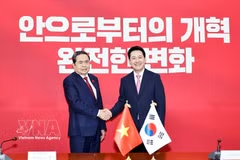
President of the Vietnamese National Assembly Tran Thanh Man (right) and Chairman of the Democratic Party of Korea Kim Min Seok meet in Seoul on September 7. (Photo: VNA)

Vietnam's top legislator meets with Democratic Party of Korea leader

Lauding the friendship and sound cooperation between the Communist Party of Vietnam and the DPK in recent years, NA President Tran Thanh Man called on both sides to continue effectively following their 2019 cooperation agreement, and foster political trust and mutual understanding by maintaining all-level delegation exchanges and meetings.