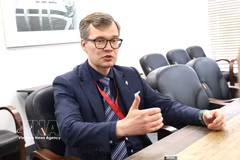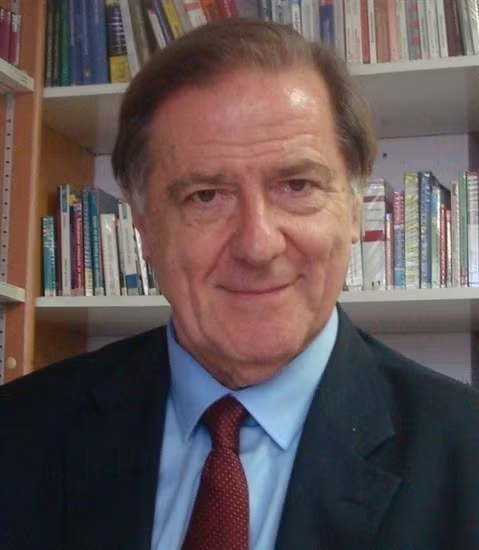
Hanoi (VNA) – Profound shifts in the geopolitical landscape are underscoring the need for Vietnam and France to deepen their Comprehensive Strategic Partnership through more concrete and ambitious cooperation programmes, according to former French Ambassador to Vietnam Claude Blanchemaison.
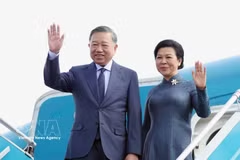
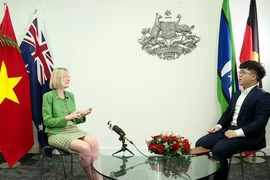
Speaking to Vietnam News Agency correspondents in Paris ahead of General Secretary of the Communist Party of Vietnam Central Committee and President To Lam’s official visit to France, Blanchemaison said the establishment of the Comprehensive Strategic Partnership was a logical step in bilateral ties, which had gained strong momentum since President François Mitterrand’s visit to Hanoi in February 1993 – the first visit to Vietnam by a Western head of state.
The former ambassador noted that the global geopolitical landscape has changed profoundly since his tenure in Vietnam, with recent developments highlighting the political need for a substantive partnership between the two countries.
He said Vietnam is now deeply integrated into the region, has become one of the world’s most dynamic economies and plays an active role in the Association of Southeast Asian Nations (ASEAN). Vietnam maintains stable relations with China, continues to develop its traditional ties with Russia and has expanded exchanges with the US since Washington lifted its embargo in 1994.
According to Blanchemaison, Vietnam has consistently pursued an open policy of cooperation with countries around the world based on areas of mutual interest. In the current geopolitical context, To Lam’s visit to France comes at an opportune time to inject fresh momentum into bilateral ties and enhance the role of Vietnam–France cooperation in the foreign policies of both countries.
Against this backdrop, he said, the two sides should step up regular consultations on security issues in Asia, Europe and globally. Vietnam and France have favourable conditions for closer coordination, as both attach importance to respect for international law and the role of multilateral institutions, from the United Nations (UN) and its agencies to specialised and regional organisations.
Building on the favourable political foundation, Blanchemaison said the two countries should continue to tap new drivers and pursue increasingly concrete and ambitious cooperation programmes, thereby making the Comprehensive Strategic Partnership more effective.
In defence, Vietnam and France have maintained cooperation for many years in several specific areas, including military medicine and language training. Blanchemaison said this cooperation should be strengthened, particularly through training for forces participating in UN peacekeeping operations. France could also step up support for training Vietnamese military personnel in line with Vietnam’s needs and proposals.
Healthcare is another strength of bilateral ties, with more than 30 years of cooperation helping foster mutual understanding between healthcare systems and pharmaceutical laboratories.
Science is another long-standing area of cooperation, having been maintained even during the most difficult periods. Blanchemaison said the two sides should modernise the content of their cooperation and expand into promising fields, particularly digital technology and artificial intelligence (AI).
He also identified legal cooperation as an area requiring continued attention, as legal certainty is a shared concern of the scientific and business communities. The two countries should strengthen cooperation in training legal experts and build on the foundation established in 1993 through regular exchanges and mutual trust between their legal professionals.
Recalling Hanoi’s hosting of the 7th Francophonie Summit in 1997 as an important milestone in Vietnam’s engagement with the Francophone community, Blanchemaison said that it's a perfect time to develop legal training programmes in French at universities and bar associations.
Space is another promising area for expanded cooperation. Blanchemaison said France is ready to work with Vietnam in this field, particularly in deploying Earth-observation, meteorological and other satellites to serve different needs.
The two countries could also step up cooperation on sustainable development, including the use of carbon-free energy sources, particularly nuclear power. There is also considerable room, he said, for further cooperation in transport infrastructure.
Beyond State-level cooperation and strategic fields, Blanchemaison stressed that greater mutual understanding between the two societies would be important to the future of Vietnam–France relations. He called for stronger exchanges among students, lecturers, researchers and young experts, particularly in fields linked to Vietnam’s development needs. France’s major universities and leading higher education centres remain open to Vietnamese students, he noted.
Given the long literary traditions of both countries, the former ambassador also proposed promoting the translation of outstanding works from each country. Vietnam and France could establish a common platform for exchanging literary works and scientific research, contributing to greater mutual understanding and people-to-people exchanges.
Regarding Vietnam–European Union (EU) relations, Blanchemaison highlighted France’s role as a bridge in strengthening ties between the two sides. He said the Vietnam–EU framework established in early 2026, together with the EU–Vietnam Free Trade Agreement, which has been in force since 2020, continues to provide a favourable foundation for strengthening and expanding cooperation./.
VNA