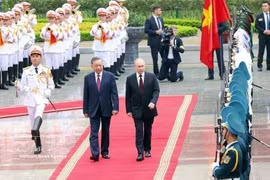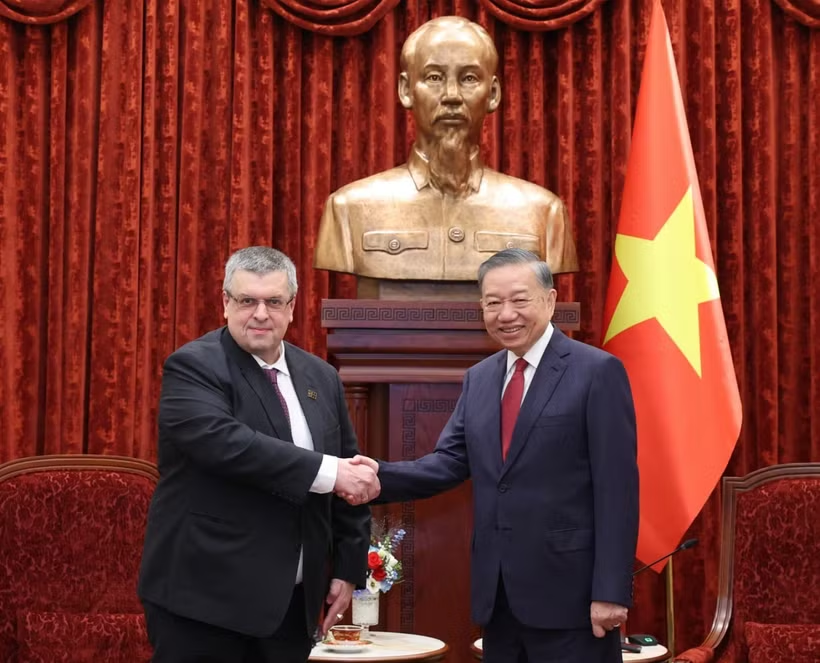
Hanoi (VNA) - General Secretary of the Communist Party of Vietnam Central Committee and President To Lam said he believes that, with the political determination of Vietnamese and Russian leaders and the support of the two peoples, the bilateral comprehensive strategic partnership would continue to develop strongly, substantively and effectively.
The leader made the remarks in an interview with Russia’s TASS news agency ahead of his state visit to the country next week at the invitation of President Vladimir Putin.
The following is a translation of the interview.
Reporter: The 14th National Congress of the Communist Party of Vietnam set out strategic orientations for Vietnam’s development in the years ahead and identified further expanding international integration and developing external relations with partners as key priorities. In your view, what role will cooperation with Russian, one of Vietnam’s first comprehensive strategic partners, play in shaping Vietnam’s foreign policy in this new period?
Party General Secretary and President To Lam: The 14th National Congress of the Communist Party of Vietnam was an important milestone, setting out strategic goals and orientations to help Vietnam achieve rapid and sustainable development in the new era of development. To achieve these goals, Vietnam continues to steadfastly pursue a foreign policy of independence, self-reliance, self-strengthening, peace, friendship, cooperation, development, and diversification and multilateralisation of its external relations in the spirit of being a friend, a reliable partner and an active, responsible member of the international community.
Within this overall orientation, the comprehensive strategic partnership between Vietnam and Russia remains one of Vietnam’s top priorities and a strategic choice in its foreign policy. This orientation is built on the foundation of traditional friendship spanning generations, time-tested political trust and the two countries’ shared vision for the future. Therefore, further developing and elevating bilateral cooperation between Vietnam and Russia in the time ahead serves the long-term interests of both countries.
The history of bilateral relations shows that the ties between the two countries are a rare bond of loyalty and trust between their peoples, as well as in international relations more broadly. These ties have been forged over more than 75 years and continuously nurtured by generations. Vietnam will never forget its Soviet friends, comrades and brothers, including Russia, who provided Vietnam and its people with material and spiritual support, including the sacrifice of their blood and lives, throughout the two resistance wars, as well as during the country’s construction, development and international integration. This mutual understanding, close bonds and wholehearted support are precious assets that give the bilateral relationship its unique vitality.
At the same time, in the new era, the two countries share many common interests, development visions and areas of mutually complementary cooperation. Cooperation between Russia, a country with an important role, standing and voice in the world, and Vietnam, a country that is rising strongly and playing an increasingly important role in the region and the world, not only meets the legitimate aspirations and interests of the two peoples, but also contributes to peace, stability and development in the region and beyond. Russia has strengths and extensive experience in many fields, while Vietnam can complement these strengths and help unlock and further enhance their potential.
Therefore, the goal in the time ahead is not only to preserve and build on the achievements of the past 75 years, but also to deepen and elevate Vietnam-Russia cooperation across the board. Traditional areas such as education and training, energy, culture and the arts are the foundation that needs to be further strengthened and renewed. At the same time, emerging areas should be translated into concrete, long-term and strategic projects, including maritime affairs, railways, space, science and technology, innovation and digital technology.
I am confident that, with the political determination of the two countries’ leaders and the support of their peoples, the comprehensive strategic partnership between Vietnam and Russia will continue to develop strongly, substantively and effectively, making a positive contribution to the development and nation-building efforts of both countries, for the benefit of their peoples and for peace, stability, cooperation and development in the region and the world.
Reporter: In 2025, Vietnam and Russia jointly celebrated many important historical events, including the 75th anniversary of the establishment of diplomatic relations, the 80th anniversary of the Victory in the Great Patriotic War, the 80th anniversary of the August Revolution and National Day of Vietnam, and the 50th anniversary of the Liberation of the South and National Reunification. The two peoples always stood side by side and supported each other during those historical periods. In your view, what significance does this enduring friendship hold for the development of bilateral relations today?
Party General Secretary and President To Lam: The major events that Vietnam and Russia jointly celebrated in 2025 show that the histories of the two nations have many profound points of convergence, associated with shared values of independence, freedom and peace. The Victory in the Great Patriotic War was significant not only for the Soviet people, but also made a decisive contribution to humanity’s victory over fascism, creating favourable conditions for peoples around the world, including Vietnam, in their struggles for independence and freedom.
The Soviet Union’s Victory in the Great Patriotic War was a great source of encouragement and inspiration for the Vietnamese people, under the leadership of the Communist Party of Vietnam and President Ho Chi Minh, to launch a general uprising to seize power. The success of the August Revolution in 1945, amid “ripe opportunities,” and the establishment of the Democratic Republic of Vietnam ushered in an era of independence for the Vietnamese nation.
Throughout the 80-year history of the struggle for independence and national reunification, as well as the subsequent process of reconstruction, nation-building and development, the Vietnamese people have always cherished and remembered the great, selfless and wholehearted support provided by the Soviet people in the past and the Russian people today. Soviet military experts directly trained and fought alongside the Vietnam People’s Army; experts, professors, engineers and doctors worked in and helped Vietnam build many economic, cultural, scientific and educational facilities, which have become symbols of the friendship between the two countries. Tens of thousands of Vietnamese officials, experts, scientists, artists and cultural figures were trained in the former Soviet Union and Russia today, making important contributions to the cause of national construction and development. The sharing and mutual assistance during the most difficult moments have not only been part of history, but have also become a valuable asset of Vietnam-Russia relations.
It is from this historical foundation and these sentiments that political trust has been established and continuously nurtured over the years. With such trust, Vietnam and Russia can engage in sincere and open exchanges on strategic issues, in a spirit of respect, understanding and consideration for each other’s legitimate interests. This also provides a basis for the two sides to overcome fluctuations in the international situation, expand and deepen cooperation across various fields, make the comprehensive strategic partnership increasingly substantive and effective, and contribute to the new development phase of each nation.
I believe that the history of relations between the two countries has built strong trust, providing a firm foundation for bilateral relations today. The future of bilateral ties, however, must continue to be shaped by concrete results. Therefore, it is important to continue translating political trust and the good sentiments between the two peoples into meaningful cooperation programmes, projects and works in such areas as economy, defence and security, science and technology, education and training, culture and the arts, as well as the fields that directly serve the lives of the two peoples.
At the same time, the enduring Vietnam-Russia friendship must be inherited and promoted across generations. The two sides need to create more opportunities for the younger generations to better understand each other, strengthen youth and student exchanges, and promote cooperation in education and culture, as well as the teaching and learning of the Russian and Vietnamese languages, so that the noble values of the traditional friendship are not only preserved but also further nurtured under new circumstances and live on through time.
I am confident that when the past is cherished, the present is nurtured and the future is jointly built, the Vietnam-Russia friendship will not only be preserved as an invaluable legacy of history, but will also continue to be enriched with new achievements in cooperation, for the benefit of the two peoples and for peace, cooperation and development.
Reporter: Recently, the Jury of the Lev Tolstoy International Peace Prize met and unanimously voted to award the 2026 prize to you. Congratulations to you on this honour and on your important contributions to Vietnam’s construction and development cause, as well as to the cause of promoting justice in the world, respecting international law, and spreading to the world the peace-loving and humanitarian traditions of the Party, State and people of Vietnam. How do you assess the significance of this award? And what important orientations will Vietnam pursue in the coming period in furthering the cause of consolidating peace, stability, cooperation and development among nations?
Party General Secretary and President To Lam: I am deeply honoured to receive the 2026 Lev Tolstoy International Peace Prize. The award represents recognition of the values of peace and humanity that the Vietnamese nation has always preserved and pursued, as well as of Vietnam’s persistent efforts to promote peace, friendship, cooperation, respect for international law and greater understanding among nations.
Vietnam is a peace-loving nation and deeply understands the value of peace. Over 40 years of Doi moi (Renewal), Vietnam’s foreign policy of independence, self-reliance, self-strengthening, peace, friendship, cooperation and development, and diversification and multilateralisation of external relations, has made an important contribution to creating a favourable environment for national development and enhancing Vietnam’s position in the international arena. Vietnam will continue to steadfastly pursue this foreign policy, being a friend, a reliable partner and an active and responsible member of the international community.
In an increasingly interconnected and interdependent world, we believe that dialogue is better than confrontation and cooperation is better than division. Differences should be resolved by peaceful means, on the basis of equality, mutual respect, respect for the legitimate interests of all parties and international law. Only on such a foundation can relations among countries be stable, sustainable and mutually beneficial.
With its new stature and strength after 40 years of Doi moi, Vietnam will continue to make more proactive, active and responsible contributions to the common affairs of the international community. Vietnam is ready to serve as a bridge for cooperation, dialogue and reconciliation; contribute to building a fair and equal international order based on international law; and engage in an increasingly substantive manner in efforts to maintain peace, conduct search and rescue operations, promote sustainable development, ensure food security and respond to climate change.
We believe that peace is the common aspiration of all nations, cooperation is the path to shared development, and mutual respect is the foundation for coexistence and progress. Vietnam will continue to do its utmost to pursue these goals.
Reporter: Thank you very much!/.
Russia pins hope on new cooperation orientations, strengthening of ties with Vietnam: diplomat
Vietnam-Russia relations are currently developing dynamically across many fields and dimensions, on the solid foundation of friendship and mutual understanding cultivated over years.