Top Vietnamese leader’s Russia visit - Milestone in elevating comprehensive strategic partnership

With careful preparations and strong political determination, the top leader’s state visit is expected to open a new chapter in the Vietnam-Russia Comprehensive Strategic Partnership, contributing to prosperity, peace and stability in the region and the world.

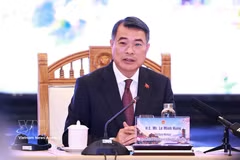
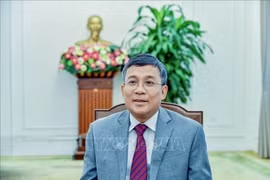
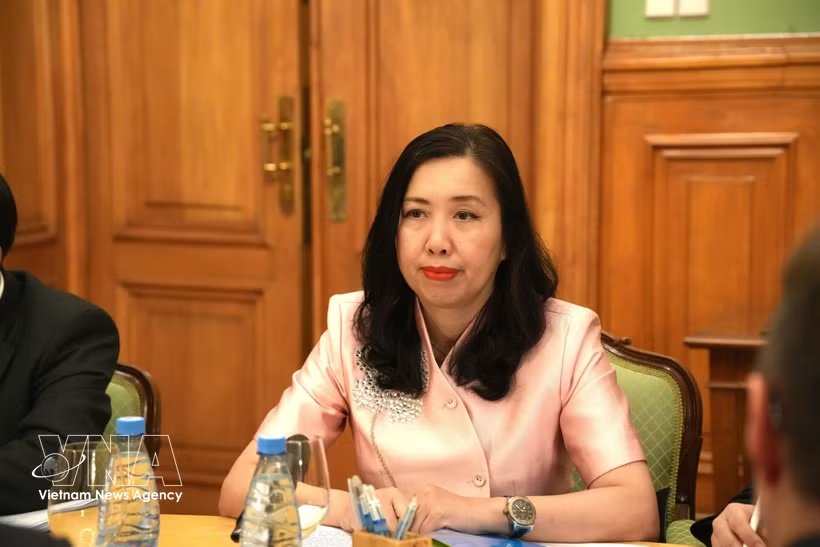
Deputy Minister of Foreign Affairs Le Thi Thu Hang (Photo: VNA)

Hanoi (VNA) – The state visit to Russia by General Secretary of the Communist Party of Vietnam Central Committee and President To Lam, his spouse and a high-ranking Vietnamese delegation from September 7 is expected to set out a long-term vision and create fresh political momentum to elevate bilateral ties comprehensively in the new period.

The visit, made at the invitation of Russian President Vladimir Putin, holds historical significance, as it has been the first state visit to Russia by Vietnam’s Party and State leader since 1991, according to Deputy Minister of Foreign Affairs Le Thi Thu Hang. It will provide an opportunity for the two countries’ top leaders to hold in-depth discussions on strategic issues.

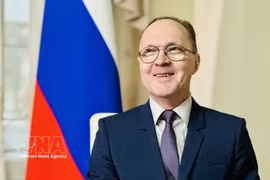
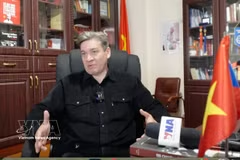
Russian Ambassador to Vietnam Gennady Bezdetko said Russia regards the visit as an important milestone in the development of the Vietnam-Russia Comprehensive Strategic Partnership. He expressed his hope that the two sides will engage in substantive discussions on the entire bilateral agenda, agree on new long-term areas of cooperation and make concrete decisions to further strengthen bilateral ties.

According to Nguyen Dang Phat, Vice President and Secretary General of the Vietnam-Russia Friendship Association, exchanges at the highest level play a pivotal role in bilateral diplomacy. With the two countries enjoying deep political trust, high mutual confidence and a strong historical tradition, he expressed his belief that the visit will deliver substantive results.

The visit is also a vivid manifestation of Vietnam’s consistent foreign policy of independence, self-reliance, self-strengthening, peace, friendship, cooperation and development, and diversification and multilateralisation of external relations.

In an interview with Russia’s TASS news agency ahead of the visit, General Secretary and President Lam reaffirmed that the Vietnam-Russia Comprehensive Strategic Partnership remains one of the top priorities and a strategic choice in Vietnam’s foreign policy.

The partnership is underpinned by a strong historical foundation and profound bonds forged over more than 75 years. Vietnam has always cherished the invaluable support provided by the Soviet Union, including Russia, during its past struggles for national independence and subsequent national reconstruction, development and international integration, he said.

Building on this foundation, the two countries have maintained frank and open exchanges on strategic issues based on mutual respect, understanding and consideration of each other’s legitimate interests. Entering a new era, they are seeking to translate this longstanding goodwill into substantive and strategic cooperation, particularly in energy, oil and gas, defence-security and the peaceful use of atomic energy.

Hang expected the visit to generate breakthroughs in traditional pillars of cooperation, especially oil and gas and energy, including nuclear power, while making economic, trade and investment ties and infrastructure connectivity new drivers of bilateral relations.

Science, technology and innovation are also emerging as strategic priorities. The two countries have designated 2026 as the Year of Science and Education Cooperation, while continuing joint research in marine science, ecology, climate change, biomedicine and materials science. Cooperation is also expanding into high-tech fields such as artificial intelligence, information security, smart cities and digital solutions for industry and transport.

Education remains an important bridge between the two peoples. Building on the Soviet Union’s training of nearly 40,000 Vietnamese officials, Russia continues to provide 1,000 state-funded scholarships annually to Vietnamese students.

Cultural and people-to-people exchanges further reinforce bilateral ties. Following the resumption of direct flights, tourism has recovered strongly, with Vietnam welcoming 742,000 Russian visitors in the first six months of 2026, 2.8 times higher than the same period last year.

With careful preparations and strong political determination, the top leader’s state visit is expected to open a new chapter in the Vietnam-Russia Comprehensive Strategic Partnership, contributing to prosperity, peace and stability in the region and the world./.

VNA
See more

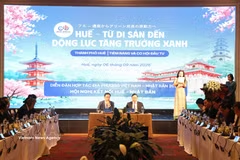
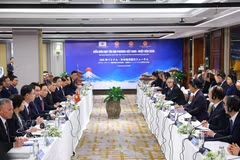
A view of the Hue–Japan Connectivity Conference 2026 held in the central city of Hue on September 6, 2026. (Photo: VNA)

Hue strengthens connectivity with Japanese partners

With the aim of creating an increasingly favourable and transparent environment for investment and cooperation, Hue is committed to continuing to accompany, support and create conditions for Japanese investors, businesses and organisations in exploring and implementing activities in the city.

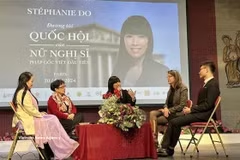
Stéphanie Do (centre) at a discussion with French readers and the Vietnamese community in France about her book, titled The Journey to Parliament of the First Vietnamese-French Female Lawmaker. (Photo published by VNA)

Vietnam–France relations: From cooperation to co-creation

Vietnam and France are facing a “historic opportunity” as Vietnam undergoes rapid transformation, while France is also seeking to strengthen partnerships with dynamic economies in Asia. The two countries therefore share a common interest in moving forward together and seizing the current opportunity to bring bilateral relations into a new phase of development.

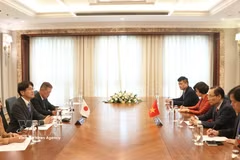
A view of the meeting between Politburo member and Minister of Foreign Affairs Le Hoai Trung and Governor of Nara prefecture Yamashita Makoto in Hue city on September 6, 2026. (Photo: VNA)

Foreign Minister receives Japanese officials in Hue

Minister of Foreign Affairs Le Hoai Trung affirmed that locality-to-locality cooperation is an effective channel for implementing commitments and agreements reached by the two countries’ high-ranking leaders, while strengthening connectivity and people-to-people exchanges between Vietnam and Japan.

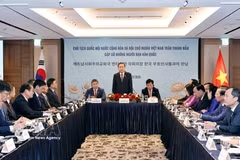
National Assembly President Tran Thanh Man speaks at a meeting with Korean friends in Seoul on September 6. (Photo: VNA)

National Assembly President meets Korean friends in Seoul

National Assembly (NA) President Tran Thanh Man stressed that Korean non-governmental organisations, associations, scientists and businesses have contributed significantly to major achievements recorded in Vietnam-RoK relations over the past years.

An overview of the meeting between Prime Minister Le Minh Hung and a delegation of Japanese localities in Hue city on September 6. (Photo: VNA)

Local cooperation a distinctive feature of Vietnam-Japan relations: PM

Prime Minister Le Minh Hung emphasised that local collaboration is an important and distinctive feature of Vietnam-Japan relations, and that the Vietnamese Government considers it a practical and effective channel that contributes to the overall development of bilateral ties.

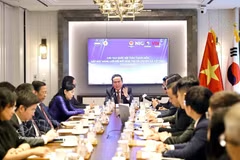
National Assembly President Tran Thanh Man and his spouse meet with Vietnamese Embassy officials and staff, and representatives of the Vietnamese community in the Republic of Korea in Seoul on September 6. (Photo: VNA)

NA President meets Vietnamese community in RoK

The NA President called on Vietnamese people in the RoK to continue strengthening solidarity, abiding by local laws, and contributing to the host country and bilateral ties, while preserving the Vietnamese language, national cultural identity and traditions.

Myanmar President Min Aung Hlaing and his spouse, Kyu Kyu Hla, lay a wreath at the Monument to Heroic Martyrs on Bac Son Street in Hanoi. (Photo: VNA)

Myanmar President concludes official visit to Vietnam

The visit contributes to strengthening political trust and creating momentum for increasingly substantive and effective cooperation between the two countries, for the benefit of their peoples and development, while contributing to peace, stability and development in the region.

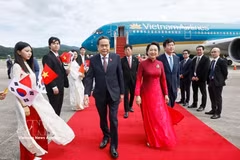
National Assembly President Tran Thanh Man and his spouse Nguyen Thi Thanh Nga arrive in Seoul on the afternoon of September 6 (local time), beginning an official visit to the Republic of Korea. (Photo: VNA)

National Assembly President begins official visit to RoK

The visit aims to promote parliamentary diplomacy between the two countries, contributing to breakthroughs in economic, trade and investment cooperation, particularly by making effective use of the new pillar of science and technology collaboration.

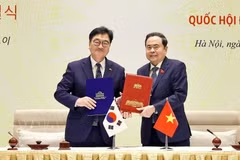
Vietnamese National Assembly President Tran Thanh Man and then-RoK National Assembly Speaker Woo Won Shik sign memorandum of understanding on cooperation between the two legislatures in 2025. (Photo: VNA)

Parliamentary diplomacy helps strengthen Vietnam–RoK comprehensive strategic partnership

The official visit to the Republic of Korea (RoK) by National Assembly President Tran Thanh Man affirms the consistent importance that the Party, State and NA of Vietnam attach to the bilateral Comprehensive Strategic Partnership. It is not only aimed at strengthening political trust, but also at discussing specific measures to translate high-level agreements into concrete outcomes.

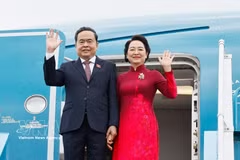
National Assembly (NA) President Tran Thanh Man and his spouse, Nguyen Thi Thanh Nga, leave Hanoi on September 6 for official visits to the Republic of Korea (RoK) and Mongolia. (Photo: VNA)

NA President departs for official visits to RoK, Mongolia

The visits affirm Vietnam's commitment and desire to further advance its comprehensive strategic partnership with the RoK and comprehensive partnership with Mongolia in an increasingly substantive, effective and sustainable manner.