Hanoi (VNA) – Northern Vietnam continued to be the country’s leading destination for manufacturing foreign direct investment (FDI), attracting 8.63 billion USD in newly registered capital from 274 projects in the first half of 2026, according to Savills Vietnam.
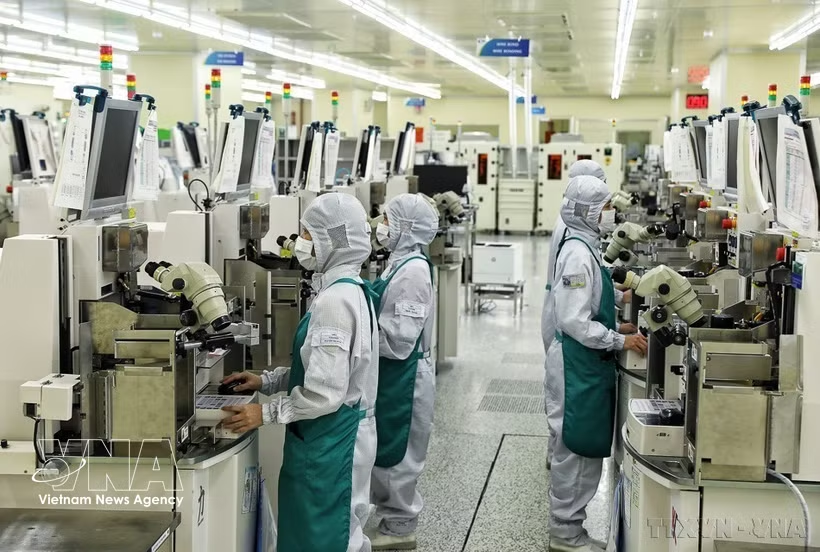
The figure accounted for 80.5% of the country’s total new manufacturing FDI, with electronics, semiconductors and high technology emerging as key drivers.
The North also recorded an increase in large-scale projects, indicating a shift towards higher value-added segments of the manufacturing value chain.
John Campbell, Director and Head of Industrial Services at Savills Vietnam, said investment in electronics and semiconductors continued to concentrate in northern localities, which have developed relatively complete manufacturing ecosystems encompassing industrial infrastructure, technical labour and supplier networks.
Such foundations enable high-tech investors to expand operations and integrate more deeply into regional supply chains, he said.
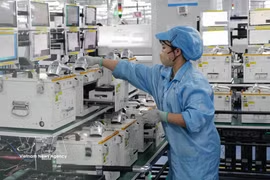
The group of computers, electronics and optical products accounted for nearly 66% of newly registered manufacturing FDI, attracting more than 7.03 billion USD. Although it involved only 65 projects, investment in the sector surged 614% year-on-year, mainly driven by large-scale projects.
The trend reflects multinational corporations’ growing investment in high value-added fields such as semiconductors, electronic components, precision engineering and advanced technology manufacturing.
Thai Nguyen province led the country in newly registered manufacturing FDI, attracting about 5.77 billion USD from 17 projects, accounting for more than half of the national total. Major projects included a 4.08-billion-USD investment by Samsung Semiconductor Asia Holdings and a 1.28-billion-USD project by Samsung Electro-Mechanics Vietnam.
Hai Phong city remained a major electronics manufacturing hub, with a 1-billion-USD expansion project by LG Innotek Vietnam. Bac Ninh province led in the number of new manufacturing projects, with 111, demonstrating the strong appeal of its established industrial ecosystem, Savills said.
The presence of major electronics corporations is also generating spillover effects across supply chains, increasing demand for suppliers, industrial services and supporting industries.
Campbell said investors were increasingly choosing localities where major electronics corporations are already operating in order to benefit from established supply networks. The presence of leading enterprises, in turn, attracts more suppliers, expansion projects and new investment.
This is gradually shifting the North’s competitive advantage from land availability and operating costs towards connectivity with global technology supply chains.
For electronics and semiconductor manufacturers, project implementation time, access to suppliers and the quality of technical human resources are becoming increasingly important factors in site selection.
Savills also highlighted the significant role of the Republic of Korea (RoK) in the region’s manufacturing development. The RoK remains a major force behind the formation of electronics and high-tech manufacturing clusters in northern Vietnam.
Singapore was the largest source of manufacturing FDI in the first half. However, a significant portion came from Samsung Semiconductor Asia Holdings, which is registered in Singapore but belongs to the RoK’s Samsung Group.
Alongside Samsung, LG Innotek has continued expanding its operations in Vietnam, contributing to the development of supplier networks and supporting industries.
Savills said these investment flows underscored Vietnam’s increasingly prominent position in regional technology supply chains, particularly in electronics and semiconductors.
As global corporations diversify production and restructure supply chains, localities with developed infrastructure, industrial ecosystems and technical human resources will have an advantage in attracting high-tech investment.
Campbell said northern Vietnam was gradually transforming from a major manufacturing hub into a high-tech manufacturing centre, playing an increasingly important role in regional electronics and semiconductor networks. The expansion of these industries will remain a major driver of the industrial market in the coming years./.