Hanoi (VNA) – As artificial intelligence (AI) models become increasingly widespread, a bank's competitive edge is no longer determined by technology alone, but by the quality of its data. The more complete and accurate the data, and the more effectively it is managed, the greater the value AI can generate for business operations.
In just a few years, AI has evolved from an experimental technology into an “assistant” for many banks, supporting everything from customer service, credit approval, and fraud detection to risk management. However, as the technological gap between institutions narrows, a new question is emerging: What will determine banks' competitive advantage in the AI era?
The answer does not lie in which bank possesses the most advanced AI model. In reality, most AI models today are built on shared technological platforms that can be adopted by multiple organisations. What sets banks apart is their data – a unique asset accumulated over decades of operations, ranging from transaction histories and customer behaviour to business processes and risk-management experience.
According to Dao Minh Tu, Standing Vice Chairman and Secretary-General of the Vietnam Banks’ Association, AI can only deliver its full potential when powered by high-quality data and supported by a robust data governance framework. This is also essential for banks to use the technology safely and transparently and generate tangible value, rather than merely showcasing technological applications.
Sharing this view, Nguyen Phuong Thanh, deputy director of banking and financial services advisory at Ernst & Young Vietnam (EY Vietnam), said the banking industry is entering a new phase, moving from applying AI to individual business functions towards building banks that operate on an AI foundation.
Differences in data will ultimately determine each institution's ability to personalise services, manage risks and harness AI effectively.
According to EY Vietnam, the transition to AI-powered banking requires institutions to establish a comprehensive data governance framework covering data quality, master data, metadata and data lineage. This is not merely a technological requirement, but also the foundation for AI to operate transparently, reliably and at scale across multiple professional areas.
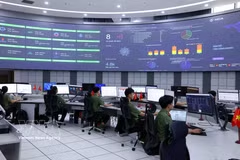
From a practical implementation perspective, Bui Gia Hieu, Head of Security at Military Commercial Joint Stock Bank (MB), said that rather than giving AI full decision-making authority, the bank had built an end-to-end operating model connecting cybersecurity threat intelligence sources with layers of defence throughout the digital transaction journey.
Under this model, AI processes large volumes of data, including data collection, filtering, enrichment, event correlation and investigation recommendations, while final decisions remain in the hands of experts. Practical implementation has demonstrated clear benefits, with AI helping MB increase its capacity to receive and analyse cybersecurity threat intelligence from around 3,000 to 10,000 items per day, more than three times the previous level.
Notably, MB does not measure the effectiveness of AI by the number of models or deployment licences, but by its ability to shorten the detection-testing-alert-response cycle. AI is used to process data at a higher speed and larger scale, while any action affecting systems or customers must still go through human approval mechanisms.
At the same time, as AI continues to develop, data governance requirements are becoming increasingly closely linked to the legal framework.
According to Hoang Ha, a data protection and AI governance expert and CEO of Data Protectify, data use and AI applications must comply with the laws on data and on personal data protection as well as requirements concerning risk management, transparency and accountability. These are not merely compliance requirements, but also important factors in strengthening customers' trust in digital services./.
See more
3.5 billion-USD AI data centre complex proposed in Tay Ninh
The project is designed for a total IT load capacity of 200 MW. In the first phase, the consortium plans to invest 3.5 billion USD in a 100MW facility, targeting groundbreaking in the fourth quarter of 2026 and commercial operation in 2027.
Optimising int’l science-technology cooperation to enhance national competitiveness
Vietnamese scientists should be encouraged to join international scientific organisations and gradually take on leadership roles, contributing to agenda-setting, research priorities, initiatives, standards and decisions on the allocation of international scientific resources.
Vietnam, Singapore seek to make technology a strategic cooperation pillar
The Joint Statement on the Technology Connectivity Strategy issued after the first Vietnam-Singapore Strategic Dialogue reaffirmed the shared interest in deepening cooperation in science and technology, innovation, connectivity and the digital economy. The two sides shared a vision of making Vietnam and Singapore leading strategic technology partners in Southeast Asia, with both countries becoming more technologically self-reliant through cooperation and connectivity.
2026 Make in Vietnam Digital Product Awards launched
Launched in 2020, the Make in Vietnam Digital Technology Product Awards are the official annual awards in the digital technology sector organised by the Ministry of Science and Technology. Over six editions, the awards attracted nearly 1,500 entries, with 299 outstanding digital technology products honoured.
Vietnam targets top-three ASEAN ranking in AI by 2030
By 2030, Vietnam aims for 60% of businesses using AI to improve efficiency, all civil servants using AI in their work weekly, and 60% of administrative decisions supported by data and AI. The satisfaction rate for AI-supported public services is expected to rise by at least 30%.
Vietnam’s data centre race draws multibillion-dollar investment
Ho Chi Minh City currently has 20 operational data centres and nine proposed projects, according to the municipal Department of Science and Technology. New projects are moving beyond traditional data centres toward large complexes integrating AI and other digital infrastructure.
Hanoi allows 24-month trial of autonomous vehicles at Hoa Lac
The project aims to assess the safety, reliability and readiness of autonomous vehicles under real traffic conditions, as well as the effectiveness of autonomous public transport and compatibility with existing systems. Its results will contribute to developing technical standards, operating procedures and management models suited to Hanoi’s traffic conditions.
Resolution 57 opens digital door to drive marine economic development
Through persistent, hands-on efforts and a determination to “leave no one behind”, the Ho Chi Minh City authorities are working to ensure that every resident has the opportunity to access and benefit from digital transformation under Politburo Resolution No. 57-NQ/TW
Singapore’s experience suggests solutions to Vietnam’s human resources challenge in AI era
As Vietnam accelerates digital transformation and high-tech development, Singapore’s experience and the engagement of global technology companies demonstrate that human resources preparation must stay ahead of the curve. The ability to filter knowledge, collaborate, innovate and effectively use AI will increasingly become essential to helping workers adapt to a changing labour market and strengthening the competitiveness of Vietnam’s economy in the new era.
Vietnam moves to strengthen digital shield amid rise of AI, deepfakes
An effective “digital shield” should have three key capabilities: early warning to identify unusual topics, sources and dissemination patterns, as well as signs of fabrication or coordinated activity; rapid verification through coordination among authorities, databases, experts and the press; and proactive communications, providing accurate, accessible and multimedia content to the right audiences once information is verified.
Long-term vision required for quantum technology development: experts
The country needs a long-term approach, sustained investment and a willingness to accept risks, potentially requiring at least 10–20 years of persistent efforts, an expert has said.
Vietnam data centre boom draws billions USD as AI demand accelerates
Vietnam is among the highest-potential markets with installed capacity of roughly 104MW seen rising five-to six-fold to nearly 600MW by 2030.
Singapore’s experience offers lessons for Vietnam
Singapore’s experience in linking policies with business needs, mobilising technology corporations to address national challenges and ensuring vulnerable groups are not left behind could provide valuable lessons for Vietnam.
Deputy PM highlights overseas Vietnamese experts’ role in AI development
Deputy Prime Minister Ho Quoc Dung expressed his pleasure at meeting Prof. Dr. Nguyen Van Tam, a prominent Vietnamese scientist in France who has conducted outstanding research and holds key academic positions at IP Paris and Télécom Paris.
Building AI capabilities tailored to Vietnam’s needs
Vietnam is entering a new phase of AI development, moving beyond the adoption of existing technologies to building its own capabilities by advancing models, computing infrastructure, data, and talent in parallel to create an ecosystem capable of developing technologies tailored to the country’s needs.
Top-performing teams at ROBOTACON WRO 2026 national finals honoured
The national finals of the ROBOTACON WRO 2026 robot talent competition concluded in the central province of Gia Lai on August 23, providing students with a valuable learning and experiential environment where they could develop STEM skills, learn to work together, think creatively and solve complex problems.
Vietnam team wins three awards at ABU Robocon 2026
The LH-FOF team from Vietnam's Lac Hong University won three awards the 2026 Asia-Pacific Broadcasting Union Robot Contest (ABU Robocon): third place overall, the best design award and a sponsor’s award.
Skilled workforce vital to Vietnam’s nuclear power programme
The long-term challenge Vietnam must proactively address is building a pool of personnel in management, regulation, research and development, and technical support. These are areas in which the country must take the initiative in training and building up its own capabilities so that it can independently conduct assessments, evaluate safety, verify technical calculations, carry out research, and provide support for the sustainable development of the nuclear programme.
Vietnam issues new cybersecurity rules for domestic, foreign businesses
Issued on August 19, the decree comprises six chapters and 32 articles, covering cybersecurity protection measures, information security assurance, specialised cybersecurity training, and management of IP address identification for telecommunications and Internet service providers.
Nearly 500 contestants compete at ROBOTACON WRO 2026 national finals
Held under the theme “Robots Meet Culture”, this year’s competition aims to connect technology with cultural values, encouraging students to apply their knowledge of science, engineering and programming to real-world problems while promoting cultural values through creative solutions.