Expert proposes global Vietnamese intellectual ecosystem to boost AI development

Prof. Dr. Nguyen Van Tam, Chair of the Department of Computer Science, Data and Artificial Intelligence at IP Paris, said the Political Bureau’s Resolution No. 23-NQ/TW, which elevates overseas Vietnamese to one of the country's important strategic resources, should be translated into practical mechanisms for deeper participation of OVs in the country’s scientific and technological development, particularly in artificial intelligence (AI).

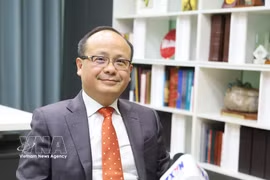
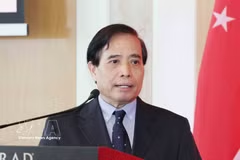
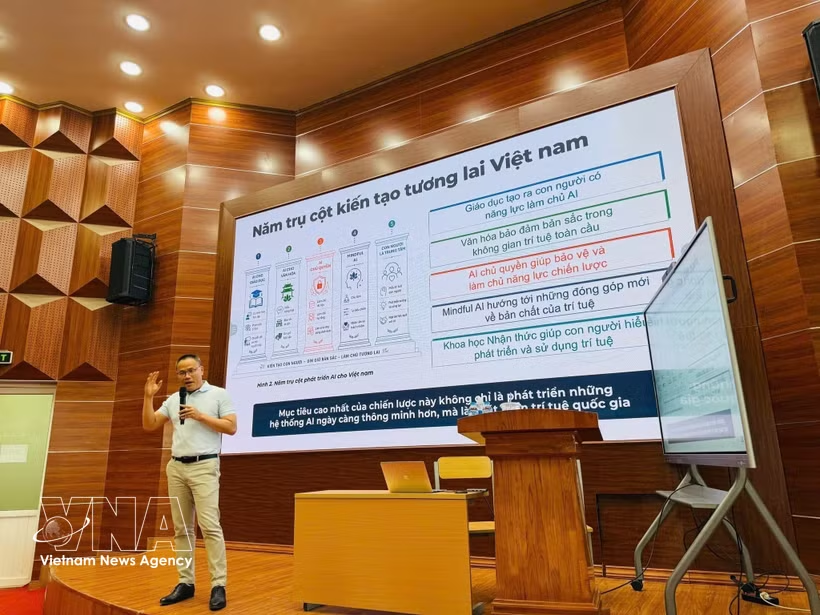
Prof. Dr. Nguyen Van Tam, Chair of the Department of Computer Science, Data and Artificial Intelligence at the Polytechnic Institute of Paris (IP Paris) (Photo: VNA)

Hanoi (VNA) – Vietnam should move beyond simply connecting Vietnamese experts worldwide to fostering joint creation in science and technology, to build a global Vietnamese intellectual ecosystem and turn the country’s worldwide talent pool into national scientific and technological capacity, said an expert from the Polytechnic Institute of Paris (IP Paris).

Talking to the Vietnam News Agency (VNA), Prof. Dr. Nguyen Van Tam, Chair of the Department of Computer Science, Data and Artificial Intelligence at IP Paris, said the Political Bureau’s Resolution No. 23-NQ/TW, which elevates overseas Vietnamese to one of the country's important strategic resources, should be translated into practical mechanisms for deeper participation of OVs in the country’s scientific and technological development, particularly in artificial intelligence (AI).

He said science and technology now operate as a global network, with a country’s strength depending not only on capital, data and computing capacity, but also on people who can generate knowledge, master technology and connect the country with leading intellectual centres worldwide.

Vietnam has many professors, scientists, engineers and entrepreneurs working at major global science and technology hubs. To turn this intellectual resource into national capacity, he proposed connecting people, promoting cooperation and transforming cooperation into capacity.

Expert networks such as the Vietnam Global AI Network (VGAIN) could facilitate cross-border research groups, joint supervision of PhD students, data and model development, technology transfer and efforts to address major national challenges, Tam said.

The focus should shift from identifying which Vietnamese experts are overseas to determining what scientific and technological capabilities Vietnam needs to build over the next five to 10 years. Flexible mechanisms should also allow overseas Vietnamese intellectuals to contribute regularly without having to return permanently.

Tam said science and technology diplomacy in AI should move from “connecting people” to co-creating science and technology, enabling OV scientists to jointly lead research programmes, supervise doctoral students and participate in technology development.

He identified three priorities: joint scientific leadership; shared research infrastructure for data, computing resources, evaluation standards and testing environments; and focused investment in major AI challenges facing Vietnam.

For sensitive or strategic data, trusted research environments could enable remote collaboration while ensuring that data remain under Vietnamese control and are adequately protected, he said.

He also called for flexible research funding, greater scientific autonomy, appropriate appointment and remuneration mechanisms, and clear rules on intellectual property and data. Performance should be measured not simply by the number of experts connected, but by the number of cross-border research groups, jointly supervised researchers, technologies, patents, data resources and new research capacity created in Vietnam.

Looking ahead, Tam said the goal should be a global Vietnamese intellectual ecosystem, rather than merely an expert network.

He identified mutually reinforcing strategic directions for AI: AI for education, AI for culture, sovereign AI, “mindful AI”, and human-centred AI underpinned by cognitive science.

AI should help personalise STEM education while strengthening human intelligence rather than replacing it. In culture, AI can help preserve and transmit Vietnamese language, history, knowledge and values, while creating data infrastructure that enables future AI systems to better understand Vietnam.

For sovereign AI, Vietnam should selectively master strategically important capabilities, particularly control over strategic data, essential systems and decision-making. “Mindful AI” could bring AI together with neuroscience, cognitive science, psychology and philosophy of mind to explore new principles for AI inspired by a deeper understanding of natural intelligence.

Finally, cognitive science could serve as a cross-cutting foundation for education, helping people understand and master AI rather than become dependent on it, the expert said.

To implement Resolution No.23, Tam proposed immediately selecting major national AI challenges and forming cross-border research teams to tackle them; connecting OV scientists with young researchers through mentorship, internships, co-supervision and research collaboration; and developing shared and cumulative research infrastructure covering data, computing resources, evaluation standards, tools and research environments.

If pursued consistently, Tam said, these efforts could gradually turn the intellectual resources of Vietnamese people worldwide into an integral part of the country’s national intellectual capacity./.

VNA

See more

The strategy pivots Vietnam toward AI research and development tied to economy-wide transformation. (Illustrative photo: VNA)

Vietnam approves AI strategy targeting regional hub status by 2030

The strategy pivots Vietnam toward AI research and development tied to economy-wide transformation. Instead of retrofitting AI into existing products and processes, the plan treats AI as a core capability from problem identification through design, organisation and operations.

A student at Thang Long Primary School in Hanoi attend an online class. (Photo: VNA)

Vietnam alliance steps up efforts to promote online safety, digital trust

Since its establishment, the Digital Trust Alliance (DTA) has expanded its membership and activities, with hundreds of applications to join recorded in the first six months of 2026. It aims to establish Digital Trust Clubs in all 34 provinces and cities and bring together around 1,000 members nationwide.

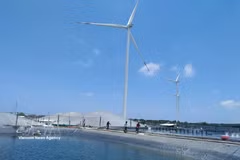
Hi-tech shrimp farming and wind power development in Thanh Hai commune, Vinh Long province (Photo: VNA)

Vietnam targets productivity-driven growth over cheap labour

A development model based on productivity, knowledge and technology requires long-term capital, a skilled workforce, innovation capacity, technology absorption and incentives for long-term invest. Therefore, Vietnam’s greatest challenge is moving from cost-based advantages to ones based on productivity, technology and added value.

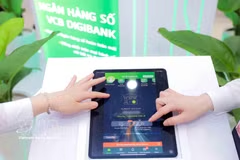
Vietcombank is one of the leading banks in digital transformation. (Photo: VNA)

Banking industry in AI era: When data becomes competitive advantage

In just a few years, AI has evolved from an experimental technology into an “assistant” for many banks, supporting everything from customer service, credit approval, and fraud detection to risk management. However, as the technological gap between institutions narrows, a new question is emerging: What will determine banks' competitive advantage in the AI era?

3.5 billion-USD AI data centre complex proposed in Tay Ninh

3.5 billion-USD AI data centre complex proposed in Tay Ninh

The project is designed for a total IT load capacity of 200 MW. In the first phase, the consortium plans to invest 3.5 billion USD in a 100MW facility, targeting groundbreaking in the fourth quarter of 2026 and commercial operation in 2027.

At the first Vietnam-Singapore Strategic Dialogue (Photo: VNA)

Vietnam, Singapore seek to make technology a strategic cooperation pillar

The Joint Statement on the Technology Connectivity Strategy issued after the first Vietnam-Singapore Strategic Dialogue reaffirmed the shared interest in deepening cooperation in science and technology, innovation, connectivity and the digital economy. The two sides shared a vision of making Vietnam and Singapore leading strategic technology partners in Southeast Asia, with both countries becoming more technologically self-reliant through cooperation and connectivity.

Delegates at the regular press briefing on August 28 hosted by Ministry of Science and Technology (Photo: mst.gov.vn.webp)

2026 Make in Vietnam Digital Product Awards launched

Launched in 2020, the Make in Vietnam Digital Technology Product Awards are the official annual awards in the digital technology sector organised by the Ministry of Science and Technology. Over six editions, the awards attracted nearly 1,500 entries, with 299 outstanding digital technology products honoured.

A area showcasing products at AI Day 2026 held in Hanoi on April 5, 2026 (Photo: VNA)

Vietnam targets top-three ASEAN ranking in AI by 2030

By 2030, Vietnam aims for 60% of businesses using AI to improve efficiency, all civil servants using AI in their work weekly, and 60% of administrative decisions supported by data and AI. The satisfaction rate for AI-supported public services is expected to rise by at least 30%.

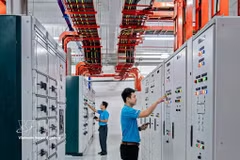
VNPT’s data centre (IDC) at Hoa Lac Hi-Tech Park, the largest of its kind in Vietnam, is equipped with state-of-the-art technologies and fully meets international technical standards. (Photo: VNA)

Vietnam’s data centre race draws multibillion-dollar investment

Ho Chi Minh City currently has 20 operational data centres and nine proposed projects, according to the municipal Department of Science and Technology. New projects are moving beyond traditional data centres toward large complexes integrating AI and other digital infrastructure.

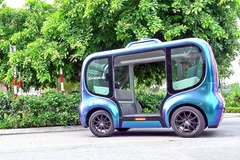
A mini autonomous bus undergoing testing in Hanoi (Photo: Phenikaa-X)

Hanoi allows 24-month trial of autonomous vehicles at Hoa Lac

The project aims to assess the safety, reliability and readiness of autonomous vehicles under real traffic conditions, as well as the effectiveness of autonomous public transport and compatibility with existing systems. Its results will contribute to developing technical standards, operating procedures and management models suited to Hanoi’s traffic conditions.

Aquaculture rafts on the Rang river in Long Son commune, Ho Chi Minh City, have benefited greatly from expanded digital connectivity, using technology in farming and selling their products online. (Photo: VNA)

Resolution 57 opens digital door to drive marine economic development

Through persistent, hands-on efforts and a determination to “leave no one behind”, the Ho Chi Minh City authorities are working to ensure that every resident has the opportunity to access and benefit from digital transformation under Politburo Resolution No. 57-NQ/TW

Professor Vu Minh Khuong of the National University of Singapore. (Photo: VNA)

Singapore’s experience suggests solutions to Vietnam’s human resources challenge in AI era

As Vietnam accelerates digital transformation and high-tech development, Singapore’s experience and the engagement of global technology companies demonstrate that human resources preparation must stay ahead of the curve. The ability to filter knowledge, collaborate, innovate and effectively use AI will increasingly become essential to helping workers adapt to a changing labour market and strengthening the competitiveness of Vietnam’s economy in the new era.

Online public services in Thanh Khe ward, Da Nang city, help residents protect personal data. (Photo: nhandan.vn)

Vietnam moves to strengthen digital shield amid rise of AI, deepfakes

An effective “digital shield” should have three key capabilities: early warning to identify unusual topics, sources and dissemination patterns, as well as signs of fabrication or coordinated activity; rapid verification through coordination among authorities, databases, experts and the press; and proactive communications, providing accurate, accessible and multimedia content to the right audiences once information is verified.

Shanti Alexander (centre), Meta’s Director of Policy Programmes and Campaigns for Asia-Pacific and Thao Dao, Country Strategy & Operations Lead at Google at a seminar in Singapore (Photo: VNA)

Singapore’s experience offers lessons for Vietnam

Singapore’s experience in linking policies with business needs, mobilising technology corporations to address national challenges and ensuring vulnerable groups are not left behind could provide valuable lessons for Vietnam.