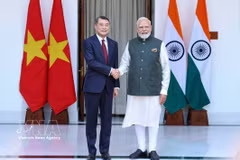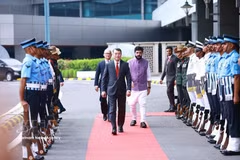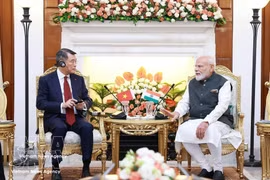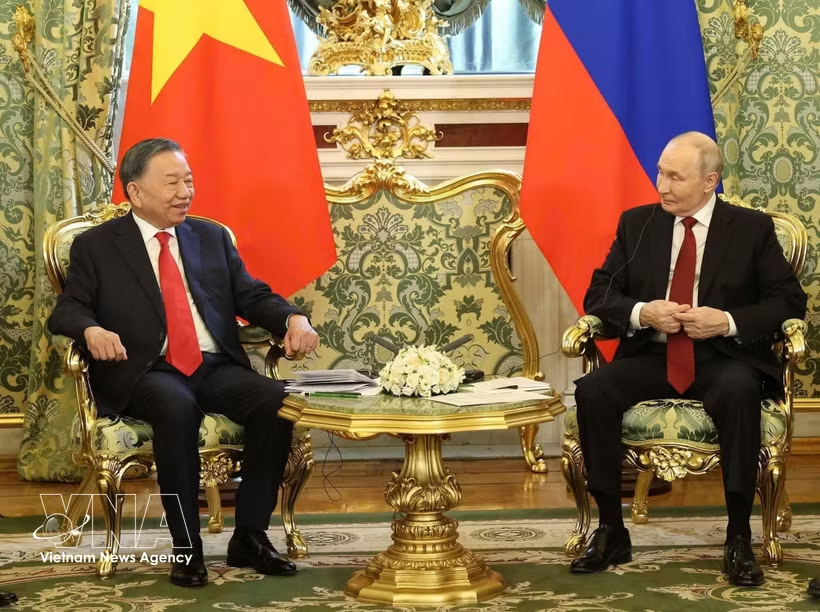
Hanoi (VNA) - The State visit to Russia by General Secretary of the Communist Party of Vietnam Central Committee and President To Lam on September 7-9 was a success, leaving a strong imprint across Party, State, parliamentary, and people-to-people channels and economic, science-technology and cultural areas.
It has also opened a new phase of deep and substantive cooperation, contributing to consolidating the Vietnam-Russia Comprehensive Strategic Partnership.
The visit took place as Vietnam enters a new development period following the 14th National Party Congress, looking toward the goals of achieving double-digit growth and becoming a high-income nation by 2030 and 2045. It reaffirmed Vietnam’s consistent foreign policy of attaching importance to relations with Russia, while creating fresh political momentum for aligning bilateral cooperation with the strategic development strategies of each country.
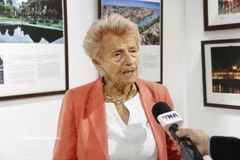
Russian historian Anton Bredikhin, senior researcher at the Institute of China and Contemporary Asia under the Russian Academy of Sciences, said that General Secretary and President Lam’s visit marked a new historic milestone, affirming the unwavering commitment and determination to further deepen the Comprehensive Strategic Partnership and close cooperation between the two countries.
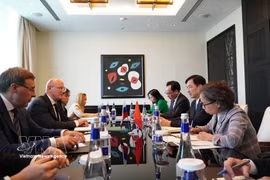
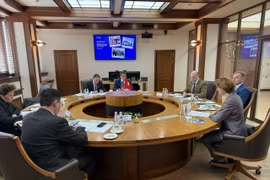
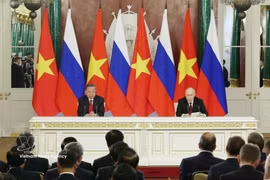
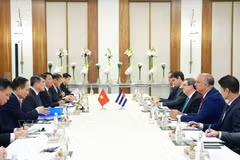
During talks and meetings, leaders of the two countries reached broad consensus on strengthening the Comprehensive Strategic Partnership with a high level of political and strategic trust; building balanced and sustainable economic, trade and investment ties; making defence-security cooperation a strategic pillar; treating energy and oil and gas as a strategic breakthrough; and making science-technology, innovation and human resources key drivers. Cultural and people-to-people exchanges were identified as bridges connecting the two nations.
The two sides also agreed to deepen cooperation in science, technology, education and training, while promoting joint research in nuclear energy for peaceful purposes, digital technology, AI, biotechnology, new materials, automation and high-tech agriculture, as well as technology transfer and exchanges among experts, scientists, universities, research institutes and technology enterprises.
Addressing the Vietnam-Russia science and technology forum, which saw the participation of Russian Deputy Prime Minister Dmitry Chernyshenko and nearly 500 experts and scientists of the two nations, General Secretary and President Lam called for new mindset, new approaches and higher goals, stressing that cooperation should move beyond expert exchanges towards jointly mastering technologies, creating products and joining markets. He said the two sides should focus on priority areas and strategic technologies such as nuclear energy, space and satellite technology, semiconductors and microelectronics, artificial intelligence (AI), quantum technology, and new materials.
The Vietnamese leader also met leaders of AFK Sistema and the Russian Direct Investment Fund (RDIF), encouraging investment and cooperation in high technology, cybersecurity, biometrics, smart cities, AI, big data, green transport, digital transformation, vaccine and next-generation biological product production, infrastructure, logistics and healthcare.
According to Minister of Science and Technology Vu Hai Quan, General Secretary and President Lam particularly emphasised the new pillar of cooperation: science and technology, innovation, and digital transformation, focusing on how Vietnam can gradually research, acquire, master, and create strategic technologies to serve national development.
The Russian side agreed to expand funding for joint strategic research projects and support training in nuclear technology. Vietnam will, for the first time, be invited by the Russian government to send at least 50 young scientists to participate in the Young Scientists Congress in Russia in December.
In addition to political and economic activities, the visit also demonstrated the depth of ties between the two peoples, leaving a profound cultural and humanitarian imprint and fostering people-to-people exchanges.
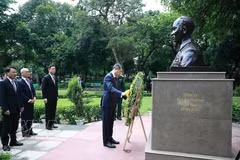
In the framework of the visit, the Vietnamese delegation paid floral tribute at the monument to President Ho Chi Minh in Moscow and at the Tomb of the Unknown Soldiers in Alexander Garden by the western wall of the Kremlin.
Meeting representatives of the Vietnamese community in Russia, General Secretary and President Lam stressed that the Political Bureau’s Resolution No. 23-NQ/TW identifies overseas Vietnamese as an important strategic resource and called on the community to strengthen solidarity and integration as well as promoting its bridging role.
The visit reaffirmed the solid historical foundation and high level of political trust between the two countries - a valuable asset of the Vietnamese and Russian people. Bilateral cooperation has gone beyond traditional areas and made breakthroughs in new fields to meet the requirements of the new development period, with expectations of creating a lasting imprint for the prosperity of the two nations and for peace and stability in the region and the world./.