Vietnam, Russia develop quantum technology cooperation roadmap

Quantum technology is an emerging field undergoing rapid breakthroughs and requiring enormous investment resources. Learning from the experience of pioneering countries such as Russia will enable Vietnam to significantly shorten the time needed to build its workforce and develop endogenous capabilities.

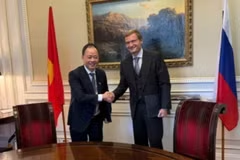
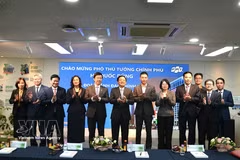
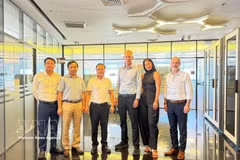
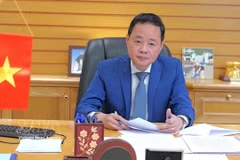
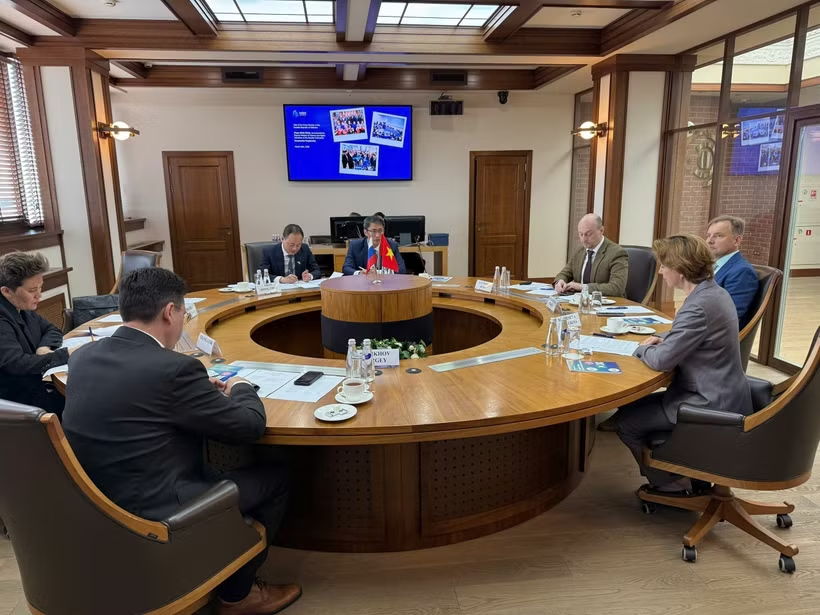
Prof. Dr. Tran Hong Thai, President of the Vietnam Academy of Science and Technology (VAST), has a working session with leaders of Russia’s State Atomic Energy Corporation Rosatom. (Photo: VNA)

Moscow (VNA) – Prof. Dr. Tran Hong Thai, President of the Vietnam Academy of Science and Technology (VAST), has held a working session with leaders of Russia’s State Atomic Energy Corporation Rosatom and leading Russian scientific and training partners at the National University of Science and Technology MISIS (NUST MISIS).

The meeting aimed to promote the development of a cooperation roadmap in strategic technologies, with an immediate focus on quantum technology, helping concretise orientations for bilateral science and technology cooperation in the new period.

The Russian side was represented by Ekaterina Solntseva, Director for Quantum Technologies at Rosatom; Academician Nikolai Kolachevsky, Director of the P.N. Lebedev Physical Institute of the Russian Academy of Sciences; Sergey Salikhov, First Vice-Rector of NUST MISIS; and Denis Avetisyan, Advisor at JV Quantum under Rosatom.

Following its participation in the BRICS Quantum Technologies Forum held in Russia in June 2026, VAST has proactively stepped up exchanges with Rosatom and Russian partners to study a comprehensive model for quantum technology development, covering priority research orientations, infrastructure development, human resources training and a three-party cooperation model linking research institutes, universities and businesses.

The participation of the P.N. Lebedev Physical Institute and NUST MISIS in the meeting provided a bridge for VAST to gain deeper access to Russia’s advanced quantum technology ecosystem.

Speaking at the meeting, Prof. Dr. Thai affirmed that quantum technology is an emerging field undergoing rapid breakthroughs and requiring enormous investment resources. Learning from the experience of pioneering countries such as Russia will enable Vietnam to significantly shorten the time needed to build its workforce and develop endogenous capabilities.

As the agency coordinating Russia’s national quantum programme, Rosatom is an ideal reference partner for VAST to develop a practical roadmap suited to Vietnam’s capabilities and actual conditions.

Building on the deep traditional friendship between the two countries, VAST has opted for an approach grounded in Russia’s strong scientific and technological foundations. Alongside creating opportunities for Vietnamese scientists, postgraduates and young officials to conduct research directly using Russia’s existing quantum computing infrastructure, VAST also plans to invite leading Russian experts to work at the academy and take charge of components of joint projects, moving towards the establishment of a joint research centre as a technological symbol of the two countries.

In a spirit of broad consensus, VAST and Rosatom agreed on a quantum technology cooperation roadmap comprising four strategic components: sharing experience in developing national strategies; human resources training; sharing and connecting research infrastructure; and gradually accessing and developing comprehensive quantum computing infrastructure covering both software and hardware.

The VAST-Rosatom quantum technology cooperation roadmap represents a concrete step to make the most of the strengths of a pioneering partner, accelerate progress and soon build strategic technology capabilities for Vietnam in the new era./.

VNA
See more

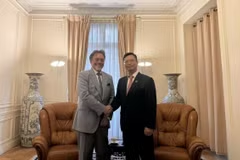
Senior Vice-President of Latin America and Asia at Thales Group Guy Bonassi (L) at a meeting with Vietnamese Ambassador to France Trinh Duc Hai (Photo published by VNA)

Vietnam, France should expand cooperation in strategic fields: business leader

General Secretary of the Communist Party of Vietnam Central Committee and President To Lam’s visit to France, Guy Bonassi, Senior Vice-President of Latin America and Asia at Thales Group, said the upgrade of bilateral ties to a Comprehensive Strategic Partnership reflects their shared desire to deepen and broaden cooperation, with technological autonomy, resilience and human resources development assuming increasingly important roles.

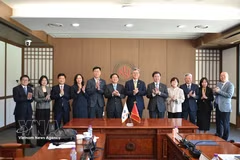
The Vietnamese delegation led by Deputy Prime Minister Ho Quoc Dung visits the Korea Institute of Science and Technology (KIST). (Photo: VNA)

Vietnam, RoK promote strategic technological cooperation

Deputy Prime Minister Ho Quoc Dung proposed expanding joint research programmes, particularly in strategic areas where Vietnam has development needs, and KIST has strengths, including semiconductor integrated circuits, AI, batteries and energy storage, and biotechnology.

Digital transformation brings economic benefits closer to businesses

Digital transformation brings economic benefits closer to businesses

In addition to streamlining processes and reducing the time required to complete administrative procedures, digital models are creating more opportunities for businesses, household enterprises and small traders to access information, adopt new payment methods, connect with partners and expand their markets.

Images are collected and processed at a satellite image receiving station. (Photo: VNA)

Vietnam, France explore new space technology cooperation opportunities

Building on the effectiveness of VNREDSat-1, Vietnam and France are continuing to promote cooperation in the next phase, including a proposal for VNREDSat-2. The two sides have discussed technological options, resources and an implementation roadmap, with a view not only to developing a new-generation satellite but also to increasing Vietnam’s level of participation and technological capabilities.

Using AI to search and process legal information (Photo: VNA)

Legal profession reshaped in age of artificial intelligence

In Ho Chi Minh City, digital transformation in the legal profession is not simply about introducing more technology into professional practice. It must also create ways of working that ensure technology serves people, while lawyers retain control and responsibility for the quality of legal services. This is particularly important in a metropolis with a large-scale economy and diverse legal needs.

Vietnamese youths learn about AI application scenarios at the China-ASEAN AI Application Cooperation Centre in Guangxi. (Photo: VNA)

China’s Guangxi fosters AI cooperation with Vietnamese localities

During his visit to China and Guangxi in April, General Secretary of the Communist Party of Vietnam (CPV) Central Committee and President To Lam expressed a desire to further expand cooperation between Vietnam, particularly border localities, and Guangxi in areas including AI.

Hanoi Market Surveillance officers inspect products showing signs of violations of regulations on product labelling, advertising and intellectual property. (Photo published by VNA)

Positive progress recorded in tackling intellectual property rights infringements

To raise public and business awareness while improving the effectiveness of preventing and dealing with infringements, the Ministry of Science and Technology will continue working with other ministries, sectors and localities to strengthen intellectual property protection and enforcement on a regular, continuous and sustained basis, with no prohibited areas or exceptions.

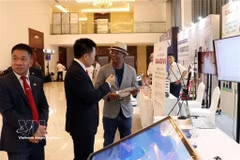
Delegates visit exhibition stands at the 2026 national quality and productivity forum in Ho Chi Minh City. (Photo: VNA)

Enabling institutions needed for science-technology to generate new productivity

The Government should shift from providing funding to creating enabling conditions by developing infrastructure, platforms, standards and markets, while coordinating the innovation ecosystem. Innovation and technology diffusion should also go hand in hand, particularly by bringing AI, digital and green technologies to small- and medium-sized enterprises as well as traditional sectors.

Prof. Dr. Nguyen Van Tam, Chair of the Department of Computer Science, Data and Artificial Intelligence at the Polytechnic Institute of Paris (IP Paris) (Photo: VNA)

Expert proposes global Vietnamese intellectual ecosystem to boost AI development

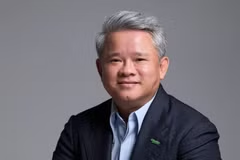
Prof. Dr. Nguyen Van Tam, Chair of the Department of Computer Science, Data and Artificial Intelligence at IP Paris, said the Political Bureau’s Resolution No. 23-NQ/TW, which elevates overseas Vietnamese to one of the country's important strategic resources, should be translated into practical mechanisms for deeper participation of OVs in the country’s scientific and technological development, particularly in artificial intelligence (AI).