Vietnam targets digital mapping for 70% of raw material areas by 2030

A scheme for 2026-2030 issued by the Ministry of Agriculture and Environment aims to establish raw material areas managed through unified data on acreage, producers, seasons, output, quality, growing area codes and production-consumption linkages.

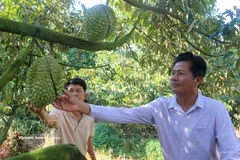
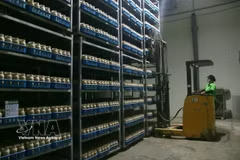
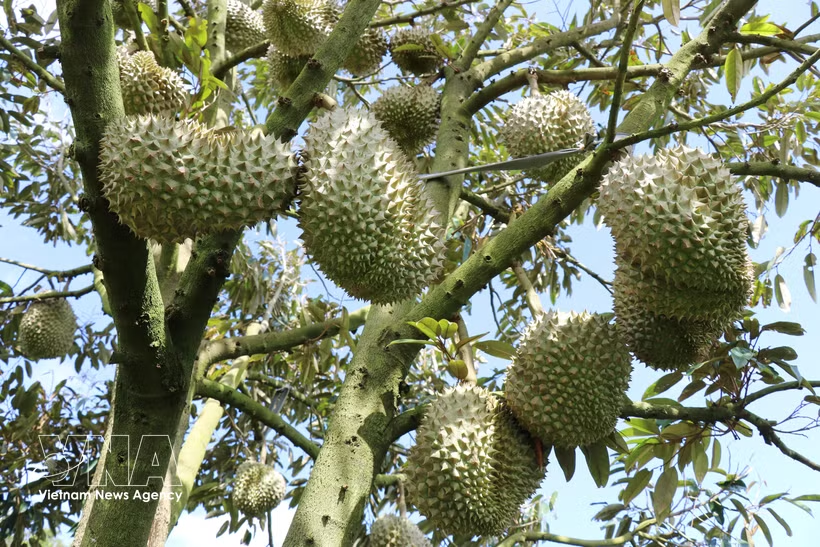
The quality of Lam Dong durians is improving thanks to standardised production processes, food safety controls and traceability (Photo: VNA)

Hanoi (VNA) – More than 70% of supported agricultural, forestry and fishery raw material areas are expected to complete digital mapping and basic data standardisation by 2030 under a scheme for 2026-2030 issued by the Ministry of Agriculture and Environment.

Digital transformation is identified as a key pillar, alongside infrastructure investment and production organisation. The scheme aims to establish raw material areas managed through unified data on acreage, producers, seasons, output, quality, growing area codes and production-consumption linkages.

At least 60% of supported acreage is expected to use electronic production diaries, area-code management and traceability systems tailored to sectoral and market requirements.

The scheme stresses that digitalisation is not simply about putting production information online, but changing how raw material areas are managed. Data must be standardised, regularly updated and connected to shared platforms, avoiding fragmented systems developed independently by local authorities, businesses or cooperatives.

The system is expected to help cooperatives, businesses and management agencies improve production planning, quality control and procurement. Updated data will help balance supply and demand and organise harvesting, collection, processing and distribution, while meeting traceability and supply-chain transparency requirements. The scheme requires raw material development to be linked from the outset with data, standards and traceability.

More than 80% of cooperatives and cooperative groups participating in supported areas are to receive training in governance, production planning, quality management, contracts and data management. Around 70% of supported areas must involve cooperatives in organising production and have at least one enterprise or processing, collection, distribution or consumption organisation with a valid linkage contract or cooperation agreement.

Cooperatives will organise producers and manage raw material areas, data and quality, while businesses will lead markets, set standards, invest in processing and boost sale and exports.

The scheme also seeks to improve infrastructure and value-chain linkages. The State will prioritise public infrastructure connecting raw material areas with collection, processing and storage facilities and markets. By 2030, transport costs are targeted to fall by at least 10%, collection time by 10-15% and post-harvest losses by 8-10%.

Material area selection will be based on market demand, processing capacity and consumption potential rather than acreage alone. Some 250-300 potential areas nationwide will be reviewed based on planning, market demand, production organisation, infrastructure, investment, digital readiness and sustainability.

The scheme targets at least 60% of output being sold under contracts, while cooperative revenues and producer incomes are expected to rise by at least 10%.

The targets build on a 2022-2025 pilot implemented in five areas across 11 provinces. By the end of 2025, these areas covered about 169,800ha, up 20%, while enterprise-linked acreage reached nearly 121,000ha, or 71.2%, up from about 17,000ha. More than 123 cooperatives were established or strengthened, bringing the total to 393, while over 5,500 managers and members received training. More than 90 linkage chains were formed./.

VNA
See more

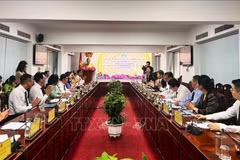
At the working session (Photo: VNA)

Can Tho, Guangxi seek collaboration in logistics, supply chains

Chinese investors now back 35 projects in Can Tho with registered capital of nearly 1.2 billion USD. In the first seven months of 2026, Can Tho’s exports to China hit 77.5 million USD, while imports stood at 64.7 million USD. Key exports included rice, seafood, farm produce, processed agricultural products and apparel while main imports comprised agricultural chemicals, veterinary medicines, fertilisers, chemicals, fabrics and other materials and inputs.

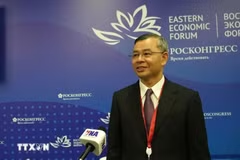
Vietnamese Minister of Finance Ngo Van Tuan grants an interview to the Vietnam News Agency (VNA). (Photo: VNA)

Vietnam, Russia move to boost financial cooperation

On bilateral economic, trade and investment ties, Tuan said two-way trade hit 3.24 billion USD in the first seven months of 2026, up 12% from a year earlier. Vietnam’s exports to Russia totaled 1.33 billion USD, while imports amounted to 1.91 billion USD.

Cai Mep - Thi Vai Port complex in Ho Chi Minh City (Photo: VNA)

Ho Chi Minh City seeks to make seaports new growth driver

To maximise its seaport advantages, Ho Chi Minh City is developing smart and green ports while promoting clean energy, lower emissions and sustainable supply chains. It aims to establish an integrated ecosystem linking seaports with industrial parks, logistics centres, free trade zones, multimodal transport networks and an international financial centre.

Farmers visit the off-season durian orchard of Cao Chi Dai in Vinh Hanh commune, An Giang province (Photo: VNA)

Vietnam promotes finance for green agriculture

Over the past five years, Vietnam has developed and gradually implemented a green finance system to support low-emission and environmentally friendly production, including agriculture. Based on the State Bank of Vietnam's Directive No. 03/CT-NHNN dated March 24, 2015, banks including BIDV, VCB, HDBank and Agribank have introduced green credit packages for waste treatment, high-tech agriculture, digital transformation, regional linkages and emission reduction across production chains.

An overview of the meeting between representatives from Polish businesses and the Agency for Domestic Market Surveillance and Development. (Photo: Agency for Domestic Market Surveillance and Development)

Polish businesses seek suppliers, partners in Vietnam

MAJAMI, a confectionery manufacturer and trader under Sweet House, is seeking distributors for Polish confectionery products in the Vietnamese market. Meanwhile, GABONA, a distributor and wholesaler of professional cosmetics, hair care and make-up products and beauty accessories, is looking for Vietnamese manufacturers of vegan and natural cosmetics.

Kendra Rinas, Chief of Mission for IOM Vietnam speaks at the event. (Photo: VNA)

Vietnam advances in building, using migrant labour data system: workshop

Data presented in the report reflects effective migration governance in recent years. The average recruitment cost paid by migrant workers dropped by 23.8%, from 164.9 million VND (6,400 USD) in 2021 to 125.7 million VND in 2025. Conversely, average first-month earnings abroad rose by 25.4%, increasing from 22.4 million VND to 28.1 million VND.

Workers produce leather shoes for export at Lefaso Tra Vinh Investment and Production Joint Stock Company in Tra Cu commune, Vinh Long province. (Photo: VNA)

Vietnamese exporters pivot to ease pressure from US tariffs

Pressure from the new US tariff policy is prompting Vietnamese exporters to reassess their strategies. Rather than pursuing volume-driven growth, many are shifting towards higher-value orders, tighter cost control, greater productivity and a more balanced allocation of markets to reduce reliance on a single destination.

A worker handles and stacks goods. Nearly 138,100 businesses were newly founded from January to August, up 7.7% over the same period last year, while more than 40,800 businesses completed dissolution procedures, a jump of 125.5%. (Photo: VNA)

Firm entry and exits point to continued restructuring pressure

Updates from the National Statistics Office last week showed that nearly 138,100 businesses were newly founded from January to August, up 7.7% over the same period last year, while more than 40,800 businesses completed dissolution procedures, a jump of 125.5%.

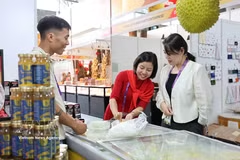
A Vietnamese business introduces durian cakes to Chinese visitors at the 22nd China-ASEAN Expo (CAEXPO) in 2025. (Photo: VNA)

Vietnam steps up trade, investment promotion at China-ASEAN Expo

According to the CAEXPO Secretariat, Vietnam will once again lease an entire exhibition area of about 3,000sq.m, featuring 170 booths, making it one of the ASEAN countries with the largest exhibition spaces at this year’s event. Nearly 100 Vietnamese businesses have confirmed their participation, including major brands such as Trung Nguyen Group, TH Group, Saigon Coffee and Biti’s.

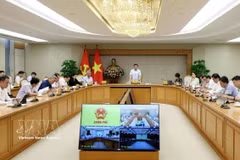
An overview of the VIFC's Executive Council meeting on September 7 (Photo: VNA)

Six groups of products, services proposed at Vietnam International Financial Centre

Deputy Minister of Finance Nguyen Thi Bich Ngoc said the products and services include investment funds and asset management, asset-backed digital assets, international carbon credits, commodity trading and derivatives infrastructure linked to trade and supply-chain financing, financial technology, and bonds issued at the centre. As these groups are at different stages of readiness, they will be rolled out in phases rather than simultaneously.