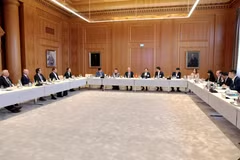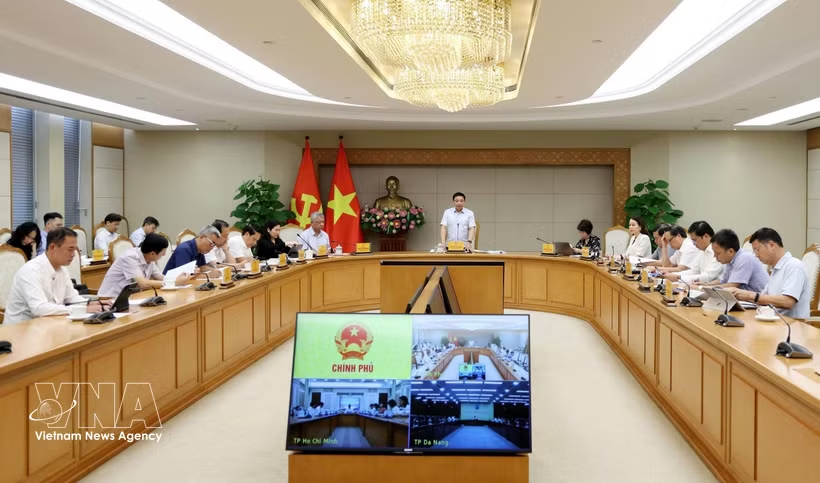
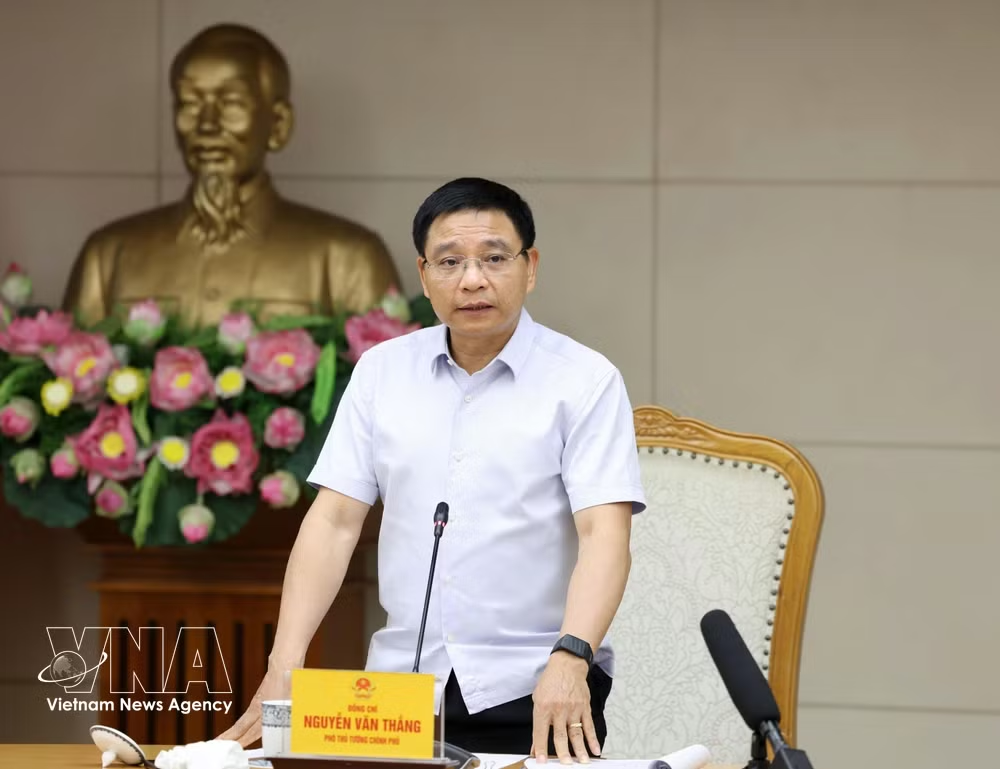
Hanoi (VNA) – Six groups of products and services have been proposed to be developed at the Vietnam International Financial Centre (VIFC), Deputy Minister of Finance Nguyen Thi Bich Ngoc said at a meeting of the centre’s Executive Council chaired by Deputy Prime Minister Nguyen Van Thang in Hanoi on September 7.
Ngoc said the products and services include investment funds and asset management, asset-backed digital assets, international carbon credits, commodity trading and derivatives infrastructure linked to trade and supply-chain financing, financial technology, and bonds issued at the centre. As these groups are at different stages of readiness, they will be rolled out in phases rather than simultaneously.
According to the official, the institutional framework and organisational structure of the centre have basically been established.
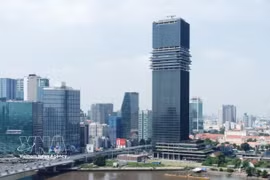
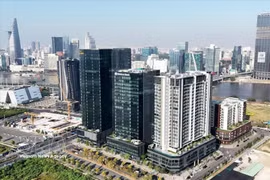
The VIFC is organised in Ho Chi Minh City and Da Nang, with a central Executive Council, two executive boards in the two cities and a joint supervisory agency. The two executive boards have issued procedures for member registration and recognition, which have been applied uniformly since August 17. A number of banks, securities companies, asset management firms and investors have signed memoranda of understanding, commitment certificates or submitted applications.
According to the Ministry of Finance, the centre's competitive positioning should be built on Vietnam's advantages in economic scale and prospects, its position in production, trade and logistics chains, and demand for medium- and long-term capital for infrastructure, energy and green transition, as well as the potential for developing capital markets, fund and asset management and financial technology.
As a priority, the ministry has proposed focusing on three key programmes, namely selecting a number of energy, infrastructure, logistics and green-transition projects involving partner banks and strategic investors; developing an ecosystem for international investment funds and asset management; and developing commodity markets linked to trade and supply-chain financing.
The ministry also proposed continuing to operate the centre under the current model while standardising service standards, procedures, data and coordination mechanisms between Ho Chi Minh City and Da Nang, ensuring that it functions as a single centre rather than two separate markets.
Notably, on August 28, the Ministry of Finance submitted to the Chairman of the Executive Council a proposal on a plan to develop guiding documents for the centre's executive boards. The plan identifies 29 tasks, with the Executive Council responsible for issuing guidance on three banking-related areas, while the executive agencies in the two cities will provide detailed guidance on 26 areas.
Concluding the meeting, Thang stressed that establishing and putting the VIFC into operation is an important task that must be carried out urgently, comprehensively and substantively, with a full legal foundation and effective management and supervision mechanisms to enable financial products and services to be introduced safely and efficiently at an early date.
He noted that the two executive boards in Ho Chi Minh City and Da Nang are now officially operational, and therefore must work simultaneously to complete the institutional framework and select a number of products for which both supply and demand already exist to engage and negotiate with investors. He asked the two boards to proactively work with investment funds and businesses, and to propose the immediate launch of products that are ready and meet all requirements.
Regarding the development of financial products, the Deputy PM requested clear identification of the mechanisms and policies required for each product, the drafting agency, the issuing authority and implementation deadlines to facilitate progress monitoring. He also called for feasible and effective inspection, examination and supervision mechanisms without creating additional administrative procedures.
The Deputy PM urged the two executive boards to urgently complete the conditions needed for the centre to operate fully, while finalising its institutions, organisational structure and human resources and negotiating and bringing investment deals to fruition. Ministries, sectors and the two executive agencies must ensure that assigned tasks remain on schedule.
Regarding information technology infrastructure, he assigned the executive boards in Ho Chi Minh City to study the hiring of consultants to design the architecture of the centre's IT platform./.