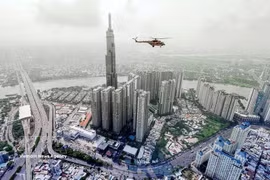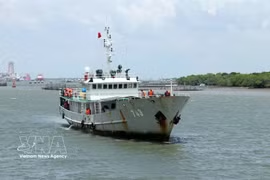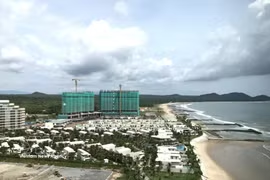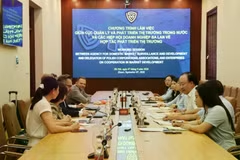
Ho Chi Minh City (VNA) – After more than a year of expanding its development space, Ho Chi Minh City has gained new opportunities to accelerate growth by linking industry, seaports, logistics, trade and finance.
Alongside implementation of Politburo Resolution No. 09-NQ/TW and special mechanisms and policies granted to the southern metropolis, the city has identified the marine economy and seaport system as important drivers for achieving its double-digit growth target.
Expanding development space towards the sea
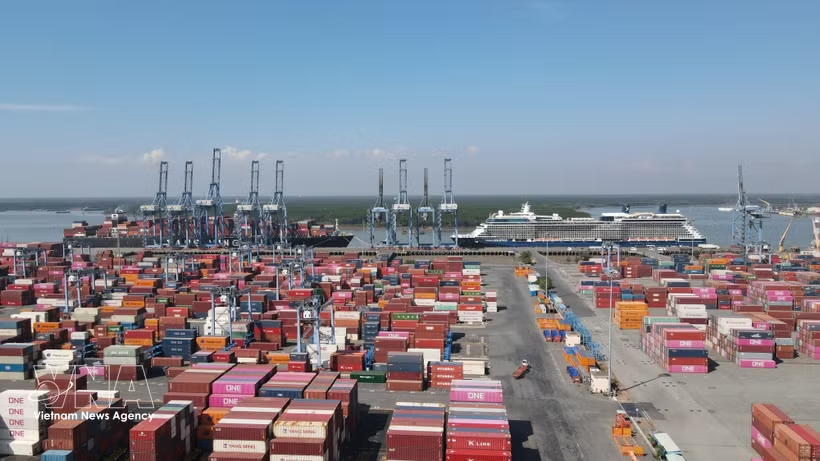
The expanded development space is enabling the city to build a more comprehensive economic structure, with maritime-oriented development advantage stemming from a system of nearly 90 seaports. Cargo throughput across its seaports reached nearly 352 million tonnes in 2025. The figure exceeded 256 million tonnes in the first eight months of 2026, up 9.2% year-on-year.
The Cai Mep-Thi Vai port complex in Tan Phuoc and Phu My wards is the city's key maritime gateway for imports and exports, with more than 30 terminals handling container, general, bulk and specialised cargo. The complex handles about 30% of the country's container throughput and maintains 48 international services weekly, including more than 20 direct routes to Europe and the Americas, strengthening the city's integration into global shipping networks.
Gemalink International Port, part of the complex, is among the world's top 19 deep-water ports and can accommodate container ships of up to 250,000 DWT. After five years of operation, the green and smart port has handled 6.5 million TEUs.
Deputy General Director of Gemalink International Port Cao Hong Phong said the port is enhancing berth capacity, synchronising equipment, applying technology and preparing resources to handle transshipment cargo in 2026-2030. It expects to handle about 2.1 million TEUs this year.
The city's seaport capacity is also being expanded through major projects, including the QTM International Port, with investment of nearly 6.9 trillion VND (265.6 million USD); the Cai Mep Ha general and container port, over 50.8 trillion VND; and the Can Gio International Transshipment Port, about 5 billion USD.
Nguyen Le Chon Tam, General Director of Saigon Port JSC, said the Can Gio port's proximity to international shipping routes and connection with Cai Mep-Thi Vai would provide major advantages. Developed alongside transport and logistics infrastructure, it could attract transshipment cargo currently handled by foreign ports, creating new space for marine economic development.
Building new growth drivers
To maximise its seaport advantages, Ho Chi Minh City is developing smart and green ports while promoting clean energy, lower emissions and sustainable supply chains. It aims to establish an integrated ecosystem linking seaports with industrial parks, logistics centres, free trade zones, multimodal transport networks and an international financial centre.
Pham Binh An, Deputy Director of the Ho Chi Minh City Institute for Development Studies, said industrial, logistics and service hubs must be connected into an integrated value chain as the city develops a multi-centred megacity model. Port and logistics projects will form links connecting the city with Cai Mep-Thi Vai and the southeastern region's transport network.
Bui Ta Hoang Vu, Director of the municipal Department of Industry and Trade, said the combination of Cai Mep-Thi Vai, Can Gio International Transshipment Port, Cai Mep Ha Free Trade Zone, Long Thanh International Airport and industrial parks would create a large-scale external economic corridor connecting the southeastern region, Mekong Delta and international markets.
The municipal Party Committee's action programme implementing Resolution No. 09-NQ/TW identifies the marine economy as a key multi-sectoral, modern, green and sustainable growth driver. The city targets average annual logistics revenue growth of 13-16% in 2026-2030, with the sector contributing 8-10% of GRDP.
The challenge is now to turn advantages into concrete projects, products and growth. With resolutions and special mechanisms implemented in tandem, seaports and logistics are expected to generate spillover effects across industry, trade, tourism, finance and technology, strengthening Ho Chi Minh City's role as a regional growth and connectivity hub./.