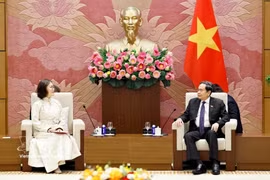
Hanoi (VNA) – More than 70 years after establishing diplomatic relations on November 17, 1954, Vietnam and Mongolia have promoted strong cooperation across a wide range of areas, with bilateral ties making substantive and comprehensive progress in recent years.
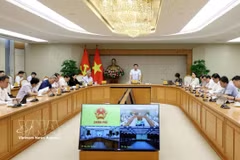
The establishment of the Vietnam-Mongolia Comprehensive Partnership has opened a new chapter, creating momentum for the two sides to broaden and deepen sustainable cooperation. Against this backdrop, the upcoming official visit to Mongolia by President of the National Assembly (NA) Tran Thanh Man is expected to help translate high-level commitments and orientations into concrete collaboration, particularly in areas with significant potential.
Vietnam and Mongolia have enjoyed traditional friendship and mutual support for decades. Mongolia regards Vietnam as one of its key comprehensive partners in Southeast Asia. Their economic and trade ties have also been strengthened through a number of cooperation agreements. The first trade agreement between the two countries was signed in 1958, while memoranda of understanding on economic and trade cooperation and sustainable rice trade have provided an important legal framework for expanding bilateral trade.
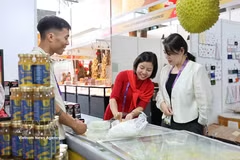
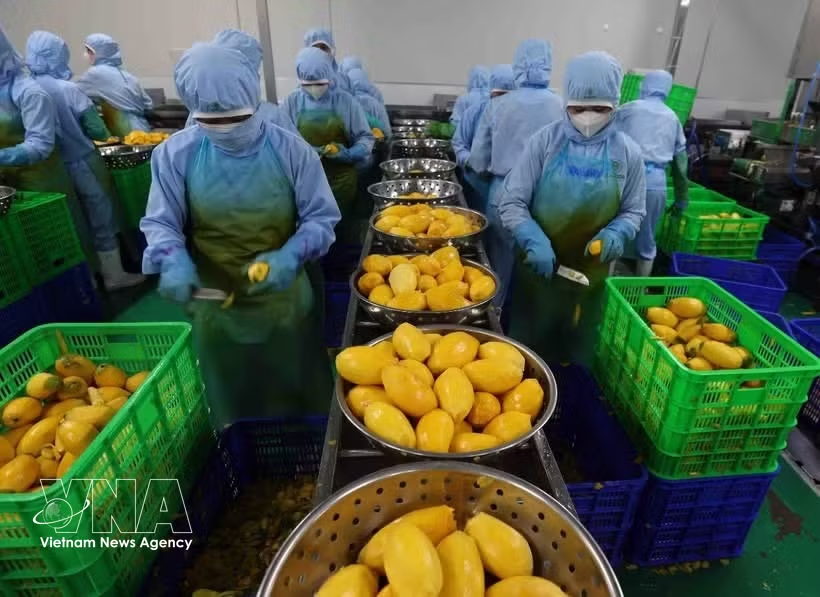
The two sides have expanded agricultural cooperation, with Mongolia supplying goat and sheep meat to Vietnam, and Vietnam exporting poultry meat and eggs to the Mongolian market. Several Vietnamese enterprises have also been implementing large-scale energy projects in Mongolia.
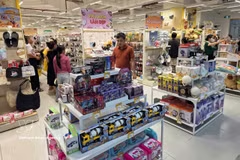
In 2025, two-way trade exceeded 155 million USD, with Vietnam’s exports surpassing 100 million USD.
Beyond traditional areas, the two countries have begun exploring collaboration in artificial intelligence (AI), e-government building and the digitalisation of public services. Mongolia is interested in working with Vietnam in AI development, the digital economy, startups and the application of emerging technologies.
According to experts, the two economies have largely complementary trade structures, creating considerable room for further expansion without significant competition or conflicts of interest.
Vietnam can further increase exports of agricultural and aquatic products, seafood and pharmaceuticals to Mongolia, while Mongolia’s competitive products, including minerals, coal, wool and felt, have potential in the Vietnamese market. Better tapping these complementary strengths could help double bilateral trade in the coming period.
In investment, the two sides are encouraged to diversify supply chains, particularly in sectors where their strengths and needs complement each other, while facilitating businesses’ access to investment opportunities. Vietnamese companies can explore opportunities in mining, animal feed processing, meat and dairy production, and leather processing, with projects potentially serving not only the Mongolian market but also neighbouring markets.
The Ministry of Industry and Trade proposed identifying key product groups with strong potential, increasing trade delegations and business promotion activities, and organising regular business-matching programmes, with a view to raising two-way trade to 200 million USD.
Vietnamese Ambassador to Mongolia Nguyen Tuan Thanh said cooperation potential remains substantial, particularly as the two countries enter a new stage of implementing commitments following the upgrade of bilateral ties to a Comprehensive Partnership.
He stressed that priority should be given to translating potential into concrete projects that deliver practical benefits to businesses and people in both countries. The two sides should further facilitate market access, strengthen business connectivity and address bottlenecks in logistics, payments, quality standards and customs procedures.
There is also significant scope for cooperation in livestock production and agriculture. Mongolia’s strengths in animal husbandry can complement Vietnam’s experience in breeding, veterinary services, food processing and agricultural value chains. The two countries can also expand collaboration in climate-adaptive agriculture, desertification comba, efficient water use and agricultural science and technology. Such areas match Mongolia’s practical needs while allowing Vietnam to share its experience.
With the Comprehensive Partnership framework in place, both sides should look beyond traditional fields and boldly explore new, long-term areas capable of generating fresh growth momentum. If market, logistics and information bottlenecks are removed, bilateral economic cooperation has substantial room for development and can become an important pillar of bilateral relations in the years ahead, Thanh said./.
See more
PM asks for sufficient supply of medicines, medical equipment at reasonable prices
Prime Minister Le Minh Hung called for stronger digital transformation, including fully digitising the supply chain - from manufacturing plants and import warehouses to retail pharmacies - through national database systems.
Vietnam advances in building, using migrant labour data system: workshop
Data presented in the report reflects effective migration governance in recent years. The average recruitment cost paid by migrant workers dropped by 23.8%, from 164.9 million VND (6,400 USD) in 2021 to 125.7 million VND in 2025. Conversely, average first-month earnings abroad rose by 25.4%, increasing from 22.4 million VND to 28.1 million VND.
Top Vietnamese legislator meets leaders of major RoK conglomerates in Seoul
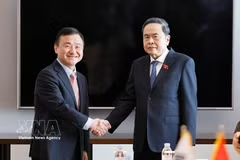
National Assembly President Tran Thanh Man met with leaders of major Republic of Korea conglomerates investing in Vietnam, including Samsung, SK, LG and Lotte, during his official visit to the country on September 8.
Three Vietnamese airports among Asia-Pacific’s most improved in air connectivity
According to ACI’s classification, Noi Bai and Tan Son Nhat were placed among the most improved airports in the 25–40 million passenger-per-year category, while Da Nang was recognised as a top improver in the 5–15 million passenger segment.
French business community expects top Vietnamese leader’s visit to boost cooperation
The official visit to France by General Secretary of the Communist Party of Vietnam Central Committee and President To Lam is expected by the French business community to further consolidate bilateral ties and serve as a “catalyst” for accelerating joint projects.
Vietnam leads ASEAN in attracting European businesses
The survey, which gathered responses from around 150 European business leaders, also pointed to stronger expectations for trade and investment across ASEAN.
Vietnamese exporters pivot to ease pressure from US tariffs
Pressure from the new US tariff policy is prompting Vietnamese exporters to reassess their strategies. Rather than pursuing volume-driven growth, many are shifting towards higher-value orders, tighter cost control, greater productivity and a more balanced allocation of markets to reduce reliance on a single destination.
Firm entry and exits point to continued restructuring pressure
Updates from the National Statistics Office last week showed that nearly 138,100 businesses were newly founded from January to August, up 7.7% over the same period last year, while more than 40,800 businesses completed dissolution procedures, a jump of 125.5%.
Vietnam steps up trade, investment promotion at China-ASEAN Expo
According to the CAEXPO Secretariat, Vietnam will once again lease an entire exhibition area of about 3,000sq.m, featuring 170 booths, making it one of the ASEAN countries with the largest exhibition spaces at this year’s event. Nearly 100 Vietnamese businesses have confirmed their participation, including major brands such as Trung Nguyen Group, TH Group, Saigon Coffee and Biti’s.
Vietnam, RoK shift towards strategic high-tech, innovation partnerships
Stronger SME ties could become the main pillar in shifting Vietnam–RoK relations from quantitative growth towards qualitative development, according to KOVECA Vice Chairman Kwon Sung Taek.
Six groups of products, services proposed at Vietnam International Financial Centre
Deputy Minister of Finance Nguyen Thi Bich Ngoc said the products and services include investment funds and asset management, asset-backed digital assets, international carbon credits, commodity trading and derivatives infrastructure linked to trade and supply-chain financing, financial technology, and bonds issued at the centre. As these groups are at different stages of readiness, they will be rolled out in phases rather than simultaneously.
Vietnam’s economy gathers pace, bolstering double-digit growth prospects
Many key sectors posted strong growth compared with the same period in 2025, providing an important foundation for the country to strive for its double-digit growth target.
Travel in autumn with Vietjet, enjoy special deals on Eco and Deluxe tickets
The promotion applies to flights scheduled between September 10, 2026, and September 10, 2027, offering passengers a wider range of options to proactively plan their upcoming trips.
Reference exchange rate goes down on September 8
The opening-hour buying and selling rates at major commercial banks also saw decreases.
Quang Ninh seeks cooperation, investment opportunities in Germany
A Quang Ninh official praised the collaboration between Siemens Mobility and VinSpeed in developing the Hanoi–Quang Ninh high-speed railway and expressed his hope that the project will pave the way for future cooperation between Siemens Mobility and Quang Ninh in modern railway development and workforce training.
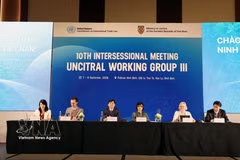
Vietnam hosts UNCITRAL Working Group III intersessional meeting for first time
By hosting the 10th UNCITRAL Working Group III intersessional meeting, Vietnam wishes to continue playing an active and proactive role in UNCITRAL in general and Working Group III in particular, working alongside the international community to strengthen cooperation, share experience and contribute to the development of the international legal framework.
Vietnam’s agricultural exports: Shifting from volume to value
Vietnam has about 1.2 million hectares of fruit-growing areas, producing around 13 million tonnes a year. Its fruits are exported to more than 60 countries, including major markets such as the US, the EU, Japan, the Republic of Korea and China. The country is also among the world’s leading exporters of rice, cashew nuts, pepper and coffee, with its products reaching more than 150 countries, including markets with stringent standards.
Northern Vietnam attracts 80.5% of new manufacturing FDI in first half
John Campbell, Director and Head of Industrial Services at Savills Vietnam, said investment in electronics and semiconductors continued to concentrate in northern localities, which have developed relatively complete manufacturing ecosystems encompassing industrial infrastructure, technical labour and supplier networks.
Vietnam, RoK seek to expand trade cooperation
The Ministry of Industry and Trade’s Department of Foreign Markets said Korean companies showed strong interest in Vietnam International Sourcing (VIS 2026), covering food, logistics, digital technology, mechanics, shipbuilding, seafood and distribution.
Vietnamese coffee exports poised for strong finish toward year-end
According to the Vietnam Coffee Cocoa Association (Vicofa), Vietnam exported nearly 1.7 million tonnes of coffee in the first eight months, earning more than 6 billion USD. Export volume rose by over 10% year on year, while export value fell by 11.2% due to lower export prices.