Top leader suggests turning sci-tech cooperation into new pillar of Vietnam–Russia ties

The top leader expressed his belief that building on the traditional friendship, high political trust, Russia’s scientific and technological capabilities, and Vietnam’s strong determination to innovate and develop, cooperation in science, technology and innovation can fully become a new driving force, a new pillar and a new symbol of bilateral relations in the 21st century.

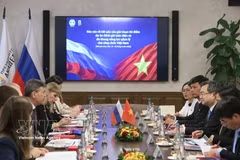
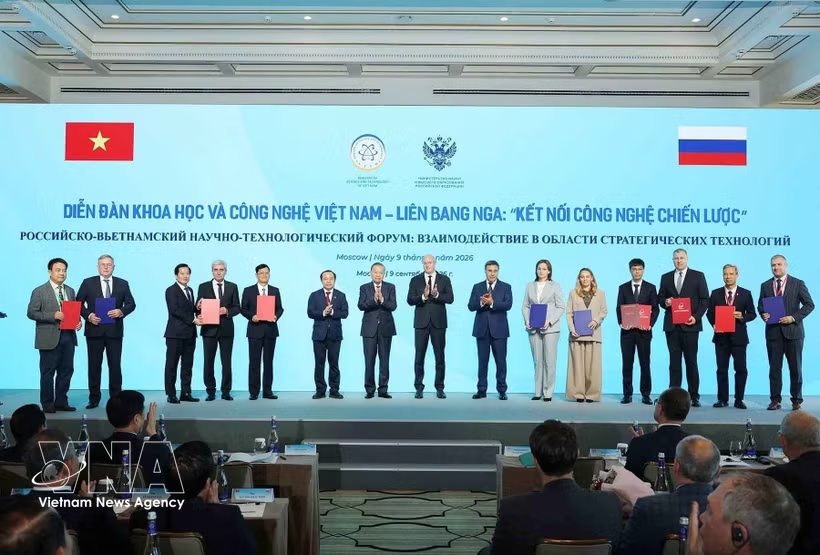
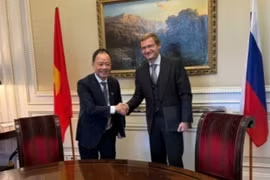
General Secretary of the Communist Party of Vietnam Central Committee and President To Lam and Russian Deputy Prime Minister Dmitry Chernyshenko witness the exchange of cooperation agreements between the two countries at the forum in Moscow on September 9, 2026. (Photo: VNA)

Moscow (VNA) – General Secretary of the Communist Party of Vietnam Central Committee and President To Lam and a high-ranking Vietnamese delegation attended the Vietnam–Russia science and technology forum on connecting strategic technologies in Moscow on September 9.

Also attending the event were Russian Deputy Prime Minister Dmitry Chernyshenko, Russian Minister of Science and Higher Education Valery Falkov, and nearly 500 other participants representing policymaking agencies, research institutes, technology business associations, experts, scientists and investors from the two countries.

Addressing the forum, General Secretary and President Lam, who is on a state visit to Russia, said Vietnam identifies science, technology, innovation and digital transformation as key drivers for renewing its growth model, improving productivity and competitiveness, and enhancing the economy’s self-reliance as in line with Politburo Resolution No. 57-NQ/TW. During this process, the country attaches importance to international cooperation, particularly with partners possessing strong scientific and technological capabilities, traditional ties, and the ability to complement Vietnam's development needs.

The top Vietnamese leader noted that bilateral relations have stood the test of many decades, with science – technology and education serving as their important foundations.

He said that Vietnam–Russia science and technology cooperation in the coming period requires new thinking, new approaches and more ambitious goals. Cooperation should go beyond expert exchanges and personnel training towards jointly mastering technologies, jointly developing products and jointly participating in markets.
vnanet-to-lam-vietnam-russia-scitech.jpg
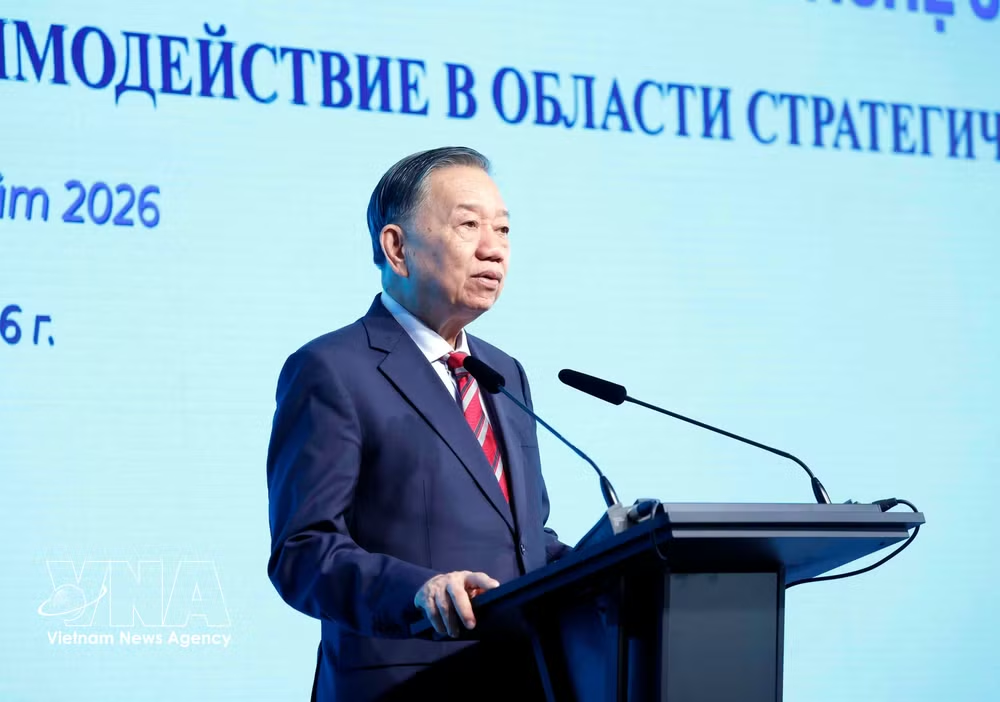
General Secretary of the Communist Party of Vietnam Central Committee and President To Lam speaks at the Vietnam–Russia science and technology forum in Moscow on September 9, 2026. (Photo: VNA)

The two countries should focus on several major orientations, including making strategic technology cooperation a new pillar of the Vietnam–Russia Comprehensive Strategic Partnership; and identifying a number of truly strategic fields that combine Russia’s sci-tech strengths with Vietnam’s development needs, human resources and market such as nuclear energy, new energy, space and satellite technology, semiconductors and microelectronics, quantum technology and artificial intelligence, he suggested.

It is also necessary to prioritise fields capable of creating new technological capacities and directly contributing to socio-economic development, security and safety safeguarding, and the enhancement of each country’s technological self-reliance, the General Secretary and President said.

He also called on Russian technology and energy corporations to increase investment and technology transfer in Vietnam, while encouraging Vietnamese technology enterprises to proactively seek investment and cooperation opportunities in Russia.

General Secretary and President Lam asked the two sides to create favourable conditions for their scientists and businesses to meet, exchange views and cooperate, while strongly investing in the next generation of Vietnamese and Russian scientists and experts. The two sides should expand training programmes in strategic technology fields, step up exchanges of young scientists, postgraduate researchers and engineers, and facilitate joint scientific and technological projects by young Vietnamese and Russian researchers.

The Governments and relevant agencies of the two countries should continue to promote the role of their joint committee for education, science and technology cooperation and consider the establishment of a mechanism for regularly reviewing key sci-tech cooperation projects, he stressed.

Each programme should clearly define its objectives, partners, resources, outputs and deadlines. Signed agreements must be translated into programmes; programmes into projects; and projects must generate technologies and products, with promising products given favourable conditions to access the market, he added.

The top leader expressed his belief that building on the traditional friendship, high political trust, Russia’s scientific and technological capabilities, and Vietnam’s strong determination to innovate and develop, cooperation in science, technology and innovation can fully become a new driving force, a new pillar and a new symbol of bilateral relations in the 21st century.
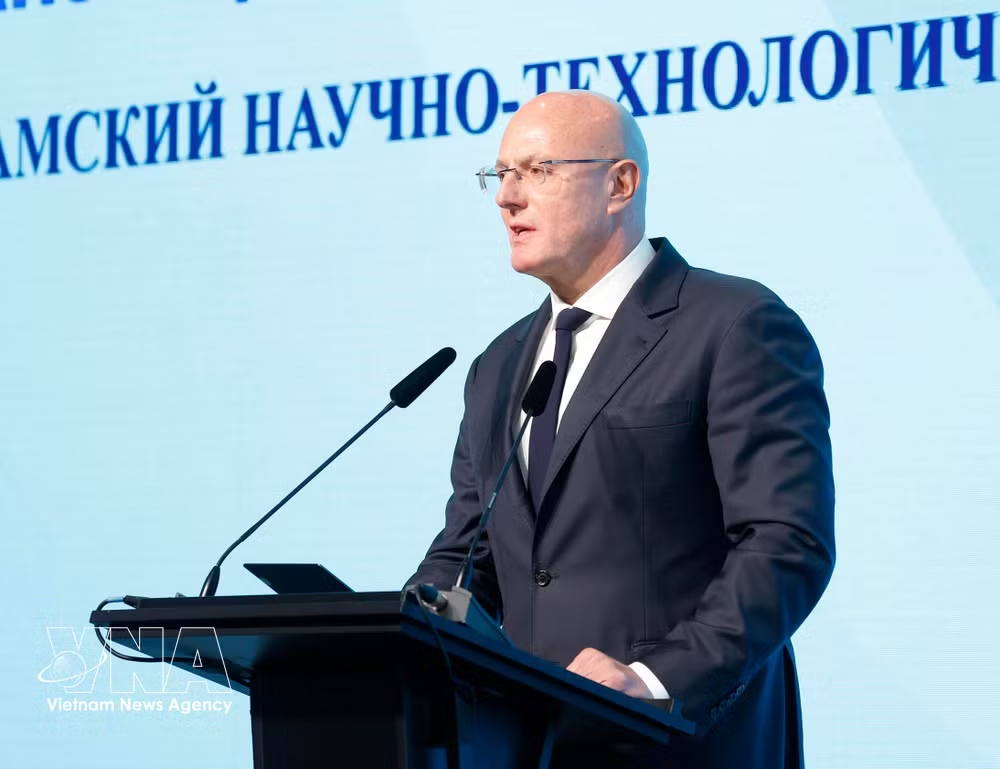
Russian Deputy Prime Minister Dmitry Chernyshenko speaks at the Vietnam–Russia science and technology forum in Moscow on September 9, 2026. (Photo: VNA)

Russian Deputy Prime Minister Dmitry Chernyshenko speaks at the Vietnam–Russia science and technology forum in Moscow on September 9, 2026. (Photo: VNA)

In his opening remarks, the Russian Deputy PM said Vietnam has long been a reliable partner of Russia. Relations are based on a tradition of friendship and mutual support and have developed across numerous fields, with science and education being among the key areas. The two sides have designated 2026 as the Year of Vietnam–Russia Educational, Scientific and Technological Exchanges under a joint declaration.

Chernyshenko said that at the forum, the two sides would kick off the selection of new joint research projects co-organised by the Russian Science Foundation and Vietnam’s National Foundation for Science and Technology Development, while also launching several other cooperation projects.

The Deputy PM stressed that what is important for the two countries is not only to share achievements but also to pool their capabilities to jointly create advanced developments. He expressed his belief that such collaboration will provide fresh momentum for the increasingly strong development of their Comprehensive Strategic Partnership.

At the forum, the sides launched the Vietnam–Russia knowledge network and exchanged cooperation documents on science – technology and education./.
VNA

See more

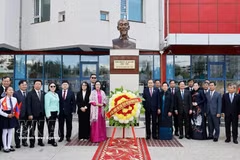
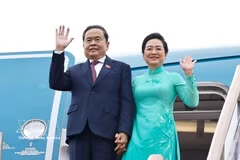
NA President Tran Thanh Man and his spouse, Nguyen Thi Thanh Nga, are welcomed by Vietnamese embassy staff and community representatives in Ulaanbaatar on September 9. (Photo: VNA)

NA President meets Vietnamese community members in Mongolia

NA President Tran Thanh Man acknowledged the difficulties facing Vietnamese people in Mongolia, particularly the harsh climate, and expressed his hope that the community will further uphold solidarity and mutual support while settling down their lives, doing business, studying and integrating into the host society.

The signing ceremony of an MoU on cooperation for 2026–2030 between Laos’ Champasak province and Vietnam’s An Giang province on September 8, 2026. (Photo: VNA)

Vietnam, Laos strengthen locality-to-locality cooperation

Over the past five years, despite the impact of global economic volatility, An Giang and Champasak have maintained regular exchanges of delegations at all levels while closely coordinating in trade promotion, business connection and human resources development.

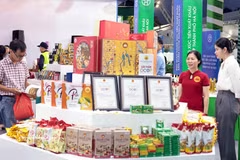
Vietnam's fresh fruits sold at a supermarket in France. Bilateral trade reached 6.3 billion USD in 2025, up 16.4% year on year, and hit 3.66 billion USD in the first six months of 2026, representing a sharp increase of 26.4% compared with the same period last year. (Photo: VNA)

Vietnam–France ties poised for new phase of strategic cooperation

With a solid foundation of cooperation and trust built over half a century, underpinned by the highest-level cooperation framework, the official visit to France and attendance at the International Space Summit by General Secretary and President To Lam will be a success, helping to further deepen bilateral ties.

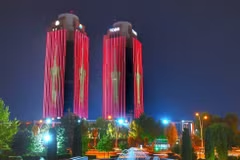
The twin towers of the Union of Chambers and Commodity Exchanges of Türkiye (TOBB) in Ankara are brilliantly illuminated with the image of Vietnam's national flag. (Photo: Vietnamese Embassy in Türkiye)

Turkey hails Vietnam’s growing international standing

Vietnamese Ambassador to Türkiye Dang Thi Thu Ha reviewed the development of bilateral ties since the establishment of diplomatic relations in 1978, affirming that cooperation has grown strongly and substantively, particularly in politics and diplomacy, economy and trade, and defence and security. She congratulated Türkiye on officially becoming a dialogue partner of ASEAN.

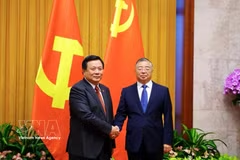
Nguyen Xuan Thang, member of the 13th Party Central Committee's Political Bureau and Chairman of the Central Theory Council (left) and Li Shulei, Politburo member, Secretary of the CPC Central Committee’s Secretariat, and Head of the CPC Central Committee’s Publicity Department, (Photo: VNA)

Vietnam, China step up theoretical exchanges, share Party-building experience

During his working visit to China, Nguyen Xuan Thang, member of the 13th Party Central Committee's Political Bureau and Chairman of the Central Theory Council, had a meeting with Li Shulei, Politburo member, Secretary of the CPC Central Committee’s Secretariat, and Head of the CPC Central Committee’s Publicity Department, during which the two sides held in-depth discussions on theoretical research, practical reviews and Party building, and agreed to further strengthen cooperation and experience sharing between the two Parties.

Vietnamese Consul General in Perth Pham Hai Anh (C) meets with Northern Territory Administrator David Connolly and his spouse. (Photo published by VNA)

Vietnam, Australia’s Northern Territory eye direct air route

A key proposal raised during the meetings was the early establishment of a direct air route linking Vietnam with Darwin. The route is expected to facilitate travel as well as trade, investment, education and tourism ties, while further promoting people-to-people exchanges.

Congratulations to DPRK on National Day

Congratulations to DPRK on National Day

Vietnamese leaders have extended their greetings to leaders of the Democratic People's Republic of Korea on the 78th anniversary of its National Day (September 9).

Chairwoman of the Vietnam - Mongolia Friendship Parliamentary Group (VMFPG) Judagiin Bayarmaam and Mongolian officials welcome President of the National Assembly Tran Thanh Man and his spouse at Chinggis Khan Aiport, Ulaanbaatar on September 9 noon (local time). (Photo: VNA)

National Assembly President begins official visit to Mongolia

The visit aims to promote substantive cooperation between the two legislatures, contributing to strengthening collobation in defence, security and economic ties, particularly in science and technology and other emerging areas of cooperation, in line with the depth and scope of the Vietnam - Mongolia Comprehensive Partnership.

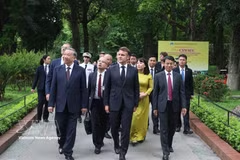
General Secretary of the Communist Party of Vietnam Central Committee and President To Lam and French President Emmanuel Macron visit the President Ho Chi Minh Relic Site at the Presidential Palace in May 2025. (Photo: VNA)

Opening up new development space for Vietnam-France relations

General Secretary of the Communist Party of Vietnam Central Committee and President To Lam’s official visit to France demonstrates Vietnam’s special regard for the Comprehensive Strategic Partnership and contributes to making the two countries strategic bridges in ASEAN and the EU.

Politburo member, Secretary of the Communist Party of Vietnam Central Committee and Head of the Committee's Commission for Policy and Strategy Nguyen Thanh Nghi holds a working session with Alexey Komissarov, Director of the Russian Presidential Academy of National Economy and Public Administration (RANEPA), in Moscow on September 8. (Photo: VNA)

Vietnam, Russia seek stronger cooperation in policy research, training

Head of the Committee's Commission for Policies and Strategies Nguyen Thanh Nghi expressed appreciation for the RANEPA and its predecessor institutions for their contributions to training and fostering Vietnamese officials. Over the past decades, nearly 1,000 Vietnamese officials and leaders have studied and received training there, many of whom have gone on to hold important positions in Vietnam’s political system.

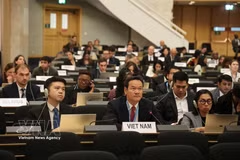
Ambassador Mai Phan Dung, Permanent Representative of Vietnam to the United Nations, the World Trade Organisation and other international organisations in Geneva at the general debate on the global human rights situation at the opening of the UNHRC’s 63rd regular session in Geneva on September 7. (Photo: VNA)

Vietnam calls for stronger effectiveness of UN Human Rights Council

As a member of the UNHRC for the 2026-2028 term, Vietnam reaffirmed its commitment to promoting sincere dialogue and constructive cooperation with all countries and UN mechanisms, in line with the principles of universality, fairness, objectivity, impartiality and non-interference.

President of the National Assembly Tran Thanh Man and his spouse Nguyen Thi Thanh Nga leave Seoul on September 9 morning, concluding their official visit to the Republic of Korea. (Photo: VNA)

NA President concludes official visit to Republic of Korea

During his stay, NA President Man held a meeting with Prime Minister Han Seong Sook and talks with NA Speaker Cho Jeong Sik. At the meetings, the two sides spoke highly of the positive development of Vietnam-RoK relations, particularly regular exchanges of delegations at all levels, especially high-level ones. They affirmed that the two countries have become each other’s leading important partners in economy, trade and investment.