Vietnam calls for stronger effectiveness of UN Human Rights Council

As a member of the UNHRC for the 2026-2028 term, Vietnam reaffirmed its commitment to promoting sincere dialogue and constructive cooperation with all countries and UN mechanisms, in line with the principles of universality, fairness, objectivity, impartiality and non-interference.

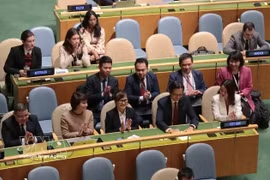
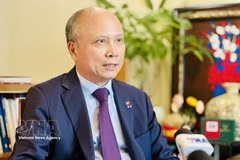
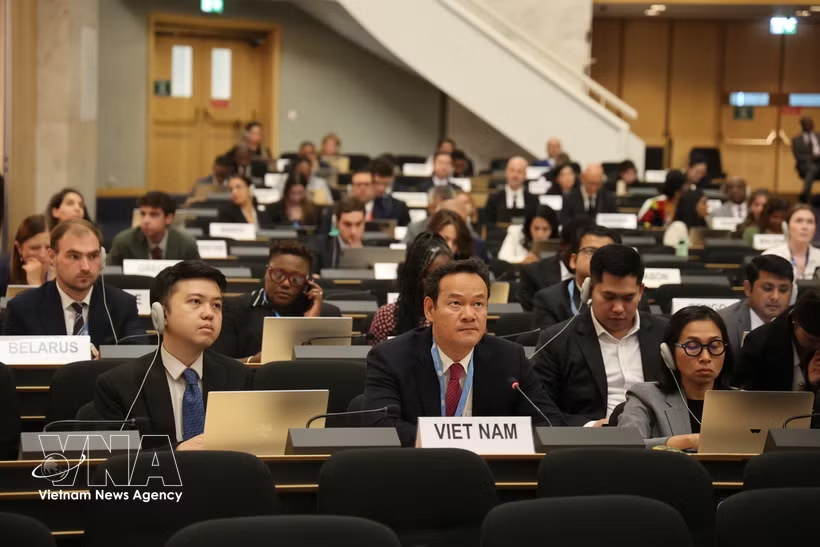
Ambassador Mai Phan Dung, Permanent Representative of Vietnam to the United Nations, the World Trade Organisation and other international organisations in Geneva at the general debate on the global human rights situation at the opening of the UNHRC’s 63rd regular session in Geneva on September 7. (Photo: VNA)

Geneva (VNA) – Vietnam has called for greater effectiveness of the UN Human Rights Council (UNHRC) in protecting and promoting human rights amid growing global challenges, including conflicts, humanitarian crises, climate change and emerging technologies.

Addressing the general debate on the global human rights situation at the opening of the UNHRC’s 63rd regular session in Geneva on September 7, Ambassador Mai Phan Dung, Permanent Representative of Vietnam to the United Nations, the World Trade Organisation and other international organisations in Geneva, affirmed Vietnam’s support for the efforts of the UN, the UN High Commissioner for Human Rights and relevant bodies.

He called for stronger action by the UNHRC to promote and protect human rights in response to current global challenges, including armed conflicts, humanitarian crises, climate change, human rights protection in cyberspace and the emergence of new technologies.

As a member of the UNHRC for the 2026-2028 term, Vietnam reaffirmed its commitment to promoting sincere dialogue and constructive cooperation with all countries and UN mechanisms, in line with the principles of universality, fairness, objectivity, impartiality and non-interference.

Dung also conveyed the Vietnamese Government’s condolences to the governments and people of China and Nepal over the loss of life and damage caused by recent floods. He congratulated Volker Türk on his re-election as UN High Commissioner for Human Rights for a second term.

In his address to the council, Türk said the past years have been marked by a growing number of armed conflicts. and diminishing respect for international human rights and humanitarian law and the United Nations Charter itself. There are now more than 60 conflicts involving at least one state, the highest number since the end of the Second World War.

He expressed concern over the heavy toll of conflicts on civilians, including deaths, displacement, loss of property and prolonged insecurity, as well as limited access to humanitarian assistance and inadequate accountability.

The High Commissioner also highlighted emerging challenges to human rights, including the growing use of drones in conflicts, risks associated with artificial intelligence and other new technologies, climate change, and access to food, housing and healthcare. He warned that replacing multilateral cooperation with transactional arrangements could undermine global efforts to protect and promote human rights.

Held in Geneva from September 7 to October 9, the 63rd UNHRC session is the Council’s final regular session of 2026. The session includes six thematic panel discussions, consideration of more than 90 thematic reports, dialogues with over 30 special procedures and UN human rights mechanisms, and discussions on human rights situations in 20 countries and territories.

During the session, Vietnam is expected to develop a joint statement on promoting human rights and access to healthcare through vaccination, host a dialogue on the right to health of older persons, and co-host events on combating online scam-related crimes and assessing the efforts and achievements of the ASEAN Intergovernmental Commission on Human Rights (AICHR).

Vietnam will also actively participate in thematic discussions and consultations on decisions and resolutions during the session./.
VNA

See more

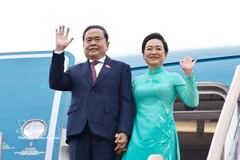
President of the National Assembly Tran Thanh Man and his spouse Nguyen Thi Thanh Nga leave Seoul on September 9 morning, concluding their official visit to the Republic of Korea. (Photo: VNA)

NA President concludes official visit to Republic of Korea

During his stay, NA President Man held a meeting with Prime Minister Han Seong Sook and talks with NA Speaker Cho Jeong Sik. At the meetings, the two sides spoke highly of the positive development of Vietnam-RoK relations, particularly regular exchanges of delegations at all levels, especially high-level ones. They affirmed that the two countries have become each other’s leading important partners in economy, trade and investment.

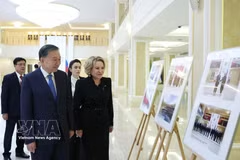
General Secretary of the Communist Party of Vietnam (CPV) Central Committee and President To Lam and Chairwoman of the Federation Council of the Federal Assembly of Russia Valentina Matvienko see photos depicting the Vietnam-Russia relationship. (Photo: VNA)

Top leader meets with Chairwoman of Russia’s Federation Council

Top Vietnamese leader To Lam proposed that the legislative bodies of Vietnam and Russia continue to play their role in improving a favourable legal framework for bilateral cooperation; and strengthen oversight of and urge the implementation of agreements reached by the senior leaders and Governments of the two countries, thereby helping translate political commitments into concrete programmes, projects and cooperation outcomes.

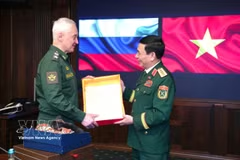
Deputy Prime Minister and Minister of National Defence Gen. Phan Van Giang (right) and Russian Defence Minister Andrey Belousov exchange souvenirs. (Photo: VNA)

Vietnam, Russia promote defence cooperation

In order for bilateral defence ties to truly match its role as a strategic pillar of the Vietnam-Russia Comprehensive Strategic Partnership in the new period, the two sides agreed to focus on promoting several key areas, including delegation exchanges and contacts at all levels, particularly high-level one; maintaining effective defence strategic consultation and dialogue mechanisms; training; and United Nations peacekeeping operations.

At the meeting between General Secretary of the Communist Party of Vietnam Central Committee and President To Lam and Russian Prime Minister Mikhail Mishustin in Moscow on September 8. (Photo: VNA)

Vietnamese, Russian leaders call for stronger trade cooperation

General Secretary of the Communist Party of Vietnam Central Committee and President To Lam and Russian Prime Minister Mikhail Mishustino agreed to study the establishment of new cooperation mechanisms and specialised working groups in various fields, and pledged to encourage businesses from both countries to expand their operations in each other’s markets.

General Secretary of the Communist Party of Vietnam Central Committee and President To Lam (L) meets with Chairman of the State Duma of the Federal Assembly of Russia Vyacheslav Volodin in Moscow on September 8. (Photo: VNA)

Top Vietnamese leader meets with Chairman of Russia’s State Duma

General Secretary of the Communist Party of Vietnam Central Committee and President To Lam reaffirmed that Vietnam attaches great importance to its traditional friendship and Comprehensive Strategic Partnership with Russia, considering Russia one of Vietnam’s leading important partners in its foreign policy.

Vietnam, US seek to boost cultural and educational exchanges

Vietnam, US seek to boost cultural and educational exchanges

Vietnam consistently regards education and training as a top national priority and a key driver of the country’s breakthrough development. The country is prioritising the development of high-quality human resources in science and technology, innovation and digital transformation.

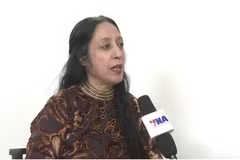
Professor Reena Marwah of the University of Delhi. (Photo: VNA)

Indian expert highlights Vietnam’s important role in BRICS

Vietnam has the potential to play a deeper role in BRICS if the grouping continues to expand and strengthen its role in global economic governance. It should engage substantively in BRICS cooperation mechanisms while maintaining a balance among BRICS, ASEAN and other partners to consolidate its strategic position.

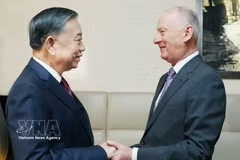
General Secretary of the Communist Party of Vietnam Central Committee and President To Lam (left) meets with Russian Presidential Aide and Chairman of the Maritime Board Nikolai Patrushev on September 8, 2026. (Photo: VNA)

Top leader highlights promising Vietnam–Russia maritime cooperation

Welcoming the two sides’ identification of orientations for maritime cooperation in 2026–2030, General Secretary and President To Lam called on relevant agencies of both countries to urgently translate them into highly feasible programmes and projects, avoiding a situation in which agreements remain merely at the level of orientations and policies.

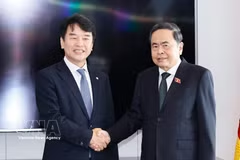
President of the Vietnamese National Assembly Tran Thanh Man (R) meets with Chairman of the Korea-Vietnam Parliamentary Friendship Group Moon Jin Seok in Seoul on September 8. (Photo: VNA)

NA President meets RoK-Vietnam Parliamentary Friendship Group chief

President of the Vietnamese National Assembly Tran Thanh Man said the Vietnamese delegation was the first foreign one to make an official visit at the invitation of NA Speaker of the Republic of Korea (RoK) Cho Jeong Sik, with representation from the Party, NA, Government and localities.

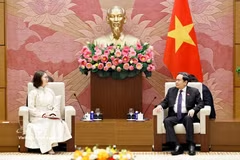
National Assembly President Tran Thanh Man (R) receives Mongolian Ambassador to Vietnam Ganbaatar Hulan in Hanoi on August 26, 2026. (Photo: VNA)

Vietnam, Mongolia work to deepen bilateral ties in substantive, effective, sustainable manner

This is the second visit by a top Vietnamese legislator to Mongolia since the two countries established diplomatic relations in 1954, and the first official visit by NA President Man to Mongolia in his capacity. The visit demonstrates Vietnam’s high regard for bilateral relations and the important role of parliamentary diplomacy in the countries’ overall relations.