Vietnam, US seek to boost cultural and educational exchanges

Vietnam consistently regards education and training as a top national priority and a key driver of the country’s breakthrough development. The country is prioritising the development of high-quality human resources in science and technology, innovation and digital transformation.

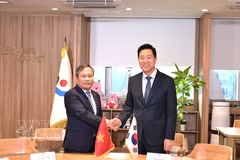
Hanoi (VNA) – Deputy Minister of Foreign Affairs Dang Hoang Giang received visiting US Assistant Secretary of State for Educational and Cultural Affairs Cate Dillon in Hanoi on September 8.

Congratulating Dillon on her appointment as Assistant Secretary of State, Giang highlighted the significance of her visit to the overall development of the Vietnam-US Comprehensive Strategic Partnership.

He affirmed that Vietnam consistently regards education and training as a top national priority and a key driver of the country’s breakthrough development. The country is prioritising the development of high-quality human resources in science and technology, innovation and digital transformation, he said.

Giang spoke highly of effective US support through the Fulbright scholarship programme, as well as cooperation by major US technology companies, including Intel and Apple, in developing high-quality personnel in Vietnam.

Regarding cultural cooperation, he said cultural ties and people-to-people exchanges have increasingly become an important area of cooperation between the two countries. He expressed his hope that both sides would continue to promote substantive cooperation in this field.

Giang asked Dillon and the US Department of State to support and consider expanding scholarship programmes for Vietnamese students, and encourage reputable US universities to establish branches or offer training programmes in Vietnam.

"Vietnam is ready to facilitate the expansion of the presence and long-term cooperation of US universities, educational institutions and businesses in the country," he affirmed.

For her part, Dillon said education and training have been a long-standing area of cooperation and play an important role in the Vietnam-US Comprehensive Strategic Partnership. She spoke highly of the results of bilateral education and training cooperation, including the Fulbright scholarship programme.

Dillon welcomed Vietnam’s goal of making English a second language in schools and said the US side would continue to effectively implement the English teaching programme of the Peace Corps to contribute to this goal.

The US Assistant Secretary of State affirmed her wish to further strengthen cooperation with Vietnam in education, training and culture. She encouraged US universities to establish branches or offer training programmes in Vietnam, and supported proposals to expand scholarship and student exchange programmes for Vietnam, providing more Vietnamese students with opportunities to study in the US.

On cultural cooperation, the two sides agreed on the need to promote activities, programmes and projects to exchange and promote the cultures of the two countries, while further strengthening people-to-people exchanges./.
VNA

See more

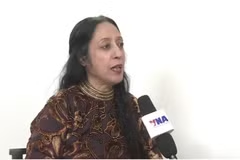
Professor Reena Marwah of the University of Delhi. (Photo: VNA)

Indian expert highlights Vietnam’s important role in BRICS

Vietnam has the potential to play a deeper role in BRICS if the grouping continues to expand and strengthen its role in global economic governance. It should engage substantively in BRICS cooperation mechanisms while maintaining a balance among BRICS, ASEAN and other partners to consolidate its strategic position.

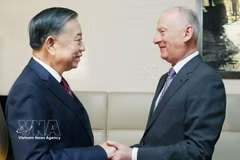
General Secretary of the Communist Party of Vietnam Central Committee and President To Lam (left) meets with Russian Presidential Aide and Chairman of the Maritime Board Nikolai Patrushev on September 8, 2026. (Photo: VNA)

Top leader highlights promising Vietnam–Russia maritime cooperation

Welcoming the two sides’ identification of orientations for maritime cooperation in 2026–2030, General Secretary and President To Lam called on relevant agencies of both countries to urgently translate them into highly feasible programmes and projects, avoiding a situation in which agreements remain merely at the level of orientations and policies.

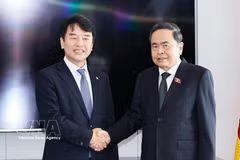
President of the Vietnamese National Assembly Tran Thanh Man (R) meets with Chairman of the Korea-Vietnam Parliamentary Friendship Group Moon Jin Seok in Seoul on September 8. (Photo: VNA)

NA President meets RoK-Vietnam Parliamentary Friendship Group chief

President of the Vietnamese National Assembly Tran Thanh Man said the Vietnamese delegation was the first foreign one to make an official visit at the invitation of NA Speaker of the Republic of Korea (RoK) Cho Jeong Sik, with representation from the Party, NA, Government and localities.

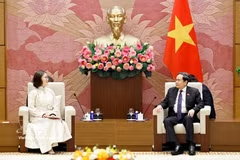
National Assembly President Tran Thanh Man (R) receives Mongolian Ambassador to Vietnam Ganbaatar Hulan in Hanoi on August 26, 2026. (Photo: VNA)

Vietnam, Mongolia work to deepen bilateral ties in substantive, effective, sustainable manner

This is the second visit by a top Vietnamese legislator to Mongolia since the two countries established diplomatic relations in 1954, and the first official visit by NA President Man to Mongolia in his capacity. The visit demonstrates Vietnam’s high regard for bilateral relations and the important role of parliamentary diplomacy in the countries’ overall relations.

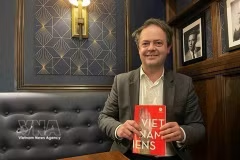
Hugues Tertrais, Honorary Professor at Paris 1 Panthéon-Sorbonne University and former Director of the Centre for Contemporary Asian History (Photo published by VNA)

Historical foundation, future momentum for Vietnam–France ties

The historical dialogue between Vietnam and France had at times been very tense, but this process helped the two sides understand and respect each other better. Greater mutual understanding built over time has created conditions for cooperation at many levels today, a French scholar has said.

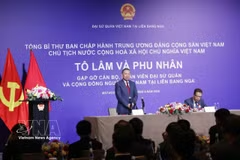
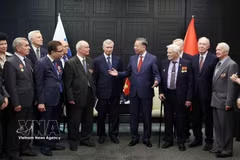
General Secretary of the Communist Party of Vietnam Central Committee and President To Lam and his spouse meet with officials and staff of the Vietnamese Embassy and representatives of the Vietnamese community in Russia in Moscow on September 7, (Photo: VNA)

General Secretary and President To Lam meets Vietnamese community in Russia

In particular, the Politburo recently issued Resolution No. 23-NQ/TW on overseas Vietnamese affairs, General Secretary and President To Lam, emphasising that in the time ahead, the Party and State will continue to improve institutions, and adopt comprehensive, open and breakthrough mechanisms and policies to connect with, attract and effectively mobilise the resources of overseas Vietnamese, particularly intellectuals, experts, entrepreneurs, scientists and young people.

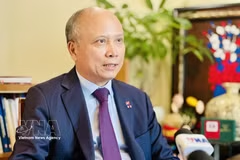
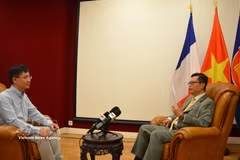
Vietnamese Ambassador to France Trinh Duc Hai (R) grants an interview to the Vietnam News Agency (Photo: VNA)

Fresh impetus for Vietnam - France cooperation on new journey

Vietnam-France relations have been nurtured over generations through historical, cultural, educational and scientific ties, as well as extensive people-to-people exchanges. Despite the ups and downs of history, the two countries have successfully built a relationship of friendship, equality and mutual respect, looking towards the future together.

Dr. Benoît de Tréglodé, Director (Africa - Asia - Middle East) at the Institute of Strategic Research (IRSEM) under the French Ministry of Armed Forces. (Photo: VNA)

Vietnam-France cooperation hoped to be expanded

Vietnam and France should also build a forward-looking, mutually beneficial partnership in which stronger economic and industrial ties serve as an indispensable foundation, said Dr. Benoît de Tréglodé, Director (Africa - Asia - Middle East) at the Institute of Strategic Research (IRSEM) under the French Ministry of Armed Forces.

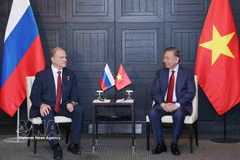
General Secretary of the Communist Party of Vietnam Central Committee and President To Lam (R) and Chairman of the Communist Party of the Russian Federation Gennady Zyuganov at the meeting in Moscow on September 7 (Photo: VNA)

Top Vietnamese leader meets Russian Communist Party chief

To deepen the two parties' ties at bilateral and multilateral levels, the top Vietnamese leader proposed both sides effectively follow the agreement on further expanding and deepening inter-Party relations, especially by increasing high-level delegation exchanges and promptly sharing information on each Party's key activities.