Paris (VNA) – Vietnam’s drive to shift from an investment-led growth model to one powered by science, technology and innovation is opening new avenues for cooperation with France in core technologies, particularly in high-speed rail, nuclear energy, semiconductors, space technology and fintech, according to an expert.
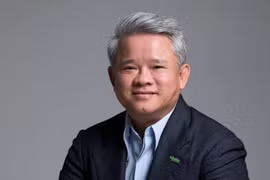
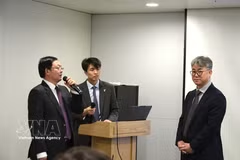
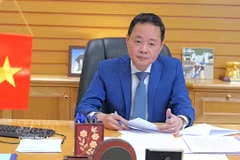
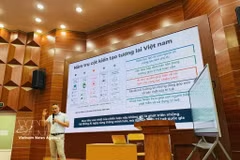
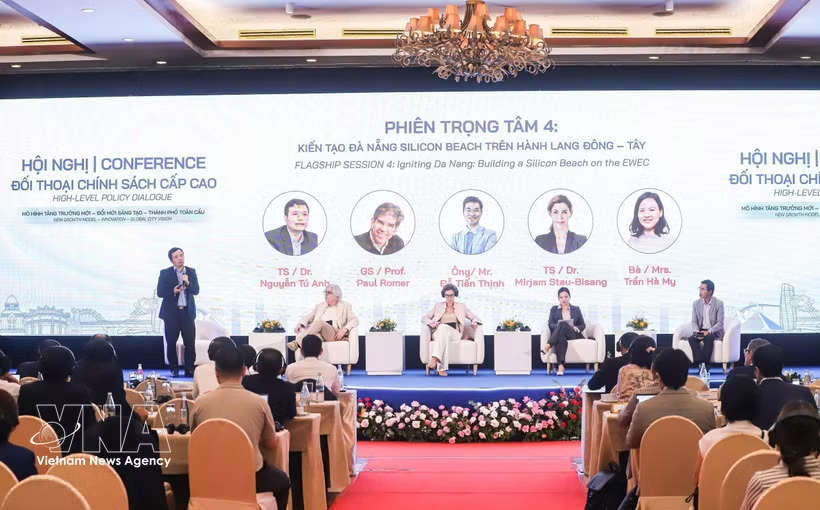
Speaking to Vietnam News Agency correspondents in Paris, Tran Ha My, President of the Vietnamese Young Business Association in Europe (VYBE) and Director of the France branch of the Vietnam Innovation Network in Europe (VINEU France), said General Secretary of the Communist Party of Vietnam Central Committee and President To Lam’s upcoming official visit to France is expected to provide fresh momentum for Vietnam-France ties as it comes at a pivotal time for Vietnam’s economic restructuring.
Under the Solow-Swan growth model, economic output is driven by technology, capital and labour. During 1995-2024, capital accounted for an average 86% of Vietnam’s GDP growth, reflecting an investment-driven economy, while total factor productivity (TFP), which manifests technological and endogenous innovation capacity, contributed only around 6-7%, despite significant improvements in some years.
According to My, who is also known as a key partner of the Vietnam International Financial Centre (VIFC), as well as the founder and President of Danang Fintech Lab (DFL24), for 2026-2030, achieving double-digit GDP growth will require more efficient capital use, with the ICOR targeted at around 4.5. As an ageing population limits labour’s contribution to about 0.7% annually, labour productivity must rise by 8.5% a year, while TFP’s contribution must increase from around 47% to over 55%.
These targets cannot be achieved simply by adding capital and labour,” My said, stressing the need for breakthroughs in core technologies.
She noted that France has technological strengths that could help Vietnam improve TFP, including materials and quantum technologies at Paris-Saclay, aerospace in Toulouse, and nuclear energy research.
The decision to combine the official visit with attendance at the International Space Summit, within the framework of the Comprehensive Strategic Partnership established by the two countries in October 2024, reflects a clear shift from trade in goods towards core technology transfer, in line with the breakthrough approach set out in Politburo Resolution No. 57-NQ/TW, she said.
From an investment perspective, My said French investors and policymakers are viewing Vietnam through at least five parallel legal frameworks, each opening up opportunities for different types of capital and technology. This distinguishes the current phase of bilateral cooperation from previous periods, she added.
|My identified five promising areas for cooperation: high-speed transport infrastructure, nuclear energy, semiconductors and digital technology, space and defence industry and aerospace, and international financial centres and controlled fintech testing.
Vietnam has approved investment in the 1,541km North-South high-speed railway, designed to operate at a speed of 350km/h and scheduled to begin construction before December 31, 2026. France, with its TGV ecosystem and companies such as Alstom, could provide not only financing but also technologies in specialised rail materials, signalling and electrification.
In nuclear energy, Vietnam has decided to resume the Ninh Thuan nuclear power project, while France has advanced capabilities through EDF and Framatome supply chain. Cooperation in this field requires government-level coordination, particularly on nuclear safety and technical standards.
Meanwhile, new legal frameworks for high-tech R&D, semiconductors, digital technology and fintech are creating opportunities for European deep-tech investment. Space technology and defence-aerospace cooperation also matches the capabilities of French companies and research institutions.
Regarding the VIFC and a pilot sandbox mechanism in fintech, French companies show a shift from traditional bank financing toward more sophisticated green and digital finance structures.
According to My, all five areas are included in the 2026-2028 action plan under the Vietnam-France Comprehensive Strategic Partnership, moving the bilateral ties from establishing a cooperation framework to implementing concrete projects.
The visit could serve as a political catalyst for advancing capital and technology flows simultaneously within a consistent framework, rather than through fragmented initiatives, she noted.
She also stressed the need to better mobilise Vietnamese experts and intellectuals in France. With more than 400,000 Vietnamese people living and working in France, including over 60,000 intellectuals, Vietnam should develop structured, long-term research and training programmes suited to the community’s academic strengths.
As a pilot model, she cited a proposal initiated by the Prime Minister in June 2025 for Prof. Nguyen Van Tam of the Institut Polytechnique de Paris (IP Paris) to develop a programme to train 100 AI engineers for Vietnam.
My proposed institutionalising targeted training and technology-transfer programmes, involving VYBE and VINEU in policy discussions, and establishing co-investment mechanisms linking overseas Vietnamese with domestic technology innovation funds. These measures, she said, could help turn Vietnamese expertise abroad into tangible technological and economic value for the nation’s development./.