Vietnam, Canada broaden economic cooperation beyond trade

Vietnam is currently Canada’s largest trading partner in ASEAN. Building on the Comprehensive and Progressive Agreement for Trans-Pacific Partnership (CPTPP), the two countries are expanding bilateral economic ties into higher value-added areas such as clean energy, critical minerals, advanced technology, manufacturing and value-chain linkages.

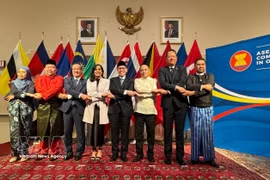
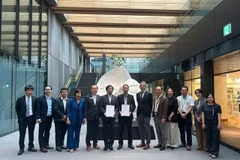
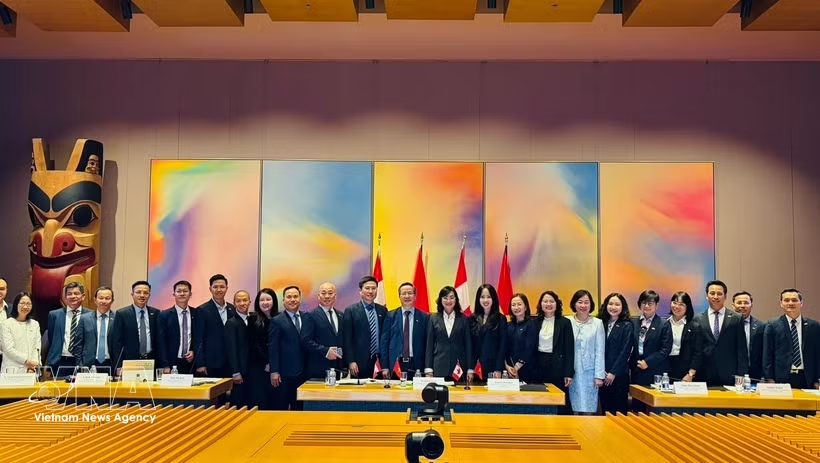
The Vietnamese delegation poses for a group photo at the third meeting of the Vietnam-Canada Joint Economic Committee (Photo: VNA)

Hanoi (VNA) – Vietnam-Canada economic ties are expanding beyond goods trade towards deeper cooperation in investment, technology, energy and manufacturing, as both countries seek to diversify markets and supply chains, according to experts.

Vietnam is currently Canada’s largest trading partner in ASEAN. Building on the Comprehensive and Progressive Agreement for Trans-Pacific Partnership (CPTPP), the two countries are expanding bilateral economic ties into higher value-added areas such as clean energy, critical minerals, advanced technology, manufacturing and value-chain linkages.

The third meeting of the Vietnam-Canada Joint Economic Committee and the recent Vietnam-Canada Business Forum highlighted this shift, with areas of mutual interest expanding beyond agriculture, consumer goods and traditional investment to clean energy, critical minerals, advanced technology, aerospace, the defence industry and the knowledge economy.

Talking to Vietnam News Agency correspondents in Canada, Vina Nadjibulla, CEO of the Centre for Strategic Statecraft of Canada, said bilateral trade has grown significantly but still has considerable room for expansion, noting that CPTPP has facilitated businesses’ access to each other’s markets.

According to Tran Thu Quynh, Commercial Counsellor at the Vietnamese Embassy in Canada, the Joint Economic Committee mechanism and interest from the two governments are creating new growth drivers. Future priorities are expected to include technology, energy, critical minerals, advanced technology and even defence industry cooperation.

From trade to industrial cooperation

In the short term, Canada has clear advantages in natural resources, agricultural products and energy products. However, Senator Yuen Pau Woo, Chair of the Canada-Vietnam Parliamentary Friendship Group, said the long-term potential lies in deeper cooperation in industry, advanced manufacturing and renewable energy.

He noted that Canada could supply abundant resources, agricultural products and energy products to Asian markets, including Vietnam, while the longer-term potential lies in jointly developing industrial capacity and creating value.

Energy and technology clearly demonstrate this complementarity. Nadjibulla said Canada could cooperate with Vietnam in areas ranging from liquefied natural gas, hydrogen and carbon capture to nuclear and renewable energy. AI, quantum technology, aerospace and defence are also emerging areas of connection.

Businesses urged to deepen value-chain participation

The broader cooperation agenda is creating new requirements for Vietnamese businesses. According to the Vietnam Trade Office in Canada, the goal is not only to increase exports but also to enhance brand value, establish a stronger direct presence in the Canadian market and participate more deeply in international distribution, manufacturing and services networks.

Connecting trade with production and making better use of the free trade agreements shared by the two countries could help link supply chains with production chains.

Quynh said this shift could lay the foundation for closer links between trade and industrial policies, promoting substantive cooperation and further upgrading bilateral ties.

Meanwhile, Yuen Pau Woo stressed the importance of a sound policy environment, noting that international relations, trade agreements and foreign policy can directly affect ties with Vietnam. Policymakers therefore need a better understanding of Vietnam and its importance to Canada.

From goods trade to production linkages and from traditional sectors to energy, technology and the knowledge economy, Vietnam-Canada relations are developing increasingly diverse connections, laying a stronger foundation for more substantive bilateral economic ties./.​

source

See more

The Index of Industrial Production (IIP) rises 14.4% in August and 11.9% in the first eight months compared to a year earlier. (Photo: VNA)

More momentum needed for economic growth in year-end race

To build momentum for the year-end race, one of the top priorities is to accelerate public investment disbursement, ensuring 100% of the allocated plan is disbursed without allowing funds to be concentrated in the final months of the year.

Vietnamese enterprises showcase products at the Vietnam Pavilion during the Foodist Istanbul 2026 fair. (Photo: Vietrade)

Vietnamese goods gain export opportunities in Türkiye, Spain

Vietrade said the programme helped businesses gain practical market information, identify potential products and partners, and better understand requirements on quality, pricing and distribution. Such direct connections are expected to help companies adapt their products and develop more effective export strategies.

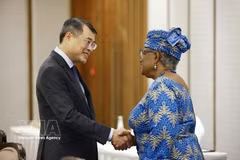
Prime Minister Le Minh Hung (left) receives WTO Director-General Ngozi Okonjo-Iweala in New Delhi, India on September 12 (Photo: VNA)

PM Le Minh Hung calls on WTO to continue support for Vietnam

Vietnam actively and responsibly participates in the WTO’s agenda and supports its coordinating role in promoting inclusive and balanced global trade for peace, cooperation and development, while effectively responding to global challenges, said Prime Minister Le Minh Hung.

Vietnamese Trade Counsellor in India Bui Trung Thuong (Photo: VNA)

Vietnam sees opportunities to deepen engagement with BRICS: Trade Counsellor

Vietnam could deepen cooperation with BRICS through four main areas: expanding trade and market access; attracting and promoting two-way investment; engaging deeper in global supply chains and logistics networks; and advancing cooperation in science-technology, innovation and digital transformation.

Quang Tri province continues to mobilise resources to complete storm shelters and anchorage areas for fishermen. (Photo: VNA)

Quang Tri province mobilises resources for fisheries infrastructure

The provincial People's Committee assigned the Department of Agriculture and Environment to prepare an investment proposal for upgrading and expanding the Con Co storm shelter in Con Co special zone. The project has a total investment of 400 billion VND (15.4 million USD) and is scheduled to be implemented from 2026 to 2028.

A farmer in Tan Phuoc 3 commune, Dong Thap province, harvest pineapples. (Photo: VNA)

Digital transformation ushers Dong Thap agriculture into modern era

The province’s farmers are gradually embracing advances in science and technology and digital transformation, providing an important impetus for the agricultural sector to shift toward modern production in line with Politburo Resolution No. 19-NQ/TW dated June 16, 2022.

Customers shop for handicrafts at a trade fair in Hanoi (Photo: VNA)

Hanoi handicrafts reach 89 international markets

Major export products include rattan and bamboo products, sedge and wickerware, fine wooden furniture and handicrafts, ceramics, lacquerware and textiles. Many craft village products feature diverse designs and good quality, gradually enhancing their competitiveness in both domestic and international markets.

General Secretary of the Communist Party of Vietnam Central Committee and President To Lam and French President Emmanuel Macron witness the exchange of cooperation documents and agreements between the two countries. (Photo: VNA)

Finance Ministry, AFD exchange 48.6 million USD financial cooperation deals

An AFD-funded project in Dien Bien province aims to improve the management and efficient use of water resources and strengthen water regulation between river basins, helping secure water supplies for production and daily life while improving resilience to drought, erosion, flooding and climate change.