New drivers to power Vietnam’s next growth phase

As localities sharpen their competitive edges, whether in logistics, semiconductors, or advanced technology, the national economy gains a more resilient ecosystem built on regional synergies.

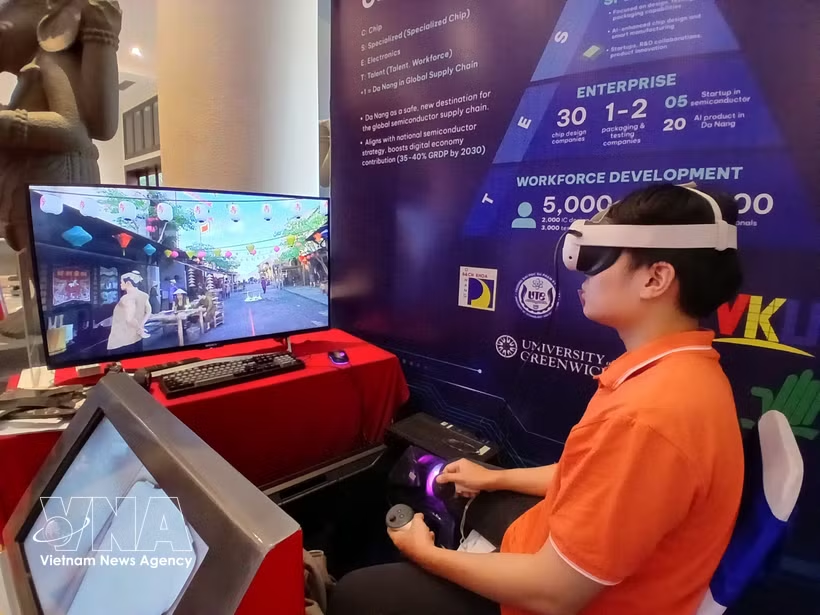
Illustrative image (Photo: VNA)

Hanoi (VNA) - This year is shaping up to be a crucial one for Vietnam to achieve its goal of double-digit growth, with early signs suggesting a structural upgrade rather than just a temporary rebound.

Growth pivots based on quality and technology

This year is shaping up to be a crucial one for Vietnam to achieve its goal of double-digit growth, with early signs suggesting a structural upgrade rather than just a temporary rebound. are rotating sharply toward high-tech and innovation, said Tran Thi Thu from the National Statistics Office under the Ministry of Finance.

Foreign direct investment is tilting into the digital economy, including electronics, semiconductors and core technologies. A heavy import bill for machinery, equipment and components signals new production capacity, a prerequisite for Vietnam to move beyond contract manufacturing and into higher-value segments of global supply chains.

Breakthroughs are broadening across all 34 centrally-governed cities and provinces, with nine posting growth above 10%. Ha Tinh led at 12.79%; Hai Phong grew 11.33% as an industrial and logistics hub. Quang Ninh expanded 11.11% as it pivots from mining to green processing, manufacturing, tourism and services. Bac Ninh, Thai Nguyen and Ninh Binh have joined the fastest-growing group, forming a new tech corridor from electronics to semiconductors.

That dispersion signals Vietnam is knitting together interconnected economic corridors and regional supply chains. As localities sharpen their competitive edges, whether in logistics, semiconductors, or advanced technology, the national economy gains a more resilient ecosystem built on regional synergies.

Institutional push, persistent chokepoint

July 1, 2026 marked a milestone as the 2025 Law on Digital Transformation and the 2025 Law on High Technology took effect, what economists call the operating “software” for the digital economy.
vnanet-b.jpg
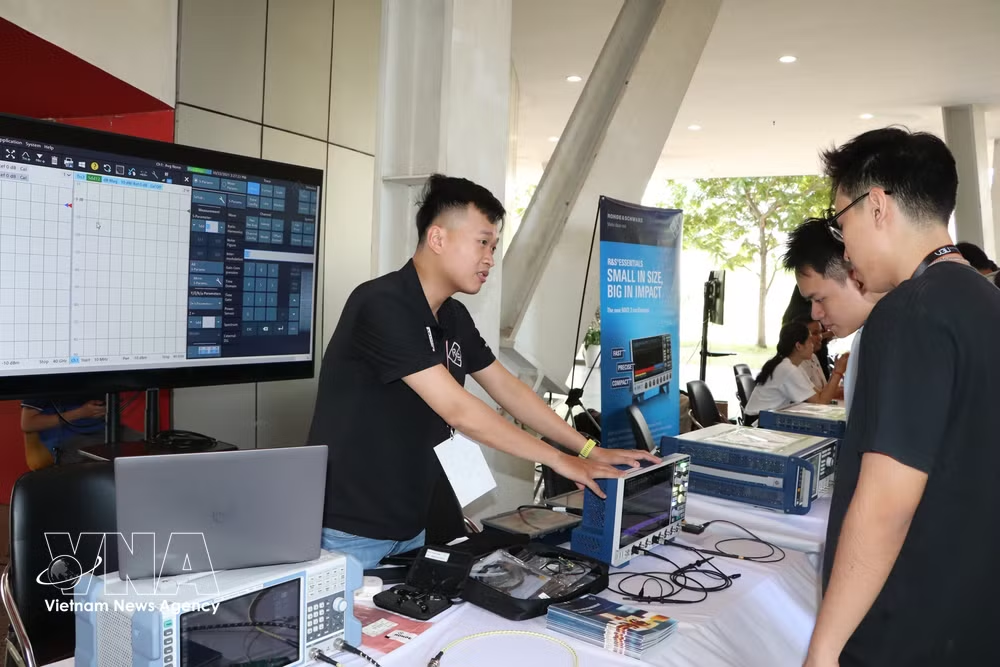
At Semiconductor Awareness Days 2026 in Ho Chi Minh City. (Photo: VNA)

Vietnam’s laws are creating a solid legal foundation to attract global tech giants in AI and data centres. The framework is being fine-tuned to draw in capital and safeguard the new value that digitalisation generates. By prioritising quality and sustainability in its FDI policy, Vietnam is moving away from chasing any investment and instead choosing the right partners to strengthen its economic power.

Still, sustaining growth above 10% through 2030 will force quick fixes to real bottlenecks. Domestic companies still capture too little value added in high-tech. Vietnam needs national champions that can partner with foreign investors, not just supply them.

That is also the lever for lifting labour productivity and workforce quality. Vietnam must rapidly expand its pool of skilled workers for an advanced digital economy, making semiconductor and AI training an urgent national priority.

A final piece is improving the business climate, so public investment acts as seed capital to unlock the private sector's resources, which is the lifeblood that must circulate through every corner of the economy if Vietnam is to hit its growth target./.

VNA

See more

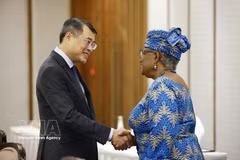
Prime Minister Le Minh Hung (left) receives WTO Director-General Ngozi Okonjo-Iweala in New Delhi, India on September 12 (Photo: VNA)

PM Le Minh Hung calls on WTO to continue support for Vietnam

Vietnam actively and responsibly participates in the WTO’s agenda and supports its coordinating role in promoting inclusive and balanced global trade for peace, cooperation and development, while effectively responding to global challenges, said Prime Minister Le Minh Hung.

Vietnamese Trade Counsellor in India Bui Trung Thuong (Photo: VNA)

Vietnam sees opportunities to deepen engagement with BRICS: Trade Counsellor

Vietnam could deepen cooperation with BRICS through four main areas: expanding trade and market access; attracting and promoting two-way investment; engaging deeper in global supply chains and logistics networks; and advancing cooperation in science-technology, innovation and digital transformation.

Quang Tri province continues to mobilise resources to complete storm shelters and anchorage areas for fishermen. (Photo: VNA)

Quang Tri province mobilises resources for fisheries infrastructure

The provincial People's Committee assigned the Department of Agriculture and Environment to prepare an investment proposal for upgrading and expanding the Con Co storm shelter in Con Co special zone. The project has a total investment of 400 billion VND (15.4 million USD) and is scheduled to be implemented from 2026 to 2028.

A farmer in Tan Phuoc 3 commune, Dong Thap province, harvest pineapples. (Photo: VNA)

Digital transformation ushers Dong Thap agriculture into modern era

The province’s farmers are gradually embracing advances in science and technology and digital transformation, providing an important impetus for the agricultural sector to shift toward modern production in line with Politburo Resolution No. 19-NQ/TW dated June 16, 2022.

Customers shop for handicrafts at a trade fair in Hanoi (Photo: VNA)

Hanoi handicrafts reach 89 international markets

Major export products include rattan and bamboo products, sedge and wickerware, fine wooden furniture and handicrafts, ceramics, lacquerware and textiles. Many craft village products feature diverse designs and good quality, gradually enhancing their competitiveness in both domestic and international markets.

General Secretary of the Communist Party of Vietnam Central Committee and President To Lam and French President Emmanuel Macron witness the exchange of cooperation documents and agreements between the two countries. (Photo: VNA)

Finance Ministry, AFD exchange 48.6 million USD financial cooperation deals

An AFD-funded project in Dien Bien province aims to improve the management and efficient use of water resources and strengthen water regulation between river basins, helping secure water supplies for production and daily life while improving resilience to drought, erosion, flooding and climate change.

The working session between Vietnamese Minister of Industry and Trade Le Manh Hung and Andrey Slepnev, Minister in charge of Trade of the Eurasian Economic Commission (photo: moit.gov.vn)

Vietnamese minister proposes EAEU open market to Vietnamese goods

Minister of Industry and Trade Le Manh Hung asked the EAEU to consider removing several obstacles to bilateral trade, with a focus on eliminating the threshold safeguard measure on Vietnamese textile and garment products and opening the Russian market further to Vietnamese fishery products.

Vice Chairman of the Hanoi People’s Committee hands over investment policy approval for Moscow House project in Hanoi to the Moscow authorities. (Photo published by VNA)

Hanoi, Russian localities step up cooperation in urban railways, technology

Secretary of the Hanoi Party Committee Tran Duc Thang and the delegation held talks with Moscow authorities to review implementation of the 2025-2027 cooperation programme and discuss key priorities for the new period, including urban transport, science and technology, digital transformation, trade and investment, and cultural exchanges.