Explicit consent required for sharing customers’ credit information from November 1

The borrower’s consent must be given through a clear and specific method that can be printed or copied in writing, including in electronic form or another verifiable format.

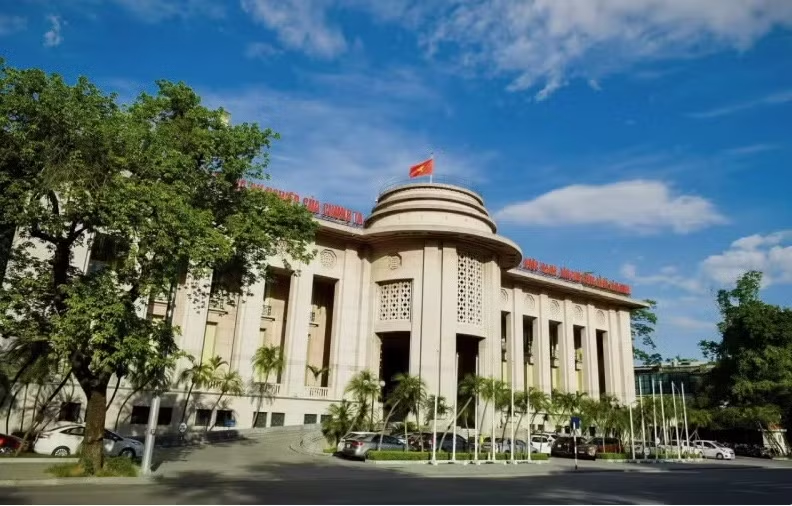
The State Bank of Vietnam headquarters in Hanoi (Illustrative photo: VNA)

Hanoi (VNA) – From November 1, 2026, the provision of borrowers’ credit information for voluntary organisations, foreign credit information organisations and other organisations must be based on the borrowers’ explicit and specific consent.

The requirement is included in Circular No. 46/2026/TT-NHNN recently issued by the State Bank of Vietnam (SBV), which amends and supplements a number of provisions of Circular No. 15/2023/TT-NHNN on credit information-related activities. The new circular will take effect on November 1, 2026.

Under the new regulations, borrowers’ credit information may be provided for voluntary organisations, foreign credit information organisations and other organisations in accordance with regulations.

However, such provision must have the borrower’s consent as required by relevant laws and comply with the information exchange agreement with the National Credit Information Centre of Vietnam (CIC).

Notably, the borrower’s consent must be given through a clear and specific method that can be printed or copied in writing, including in electronic form or another verifiable format.

The new provision is expected to establish a clearer framework for sharing borrowers’ credit information while requiring consent to be identifiable, retainable and verifiable throughout the information-sharing process.

Circular 46/2026 also revises regulations on the methods and frequency of providing credit information. Accordingly, credit information must generally be provided in electronic data form in accordance with the Credit Information Indicator System.

Where some or all groups of credit information indicators cannot be provided electronically, credit institutions and voluntary organisations may provide the information in writing as agreed with the CIC.

For credit institutions, the frequency of information provision must comply with the Credit Information Indicator System issued under a decision of the SBV Governor. For voluntary organisations, the frequency is determined by their information exchange agreements with the CIC.

The circular also clarifies requirements concerning annual financial statements of corporate borrowers. Such statements must have been submitted to tax authorities or audited. For foreign corporate borrowers, annual financial statements must comply with international accounting standards or the accounting standards of the country where they are headquartered.

Circular 46/2026 also adds and revises provisions concerning member banks and related persons of borrowers in line with relevant regulations on the Vietnam International Financial Centre and credit institutions./.

VNA

See more

Octopus processing for export at Huy Nam Company in An Giang province. (Photo: VNA)

New opportunities for Vietnam’s seafood exports

The Vietnam-EFTA Free Trade Agreement brings together two groups of highly complementary economies. EFTA members Switzerland, Norway, Iceland and Liechtenstein have strengths in technology, innovation, finance, clean energy and sustainable development, while Vietnam is one of Asia’s most dynamic economies and is emerging as a major regional manufacturing, trade and investment hub.

The saponin content of Lai Chau ginseng can reach as high as 23.85% in its natural state, a remarkably high level compared to many other ginseng species. (Photo: baolaichau.vn)

Lai Chau ginseng development gains momentum

Blessed with rare and distinctive ecological values, the northern mountainous province of Lai Chau is stepping up efforts to conserve and develop its native ginseng, with the medicinal plant expected to play a growing role in the forest-based economy and local livelihoods.

The Vietnamese delegation poses for a group photo at the third meeting of the Vietnam-Canada Joint Economic Committee (Photo: VNA)

Vietnam, Canada broaden economic cooperation beyond trade

Vietnam is currently Canada’s largest trading partner in ASEAN. Building on the Comprehensive and Progressive Agreement for Trans-Pacific Partnership (CPTPP), the two countries are expanding bilateral economic ties into higher value-added areas such as clean energy, critical minerals, advanced technology, manufacturing and value-chain linkages.

The Index of Industrial Production (IIP) rises 14.4% in August and 11.9% in the first eight months compared to a year earlier. (Photo: VNA)

More momentum needed for economic growth in year-end race

To build momentum for the year-end race, one of the top priorities is to accelerate public investment disbursement, ensuring 100% of the allocated plan is disbursed without allowing funds to be concentrated in the final months of the year.

Vietnamese enterprises showcase products at the Vietnam Pavilion during the Foodist Istanbul 2026 fair. (Photo: Vietrade)

Vietnamese goods gain export opportunities in Türkiye, Spain

Vietrade said the programme helped businesses gain practical market information, identify potential products and partners, and better understand requirements on quality, pricing and distribution. Such direct connections are expected to help companies adapt their products and develop more effective export strategies.

Prime Minister Le Minh Hung (left) receives WTO Director-General Ngozi Okonjo-Iweala in New Delhi, India on September 12 (Photo: VNA)

PM Le Minh Hung calls on WTO to continue support for Vietnam

Vietnam actively and responsibly participates in the WTO’s agenda and supports its coordinating role in promoting inclusive and balanced global trade for peace, cooperation and development, while effectively responding to global challenges, said Prime Minister Le Minh Hung.

Vietnamese Trade Counsellor in India Bui Trung Thuong (Photo: VNA)

Vietnam sees opportunities to deepen engagement with BRICS: Trade Counsellor

Vietnam could deepen cooperation with BRICS through four main areas: expanding trade and market access; attracting and promoting two-way investment; engaging deeper in global supply chains and logistics networks; and advancing cooperation in science-technology, innovation and digital transformation.

Quang Tri province continues to mobilise resources to complete storm shelters and anchorage areas for fishermen. (Photo: VNA)

Quang Tri province mobilises resources for fisheries infrastructure

The provincial People's Committee assigned the Department of Agriculture and Environment to prepare an investment proposal for upgrading and expanding the Con Co storm shelter in Con Co special zone. The project has a total investment of 400 billion VND (15.4 million USD) and is scheduled to be implemented from 2026 to 2028.