Ho Chi Minh City eyes municipal, project bonds to support infrastructure development

Great reliance on the state budget and conventional bank lending could put considerable pressure on the financial system, making it necessary to develop new and sustainable sources of funding from both domestic and international capital markets.

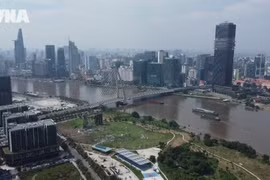
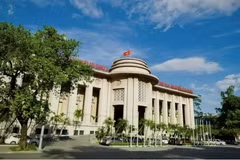
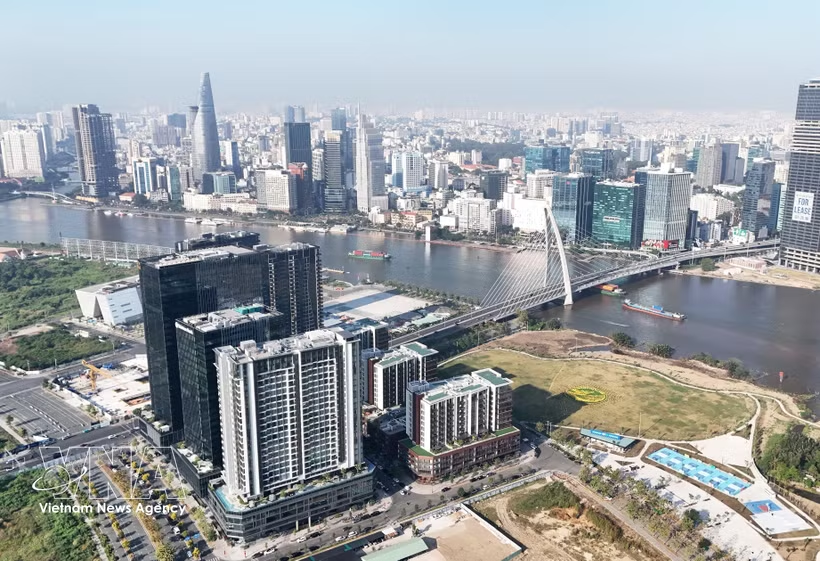
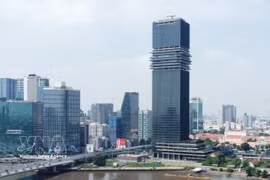
The core area of the Vietnam International Financial Centre in Ho Chi Minh City (Photo: VNA)

Ho Chi Minh City (VNA) – The establishment of mechanisms for issuing municipal and project bonds through the Vietnam International Financial Centre in Ho Chi Minh City (VIFC-HCMC) is expected to create an important medium- and long-term financing channel for infrastructure development, easing pressure on the state budget and traditional bank credit.

Ho Chi Minh City is entering a phase of breakthrough development, with substantial demand for investment in technical and social infrastructure. According to the municipal People’s Committee, the city needs more than 3.2 quadrillion VND (123.3 billion USD) in total investment across society during 2026–2030, while its budget is capable of supplying only around 1.2 quadrillion VND.

Large-scale projects such as urban railways, seaports, logistics infrastructure and energy transition projects require substantial medium- and long-term capital. Great reliance on the state budget and conventional bank lending could put considerable pressure on the financial system, making it necessary to develop new and sustainable sources of funding from both domestic and international capital markets.

Against this backdrop, the VIFC-HCMC Executive Authority has consulted stakeholders on a draft resolution of the municipal People’s Council on the issuance of municipal and project bonds.

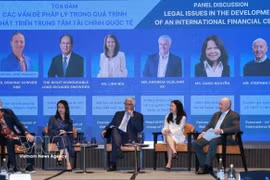
The establishment of a specialised bond financing channel at VIFC-HCMC is seen as being in line with practices adopted by major international financial centres. The consultation involved representatives of central and local authorities, financial institutions, commercial banks, securities companies and economists.

Assoc. Prof., Dr Nguyen Huu Huan, Vice Chairman of the VIFC-HCMC Executive Authority, said the mechanism aims to establish a new capital mobilisation channel, directly connecting the city’s substantial infrastructure financing needs with long-term domestic and international capital flows.

Funds raised through municipal and project bonds are set to focus on key projects with strong spillover effects, he stressed, noting that VIFC-HCMC is currently preparing a portfolio of more than 21 infrastructure projects, from which five to seven highly feasible, large-scale projects will be selected to attract strategic investors to.

Linking bond issuance to specific projects is expected to enhance transparency and enable investors to better assess project efficiency and risks, Huan added.

Experts stressed that a comprehensive legal framework and modern technical infrastructure are essential for municipal and project bonds to prove effective.

Key issues under discussion include the legal framework, inter-agency coordination, bond structures, currencies, maturities, interest rates, credit ratings, risk management and trading infrastructure. The development of green and sustainable bonds is also being considered.

The mechanism is expected not only to address Ho Chi Minh City’s immediate infrastructure financing needs but also to support its long-term development. As a hub for global investment funds, investment banks, asset management firms and fintech companies, VIFC-HCMC could help channel long-term capital into major infrastructure projects.

Beyond financial resources, experts noted that international issuance and trading through VIFC-HCMC could bring advanced financial technologies, modern management practices, international transparency standards, data systems and global expert networks. These resources will help strengthen national competitiveness and enable Vietnamese businesses to access international capital at reasonable costs while supporting their deeper integration into global value chains./

VNA
See more

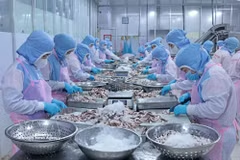
Octopus processing for export at Huy Nam Company in An Giang province. (Photo: VNA)

New opportunities for Vietnam’s seafood exports

The Vietnam-EFTA Free Trade Agreement brings together two groups of highly complementary economies. EFTA members Switzerland, Norway, Iceland and Liechtenstein have strengths in technology, innovation, finance, clean energy and sustainable development, while Vietnam is one of Asia’s most dynamic economies and is emerging as a major regional manufacturing, trade and investment hub.

The saponin content of Lai Chau ginseng can reach as high as 23.85% in its natural state, a remarkably high level compared to many other ginseng species. (Photo: baolaichau.vn)

Lai Chau ginseng development gains momentum

Blessed with rare and distinctive ecological values, the northern mountainous province of Lai Chau is stepping up efforts to conserve and develop its native ginseng, with the medicinal plant expected to play a growing role in the forest-based economy and local livelihoods.

The Vietnamese delegation poses for a group photo at the third meeting of the Vietnam-Canada Joint Economic Committee (Photo: VNA)

Vietnam, Canada broaden economic cooperation beyond trade

Vietnam is currently Canada’s largest trading partner in ASEAN. Building on the Comprehensive and Progressive Agreement for Trans-Pacific Partnership (CPTPP), the two countries are expanding bilateral economic ties into higher value-added areas such as clean energy, critical minerals, advanced technology, manufacturing and value-chain linkages.

The Index of Industrial Production (IIP) rises 14.4% in August and 11.9% in the first eight months compared to a year earlier. (Photo: VNA)

More momentum needed for economic growth in year-end race

To build momentum for the year-end race, one of the top priorities is to accelerate public investment disbursement, ensuring 100% of the allocated plan is disbursed without allowing funds to be concentrated in the final months of the year.

Vietnamese enterprises showcase products at the Vietnam Pavilion during the Foodist Istanbul 2026 fair. (Photo: Vietrade)

Vietnamese goods gain export opportunities in Türkiye, Spain

Vietrade said the programme helped businesses gain practical market information, identify potential products and partners, and better understand requirements on quality, pricing and distribution. Such direct connections are expected to help companies adapt their products and develop more effective export strategies.

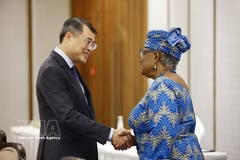
Prime Minister Le Minh Hung (left) receives WTO Director-General Ngozi Okonjo-Iweala in New Delhi, India on September 12 (Photo: VNA)

PM Le Minh Hung calls on WTO to continue support for Vietnam

Vietnam actively and responsibly participates in the WTO’s agenda and supports its coordinating role in promoting inclusive and balanced global trade for peace, cooperation and development, while effectively responding to global challenges, said Prime Minister Le Minh Hung.

Vietnamese Trade Counsellor in India Bui Trung Thuong (Photo: VNA)

Vietnam sees opportunities to deepen engagement with BRICS: Trade Counsellor

Vietnam could deepen cooperation with BRICS through four main areas: expanding trade and market access; attracting and promoting two-way investment; engaging deeper in global supply chains and logistics networks; and advancing cooperation in science-technology, innovation and digital transformation.