Vietnam advances sustainable finance initiatives in ASEAN

The discussions come as the State Bank of Vietnam and Bank Indonesia near the end of their co-chairmanship term, marking another step in their cooperation to advance ASEAN's sustainable finance agenda.

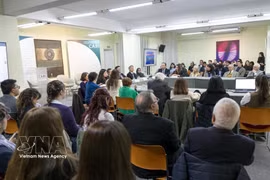
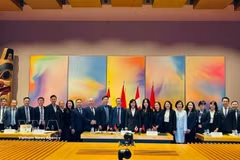
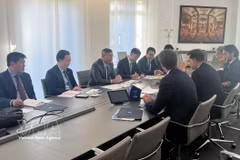
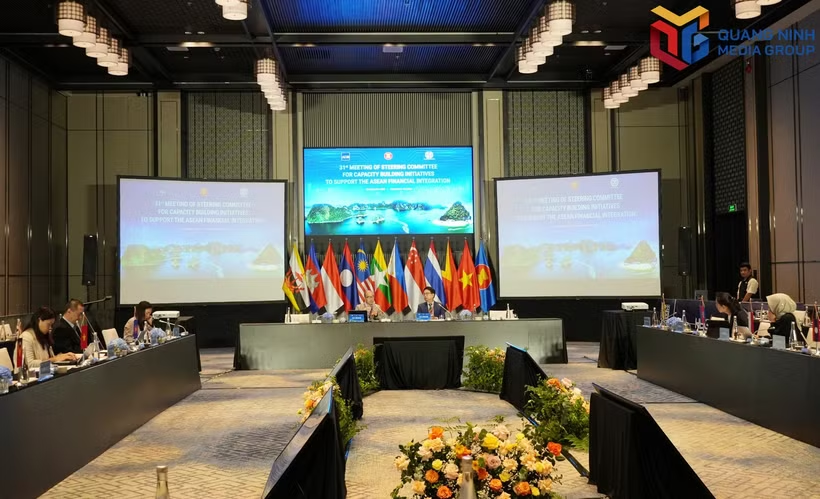
The meeting of the Steering Committee for Capacity Building Initiatives to Support ASEAN Financial Integration (SCCB) in Quang Ninh province (Photo: Quang Ninh Newspaper)

Quang Ninh (VNA) – Vietnam is advancing sustainable finance initiatives and capacity-building efforts to support deeper financial integration within ASEAN at a series of meetings held in the northern city of Quang Ninh on September 14.

The meeting of the Steering Committee for Capacity Building Initiatives to Support ASEAN Financial Integration (SCCB) and the 11th meeting of the Senior Level Committee Task Force on Sustainable Finance (SLC-TF) took place as part of the 32nd meeting of the ASEAN Senior Level Committee (SLC) on Financial Integration, held on September 14–15 by the State Bank of Vietnam and Bank Indonesia.

The SCCB meeting reviewed progress in capacity-building activities supporting ASEAN financial integration, including tailored training, knowledge-sharing and learning programmes for central banks in Cambodia, Laos and Vietnam.

Participants also discussed technical assistance and training programmes in 2026 by the Asian Development Bank (ADB) and the South East Asian Central Banks Research and Training Centre, as well as capacity-building roadmaps for ASEAN working groups in areas including capital account liberalisation, capital market development, payment systems, financial services liberalisation, banking integration and financial inclusion.

Meanwhile, the SLC-TF's 11th meeting reviewed progress on key ASEAN sustainable finance initiatives, including the development of a common framework for climate risk stress testing and the implementation of the ASEAN Taxonomy for Sustainable Finance.

The event also discussed the task force's next steps under Project Revive, which is reforming ASEAN's financial cooperation mechanisms as the SLC-TF prepares to move into a new phase.

The discussions come as the State Bank of Vietnam and Bank Indonesia near the end of their co-chairmanship term, marking another step in their cooperation to advance ASEAN's sustainable finance agenda.

The 32nd SLC meeting, scheduled for September 15, will discuss macroeconomic and financial developments, progress in ASEAN financial integration, issues facing central banks, and the implementation of Project Revive.

Participants will also review the Philippines' economic priorities during its ASEAN Chairmanship in 2026 and discuss Singapore's priorities for the ASEAN Finance Track in 2027./.

VNA

See more

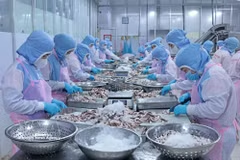
Octopus processing for export at Huy Nam Company in An Giang province. (Photo: VNA)

New opportunities for Vietnam’s seafood exports

The Vietnam-EFTA Free Trade Agreement brings together two groups of highly complementary economies. EFTA members Switzerland, Norway, Iceland and Liechtenstein have strengths in technology, innovation, finance, clean energy and sustainable development, while Vietnam is one of Asia’s most dynamic economies and is emerging as a major regional manufacturing, trade and investment hub.

The saponin content of Lai Chau ginseng can reach as high as 23.85% in its natural state, a remarkably high level compared to many other ginseng species. (Photo: baolaichau.vn)

Lai Chau ginseng development gains momentum

Blessed with rare and distinctive ecological values, the northern mountainous province of Lai Chau is stepping up efforts to conserve and develop its native ginseng, with the medicinal plant expected to play a growing role in the forest-based economy and local livelihoods.

The Vietnamese delegation poses for a group photo at the third meeting of the Vietnam-Canada Joint Economic Committee (Photo: VNA)

Vietnam, Canada broaden economic cooperation beyond trade

Vietnam is currently Canada’s largest trading partner in ASEAN. Building on the Comprehensive and Progressive Agreement for Trans-Pacific Partnership (CPTPP), the two countries are expanding bilateral economic ties into higher value-added areas such as clean energy, critical minerals, advanced technology, manufacturing and value-chain linkages.

The Index of Industrial Production (IIP) rises 14.4% in August and 11.9% in the first eight months compared to a year earlier. (Photo: VNA)

More momentum needed for economic growth in year-end race

To build momentum for the year-end race, one of the top priorities is to accelerate public investment disbursement, ensuring 100% of the allocated plan is disbursed without allowing funds to be concentrated in the final months of the year.

Vietnamese enterprises showcase products at the Vietnam Pavilion during the Foodist Istanbul 2026 fair. (Photo: Vietrade)

Vietnamese goods gain export opportunities in Türkiye, Spain

Vietrade said the programme helped businesses gain practical market information, identify potential products and partners, and better understand requirements on quality, pricing and distribution. Such direct connections are expected to help companies adapt their products and develop more effective export strategies.

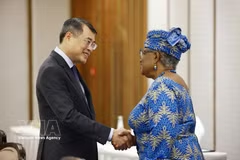
Prime Minister Le Minh Hung (left) receives WTO Director-General Ngozi Okonjo-Iweala in New Delhi, India on September 12 (Photo: VNA)

PM Le Minh Hung calls on WTO to continue support for Vietnam

Vietnam actively and responsibly participates in the WTO’s agenda and supports its coordinating role in promoting inclusive and balanced global trade for peace, cooperation and development, while effectively responding to global challenges, said Prime Minister Le Minh Hung.

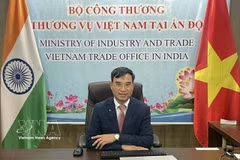
Vietnamese Trade Counsellor in India Bui Trung Thuong (Photo: VNA)

Vietnam sees opportunities to deepen engagement with BRICS: Trade Counsellor

Vietnam could deepen cooperation with BRICS through four main areas: expanding trade and market access; attracting and promoting two-way investment; engaging deeper in global supply chains and logistics networks; and advancing cooperation in science-technology, innovation and digital transformation.