Hanoi (VNA) – Deputy Minister of Foreign Affairs Dang Hoang Giang has called on the Association of Southeast Asian Nations (ASEAN) to strengthen solidarity, resilience and self-reliance, while effectively implementing the strategic framework proposed by Prime Minister Le Minh Hung at the 48th ASEAN Summit to respond to the impacts of the Middle East crisis and future crises.
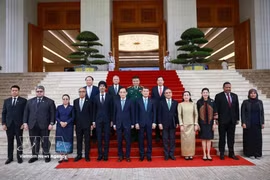
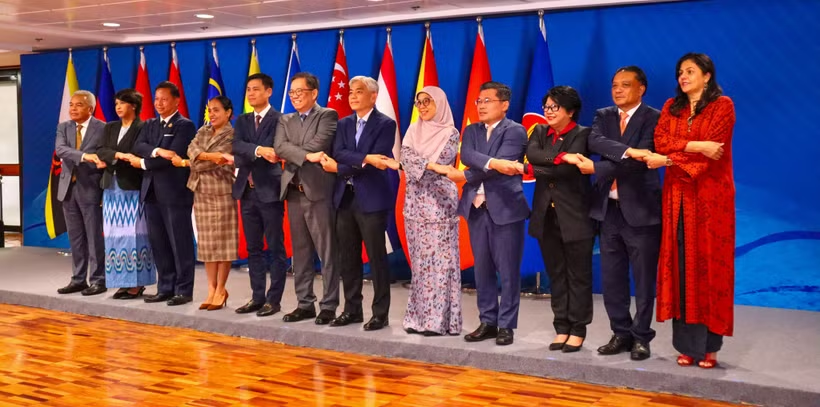
He made the call at senior officials’ meetings under the ASEAN and ASEAN+3 frameworks in the Philippines on September 9.
The meetings reviewed cooperation over the past period and discussed preparations for the 49th ASEAN Summit and the ASEAN Summits with partners scheduled for November 2026.
Giang, head of the ASEAN SOM delegation of Vietnam, praised progress in implementing the outcomes of the 48th ASEAN Summit in May, the 59th ASEAN Foreign Ministers’ Meeting and ASEAN Foreign Ministers’ Meetings with partners in July.
Highlighting the 49th ASEAN Summit and summits with partners in November, Giang affirmed that Vietnam will continue coordinating with the Philippines, other ASEAN countries and partners to ensure their success, contributing to stronger cooperation and resilience and enhancing ASEAN’s role.
He added that Vietnam plans to share policy recommendations raised at the third ASEAN Future Forum, held in Hanoi in June 2026. He also reaffirmed Vietnam’s support for Timor-Leste’s integration into ASEAN and its assumption of responsibilities as a member, including the ASEAN Chairmanship in 2029.
Amid continued regional and global volatility, Giang urged ASEAN to make full use of existing mechanisms to enhance dialogue, build trust and prevent risks and conflicts, particularly by strengthening the Treaty of Amity and Cooperation in Southeast Asia (TAC), the Southeast Asia Nuclear Weapon-Free Zone Treaty (SEANWFZ), and cooperation based on international law.
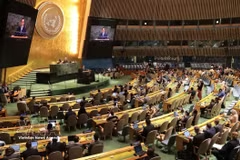
He said that Vietnam plans to host the ASEAN legal forum on public international law in October 2026 on the sidelines of the UN General Assembly in New York.
Regarding the implementation of the ASEAN Five-Point Consensus on Myanmar, Giang praised efforts made by the Philippines and other ASEAN members, calling for more effective engagement to facilitate dialogue, reconciliation and humanitarian assistance through existing mechanisms to restore peace, stability and development in the nation.
On external relations, he called for a strategic approach, with ASEAN identifying potential partners and new priorities to maximise benefits.
Regarding ASEAN+3 cooperation, Giang reaffirmed its role as a key driver of East Asian cooperation. He said ASEAN+3 should promote existing initiatives in trade, investment, finance and people-to-people exchanges while prioritising collective resilience, energy and food security, technological development, and digital and green transitions.
As ASEAN+3 approaches its 30th anniversary in 2027, he proposed a review to assess achievements, identify challenges and build a new vision for cooperation.
On the sidelines of the event, Giang met with the head of the Japanese delegation to discuss coordination within ASEAN frameworks and measures to advance bilateral ties./.