Party inspectors approve Central Military Commission report, call for personnel reform

Politburo Member and Standing Member of the Party Central Committee’s Secretariat Tran Cam Tu called for effective measures to protect officials who dare to think creatively, act, take responsibility and innovate for the common good.

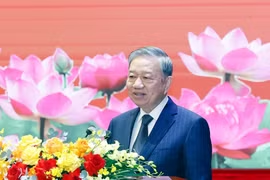
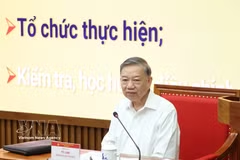
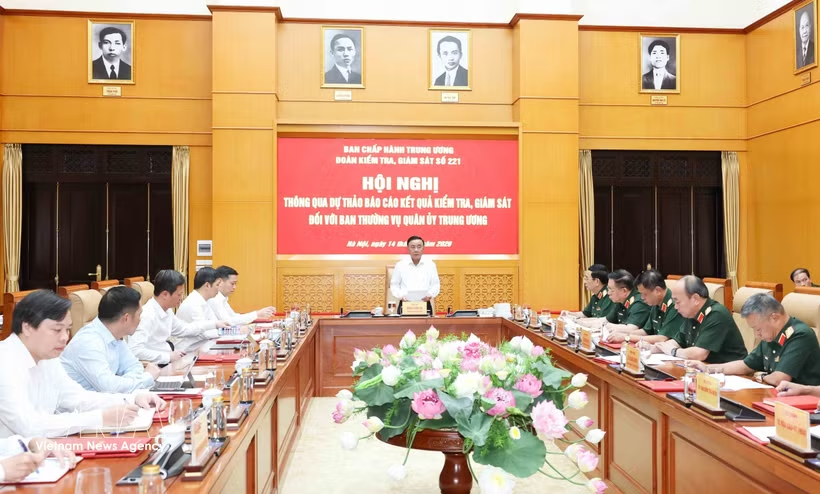
Politburo Member and Standing Member of the CPV Central Committee’s Secretariat Tran Cam Tu speaks at the conference (Photo: VNA)

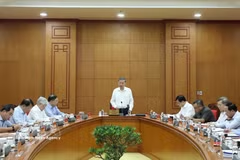
Hanoi (VNA) – Inspection team No. 221 under the Communist Party of Vietnam (CPV) Central Committee’s Politburo and Secretariat held a conference in Hanoi on September 14 to approve a draft report on the third round of inspection of the Standing Committee of the Central Military Commission.

Politburo Member and Standing Member of the CPV Central Committee’s Secretariat Tran Cam Tu, who heads the team, chaired the event.

Nguyen Long Hai, Member of the Party Central Committee, Standing Vice Secretary of the Party Committee of Central Party Agencies and the team's deputy head, presented a summary of the draft report on the inspection and supervision results.

After hearing feedback, Tu said the Central Military Commission, its Standing Committee and Party committees across the army had focused on disseminating and following the Party Central Committee's guidelines, resolutions, conclusions and regulations thoroughly and promptly.

They also issued specific documents to put those policies into practice within their authority, in line with the army's functions and assigned tasks.

Personnel assessment has been reformed, with the effectiveness of advisory and policy-proposal work and tangible results now serving as the primary yardsticks, he noted.

According to Tu, personnel planning, training, professional development, transfer, rotation, appointment and candidate introduction have, in general, been carried out in a democratic, objective and impartial manner, in accordance with established principles, procedures, and regulations. Policies and benefits for personnel have been enforced fully and in a timely manner, while efforts to attract and make effective use of talented individuals have received due attention and have initially produced positive results.

The protection of internal political security has been given adequate attention and carried out on a regular basis. The appraisal, review, verification, and conclusion of personnel’s political qualifications for personnel-related work have been conducted rigorously and in accordance with procedures and regulations.

Inspection, supervision, and power control in personnel work have also received due leadership and direction, with measures adopted seriously and synchronously, he added.

Digital transformation in personnel management has produced early positive results, with personnel databases being digitised and centralised at the Ministry of National Defence's data centre, laying the groundwork for more effective personnel management ahead.

Tu said the commission's Standing Committee promptly directed Party committees and organisations at all levels to draw lessons and fix shortcomings flagged during the inspection, while following through on conclusions from the Politburo and Secretariat's first two rounds of inspection in 2026.

New requirements for military personnel

Tu said the global and regional picture is shifting fast and growing more complex and unpredictable. Military conflicts, trade competition and non-traditional security threats are weighing heavily on national construction and defence, raising the bar for personnel work, especially building a stronger corps of leaders and commanders at every level.

The Standing Committee was told to keep disseminating the Party Central Committee's guidelines, resolutions, conclusions and regulations, and draw up schemes and plans to carry them out.

It must also direct its advisory and support agencies to regularly review and update a full set of personnel rules and regulations, ensuring they are consistent and clearly assign authority and responsibility, he said.

At the same time, collectives and individuals found to have violated rules or fallen short must be dealt with strictly, thereby promptly screening out and replacing personnel who no longer meet standards or fail to fulfill their duties.

Personnel training in remote and disadvantaged areas should also secure special attention, he added./.

VNA
See more

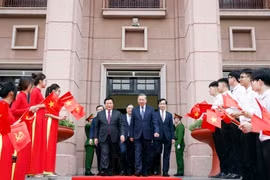
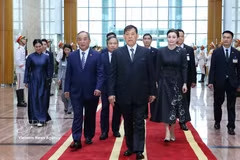
King of Thailand Maha Vajiralongkorn Phra Vajiraklaochaoyuhua and Queen Suthida Bajrasudhabimalalakshana arrive in Hanoi on September 14. (Photo: VNA)

Thai King, Queen arrive in Hanoi for State visit to Vietnam

The State visit to Vietnam by King of Thailand Maha Vajiralongkorn Phra Vajiraklaochaoyuhua and Queen Suthida Bajrasudhabimalalakshana holds not only political significance but also serves as a continuation of the friendship and close ties between the Thai Royal Family, Government and people and the Vietnamese Government and people.

☕ Afternoon briefing on September 14

☕ Afternoon briefing on September 14

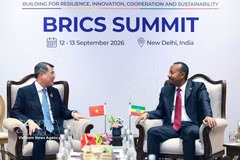
PM Le Minh Hung's meetings with foreign leaders on the sidelines of the 18th BRICS Summit, Vietnam and the US signing a five-year MoU on health cooperation, and the 32nd meeting of the ASEAN Senior Level Committee on Financial Integration are among news highlights on September 14.

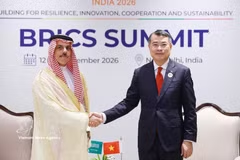
Prime Minister Le Minh Hung (R) receives Saudi Arabian Minister Foreign Affairs Prince Faisal bin Farhan Al Saud on September 13 on the sidelines of the 18th BRICS Summit in New Delhi, India. (Photo: VNA)

Vietnam seeks effective, substantive ties with Saudi Arabia

Affirming that Saudi Arabia is one of Vietnam’s most important partners in the Middle East, PM Hung expressed his pleasure at the positive development of bilateral relations in recent years, and voiced his wish to work with Saudi Arabia to further develop the bilateral relationship in a more effective and substantive manner, for the benefit of the two countries' people.

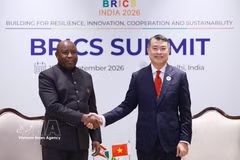
Prime Minister Le Minh Hưng and Burundi President Évariste Ndayishimiye at their meeting on September 13 (Photo: VNA)

Vietnam attaches importance to promoting friendly relations, cooperation with Burundi: PM

Thanking President Ndayishimiye and the Burundi Government for supporting the effective operation of Lumitel, the telecommunications joint venture of Vietnam’s Viettel Group in Burundi, Prime Minister Le Minh Hung proposed that Burundi continue facilitating Lumitel’s participation in e-government and digital transformation projects, while enabling it to expand investment and business activities, making it a symbol of bilateral cooperation.

☀️ Morning digest on September 14

☀️ Morning digest on September 14

PM Le Minh Hung's participation in the 18th BRICS Summit, his bilateral activities on the sidelines of the summit, and NA President Tran Thanh Man's working visit to Submarine Brigade 189 are among news highlights last weekend.

A senior Indian official sees off PM Le Minh Hung (left) as the Vietnamese leader concludes the working trip to attend the 18th BRICS Summit and conduct bilateral activities in India. (Photo: VNA)

PM Le Minh Hung wraps up working trip to India

​The working trip reaffirmed Vietnam's foreign policy of proactive and active integration into the world, and multilateralisation and diversification of external relations. It also helped to strengthen ties with partners, broaden avenues for cooperation, and enhance Vietnam's role and standing at regional and global multilateral mechanisms.

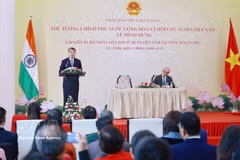
Prime Minister Le Minh Hung speaks at the meeting with staff of the Vietnamese Embassy and representative agencies as well as the Vietnamese community in New Delhi on September 13. (Photo: VNA)

Prime Minister meets with staff of Vietnamese representative agencies, community in India

At a meeting with staff of the Vietnamese Embassy and representative agencies in New Delhi on September 13, PM Hung said that officials and employees working overseas must firmly grasp the Party’s new mindset and policies on foreign affairs as well as overseas Vietnamese affairs, including the Politburo's Resolution No. 23-NQ/TW on overseas Vietnamese.

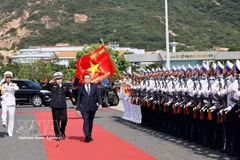
NA President Tran Thanh Man inspects the guard of honor of Submarine Brigade 189 at Cam Ranh Military Base, Naval Region 4. (Photo: VNA)

National Assembly President Tran Thanh Man visits and works with Vietnam People's Navy

NA President Man urged naval officers and personnel to thoroughly grasp and fully understand the Party’s guidelines and the State’s policies and laws regarding military and national defence affairs, with a particular focus on the "Strategy for Protecting the Fatherland in the New Situation" and the "Strategy for Sustainable Development of Vietnam’s Marine Economy to 2030, with a Vision to 2045."

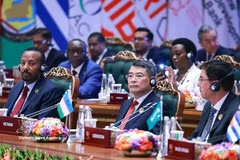
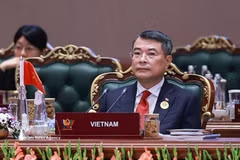
Prime Minister Le Minh Hung attends the 18th BRICS Summit. (Photo: VNA)

Vietnamese PM Le Minh Hung attends 18th BRICS Summit in New Delhi

Vietnam's own development model centres on people, institutional reform, modern governance and science and technology, while ensuring harmony among economic growth, social equity and environmental protection, PM Hung said, affirming that Vietnam stands ready to work with BRICS in a spirit of responsibility, goodwill and substantive cooperation to create a peaceful, prosperous, sustainable and inclusive future for all countries and people.

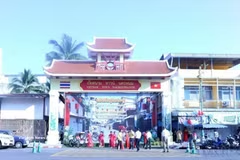
The gate of Vietnam Town in Thailand's Nakhon Phanom province (Photo: VNA)

Thai King and Queen’s Vietnam visit to deepen bilateral friendship: Official

The visit will provide strong momentum to translate leaders’ commitments into concrete outcomes. Vietnam and Thailand have agreed to step up cooperation and economic connectivity in a mutually complementary manner, with new breakthroughs and qualitative advances, striving to raise two-way trade to 25 billion USD from the current 22 billion USD in a balanced and sustainable direction.

Professor Pierre Journoud (Photo published by VNA)

Vietnam - France ties enter “acceleration of history” period: French historian

The frequency of high-level visits does not tell the whole story, but at the very least it reflects clear trust at the highest leadership level, which can then spread to government agencies and other stakeholders in both countries. It also demonstrates unprecedented efforts to translate trust into concrete results, despite practical obstacles that remain, primarily in the cultural, economic and financial spheres.