Thai King, Queen's upcoming Vietnam visit to strengthen Comprehensive Strategic Partnership

The two countries upgraded their relations to a Strategic Partnership in June 2013, becoming the first two ASEAN countries to establish such a partnership with each other. They then upgraded the relationship to an Enhanced Strategic Partnership in 2015 and a Comprehensive Strategic Partnership in May 2025.

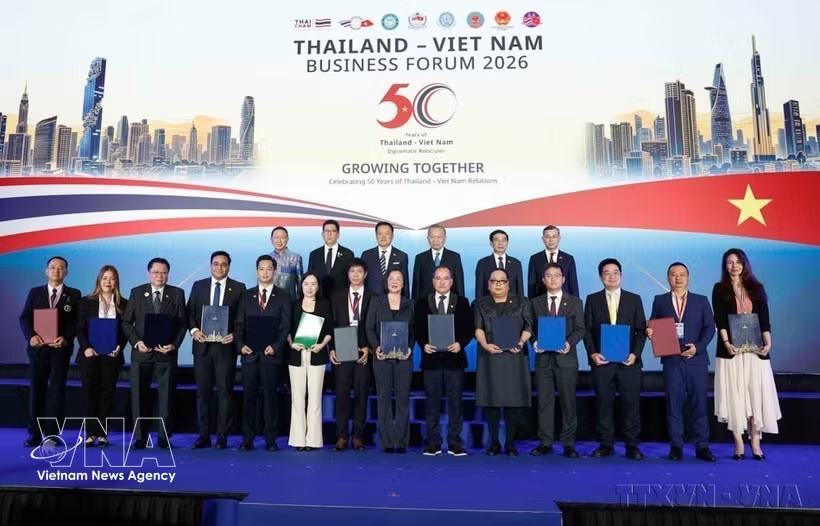
Party General Secretary and President To Lam, and Thai Prime Minister Anutin Charnvirakul witness the presentation of cooperation agreements between businesses of the two countries at the Thailand - Vietnam Economic Forum in Bangkok on May 28. (Photo: VNA)

Hanoi (VNA) - The state visit to Vietnam from September 14 - 16 by Thai King Maha Vajiralongkorn Phra Vajiraklaochaoyuhua and Queen Suthida at the invitation of General Secretary of the Communist Party of Vietnam (CPV) Central Committee and President To Lam and his spouse is expected to further strengthen the foundation of Vietnam-Thailand friendship and provide fresh momentum for the two countries' leaders and people to continue nurturing bilateral relations.

The visit comes as the Vietnam-Thailand Comprehensive Strategic Partnership continues to develop positively, with 2026 marking the 50th anniversary of diplomatic ties between the two countries (August 6, 1976 - August 6, 2026).

Vietnam and Thailand are two Southeast Asian countries with a long-standing friendship. Thailand holds an important place in the journey of President Ho Chi Minh, who travelled abroad in search of a path to national liberation. He arrived in Thailand in July 1928 and began spreading patriotism among the Vietnamese community there.

Since the two countries officially established diplomatic relations on August 6, 1976, bilateral cooperation has developed rapidly in both breadth and depth. Following Vietnam's accession to the Association of Southeast Asian Nations (ASEAN) in 1995, Vietnam-Thailand relations have continued to grow, particularly since the two countries issued the Joint Statement on the Framework for Vietnam-Thailand Cooperation in the First Decade of the 21st Century in February 2004.

The two countries upgraded their relations to a Strategic Partnership in June 2013, becoming the first two ASEAN countries to establish such a partnership with each other. They then upgraded the relationship to an Enhanced Strategic Partnership in 2015 and a Comprehensive Strategic Partnership in May 2025.

The latest upgrade has opened a new chapter in bilateral cooperation, built around three substantive pillars: partnership for sustainable peace, partnership for sustainable development, and partnership for a sustainable future.

Political cooperation has also been strengthened through the exchange of delegations and high-level contacts.

High-level contacts have played an important role in strengthening mutual understanding and political trust, creating a solid foundation for further development of friendship and cooperation. During these visits, leaders of the two sides discussed major priorities and directions for making bilateral cooperation more substantive and effective.

Vietnam and Thailand have also maintained cooperation and dialogue mechanisms across diplomacy, defence, security and economic fields. A distinctive feature of the bilateral ties is the Joint Cabinet Meeting chaired by the Prime Ministers of the two countries, reflecting their close coordination in promoting comprehensive cooperation.

Since the relationship was upgraded to the Comprehensive Strategic Partnership, Vietnam and Thailand have made strong progress in the bilateral ties. Two-way trade has grown impressively, with Thailand remaining Vietnam's largest trading partner within ASEAN and the eighth-largest among countries and territories investing in Vietnam.

Two-way trade reached 22.1 billion USD in 2025, up 10% from 2024. In the first six months of 2026, it reached 13.3 billion USD, up 27% year-on-year. The two sides aim to raise bilateral trade to 25 billion USD at an early date in a balanced and sustainable manner.

Thailand currently has 804 valid investment projects in Vietnam with total registered capital of more than 15.4 billion USD. It ranks eighth among 153 countries and territories investing in Vietnam and second among ASEAN investors in the country.
vnanet_potal-giao-luu-van-nghe-nhan-ky-niem-50-nam-thiet-lap-quan-he-ngoai-giao-viet-nam-thai-lan-8969122.jpg
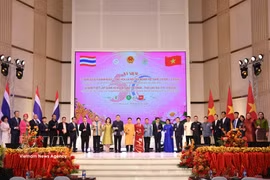
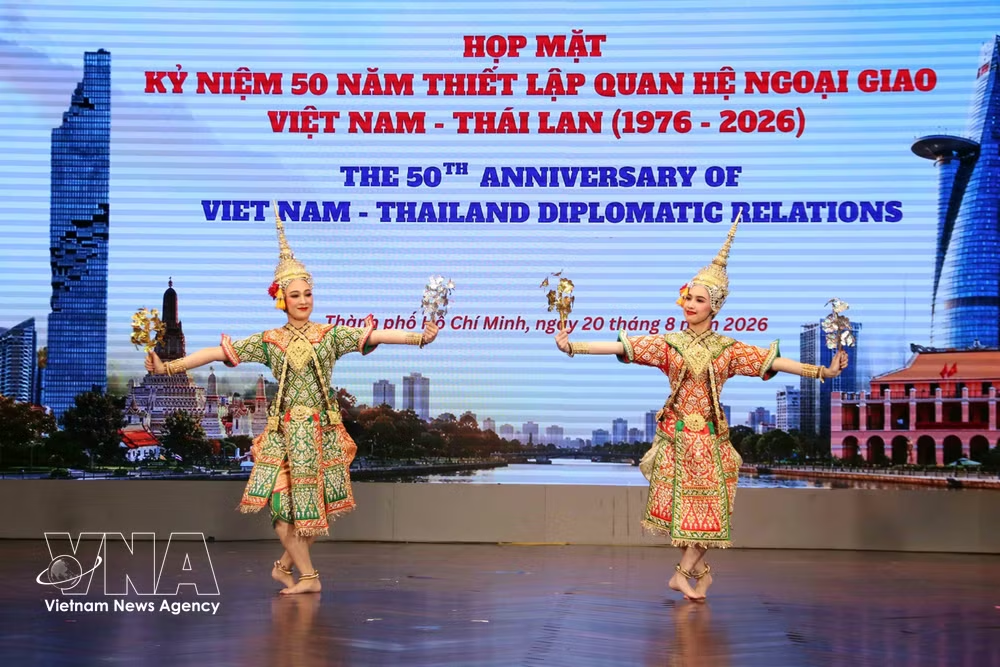
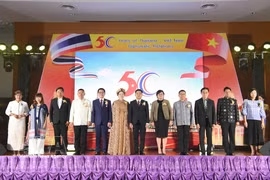
A performance at the ceremony marking 50th anniversary of Vietnam-Thailand diplomatic relations. (Photo: VNA)

In May 2026, the two sides signed an Action Programme to implement the Vietnam-Thailand Comprehensive Strategic Partnership for 2026-2031.

They are now working to develop specific measures to implement the “Three Connectivity” Strategy under the Action Programme, focusing on supply-chain connectivity; connectivity among businesses and localities of the two countries; and connectivity between sustainable growth strategies.

Cooperation is also expanding beyond traditional industries into new areas, including semiconductor technology and digital economy. Energy, culture, tourism and education cooperation continues to be strengthened.

The two countries have also closely coordinated their positions at regional and international forums, particularly ASEAN, the United Nations and the Asia-Pacific Economic Cooperation (APEC) forum.

Together with other ASEAN members, Vietnam and Thailand continue to strengthen intra-bloc solidarity, promote ASEAN centrality and support efforts to realise the ASEAN Community Vision 2045.

Deepening Comprehensive Strategic Partnership

Building on five decades of fruitful friendship and cooperation, the state visit to Vietnam by King Maha Vajiralongkorn Phra Vajiraklaochaoyuhua and Queen Suthida from September 14-16 is a historic event and an important political milestone. The visit takes place as the two countries are celebrating the 50th anniversary of diplomatic relations. It is also King Maha Vajiralongkorn's first state visit to Vietnam since his accession to the throne. Before becoming King, Maha Vajiralongkorn visited Vietnam in 1992 and 1997 as Crown Prince of Thailand.

Vietnamese Ambassador to Thailand Pham Viet Hung said the visit is important not only politically at this particular time but also as a continuation of the friendship and close ties between the Thai Royal Family, Government and people, and the Vietnamese Government and people.

The frequency and level of these exchanges are a vivid demonstration of the importance both sides attach to the relationship, as well as their mutual understanding, political trust and strong determination to further consolidate and develop the Vietnam-Thailand Comprehensive Strategic Partnership in the years ahead.

Hung also highlighted Thailand's extensive experience in cultural preservation. Projects implemented by the Thai Royal Family in Vietnam in education, community development and social welfare are vivid examples of a people-centred approach to cooperation.

He therefore expressed hope that the upcoming visit will create more opportunities for the two sides to share experience and expand effective cooperation models, bringing the benefits of the Comprehensive Strategic Partnership closer to their people.

With the positive achievements recorded during five decades of friendship and cooperation, the state visit by King Maha Vajiralongkorn Phra Vajiraklaochaoyuhua and Queen Suthida is expected to further strengthen the friendship between Vietnam and Thailand and make bilateral cooperation more effective and substantive. It will contribute to serving the common interests of the two nations' people and promoting peace, cooperation and development in the region and the world./.
VNA

See more

Professor Pierre Journoud (Photo published by VNA)

Vietnam - France ties enter “acceleration of history” period: French historian

The frequency of high-level visits does not tell the whole story, but at the very least it reflects clear trust at the highest leadership level, which can then spread to government agencies and other stakeholders in both countries. It also demonstrates unprecedented efforts to translate trust into concrete results, despite practical obstacles that remain, primarily in the cultural, economic and financial spheres.

Prime Minister Le Minh Hung (L) receives President of the Asian Infrastructure Investment Bank (AIIB) Zou Jiayi on the sidelines of the 18th BRICS Summit in New Delhi, India, on September 12. (Photo: VNA)

AIIB President pledges continued support for Vietnam in infrastructure development

PM Hung noted that Vietnam is transforming its development model toward greater reliance on science and technology, innovation and digital transformation, affirming that Vietnam wishes to strengthen its long-term partnership with the AIIB, particularly in strategic infrastructure development, green transition and climate change adaptation.

Prime Minister Le Minh Hung (third, left) meets with Bruno Rodriguez Parrilla, Politburo member and Minister of Foreign Affairs of Cuba, in New Delhi on September 12 (Photo: VNA)

Prime Minister meets with Cuban FM

Vietnam always attaches importance to its special friendship with Cuba, closely follows the situation in the Caribbean island nation, shares difficulties and challenges with Cuba, and stands ready to provide support within its capacity, said Prime Minister Le Minh Hung.

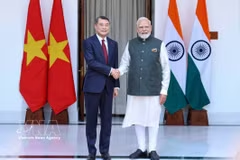
Prime Minister Le Minh Hung (L) shakes hands with his Indian counterpart Narendra Modi before their talks in New Delhi on September 12. (Photo: VNA)

Prime Minister holds talks with Indian counterpart

Vietnam and India are among the world's fastest-growing economies and have highly complementary strengths, with substantial untapped potential for cooperation. They expressed determination to step up measures to achieve the target of 25 billion USD in bilateral trade at an early date and facilitate market access for products from both countries, particularly pharmaceuticals, agricultural products, fisheries and livestock products.

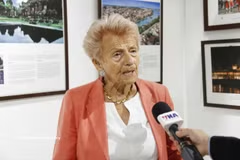
Hélène Luc, French Honorary Senator and Honorary President of the France-Vietnam Friendship Association talks to Vietnam News Agency correspondents in Paris (Photo: VNA)

Vietnam-France ties poised for deeper, more substantive cooperation

Vietnam-France relations are entering a new phase with opportunities to translate high-level orientations and agreements into concrete cooperation programmes while expanding bilateral ties in economy, science and technology, education, culture and people-to-people exchanges.

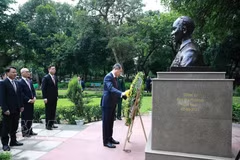
Prime Minister Le Minh Hung and a high-ranking delegation of Vietnam lay a wreath at the statue of President Ho Chi Minh in G20 Park in the Indian capital of New Delhi on September 12 (Photo: VNA)

Prime Minister pays tribute to President Ho Chi Minh in New Delhi

The statue of President Ho Chi Minh stands prominently in the Diplomatic Enclave of Chanakyapuri, New Delhi. It holds special political and diplomatic significance, reflecting the close ties between the leaders and people of the two countries, as well as India’s special sentiments toward President Ho Chi Minh in particular and Vietnam in general.

Prime Minister Le Minh Hung leaves Hanoi on September 12 morning for the 18th BRICS Summit and bilateral activities in India. Photo: VNA

Prime Minister Le Minh Hung sets off for 18th BRICS Summit in India

Vietnam's participation in the 18th BRICS Summit in India further reflects its consistent foreign policy of independence, self-reliance, self-strengthening, peace, friendship, cooperation and development; multilateralisation and diversification of external relations; and proactive, active, comprehensive, extensive and effective international integration.

Prof. Reena Marwah in the interview with Vietnam News Agency reporters in New Delhi. (Photo: VNA)

Vietnam can bring much to BRICS as partner country: Indian expert

Vietnam has demonstrated robust growth capacity, extensive integration and a foreign policy of independence. As a result, Vietnam can contribute to BRICS on multiple issues as a partner country, while BRICS members can draw lessons from Vietnam’s experience in development, integration and supply chain connectivity.

General Secretary of the Communist Party of Vietnam Central Committee and President To Lam, his wife, and the high-ranking Vietnamese delegation are seen off by French officials at Orly Airport in Paris. Photo: VNA

Vietnam’s top leader concludes official visit to France

Party General Secretary and President To Lam’s official visit reaffirmed Vietnam’s particular importance attached to its comprehensive strategic partnership with France. It also provided an opportunity to connect France’s strengths in science and technology, innovation and strategic technology sectors with Vietnam’s emerging development needs.

General Secretary of the Communist Party of Vietnam Central Committee and President To Lam (R) and President of the French Senate Gérard Larcher. (Photo: VNA)

Top Vietnamese leader meets with President of French Senate in Paris

The Vietnamese leader expected that the French National Assembly would soon complete the ratification of the European Union - Vietnam Investment Protection Agreement (EVIPA); and asked France to continue leveraging its role in the European Union to support stronger Vietnam-EU ties and tackle the illegal, unreported and unregulated (IUU) fishing, and the list of non-cooperative jurisdictions for tax purposes.

Deputy Chief of the Communist Party of Vietnam (CPV) Central Committee's Office Vo Thanh Hung (fifth, right) receives archives on President Ho Chi Minh handed over by the French National Overseas Archives on September 10. (Photo: VNA)

France hands over archival materials for exhibition at Communist Party of Vietnam Museum

The materials include a reproduction of the front page of the August 24, 1945 issue of Cuu Quoc (National Salvation) Newspaper, its first publicly printed edition after previously being secretly circulated in handwritten form, featuring the Vietnamese national flag; and documents and reports on Nguyen Ai Quoc's activities related to the establishment and orientation of the Communist Party of Annam.

General Secretary of the Communist Party of Vietnam Central Committee and President To Lam receives Vietnamese technology experts in France. (Photo: VNA)

Top leader receives Vietnamese technology experts in France

General Secretary and President Lam stressed that while the experts work in different fields, they all share a fundamental common view that Vietnam can achieve rapid, sustainable growth and greater self-reliance only by building robust scientific and technological capacity and fully pooling the brainpower of Vietnamese talents at home and abroad.