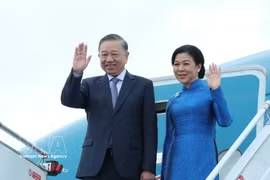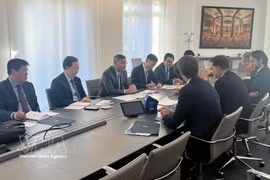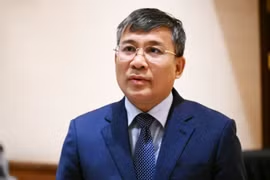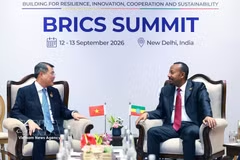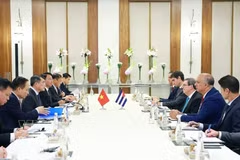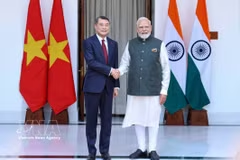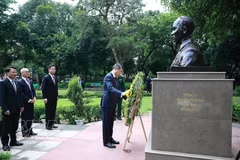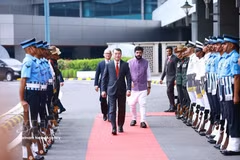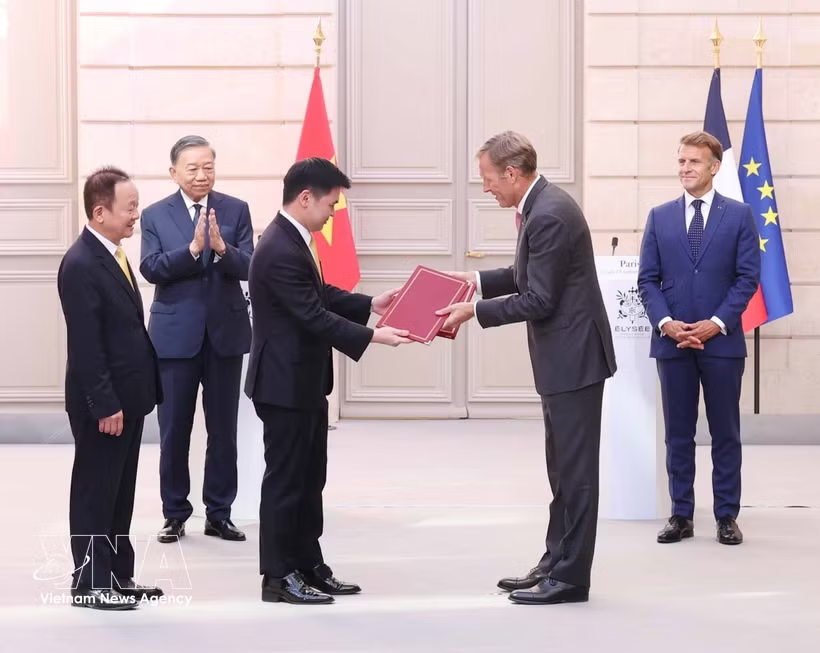
Hanoi (VNA) - In the first days of September, Vietnam's high-level diplomatic activities took place intensively on several fronts. General Secretary of the Communist Party of Vietnam (CPV) Central Committee and President To Lam paid a state visit to Russia, made an official visit to France and attended the International Space Summit in Paris, while President of the National Assembly Tran Thanh Man paid official visits to the Republic of Korea (RoK) and Mongolia.
The four destinations, with different partnership frameworks and areas of cooperation, highlight important features of Vietnam's foreign policy in the new period: expanding relations goes hand in hand with expanding development space, turning political trust into substantive cooperation and mobilising external resources to serve national development.
This also represents a concrete implementation of the Politburo's Resolution No. 59-NQ/TW on international integration in the new situation and Resolution No. 06-NQ/TW on implementing the foreign policy set out by the 14th National Party Congress.
While Resolution No. 59 places international integration at the level of a strategic driving force and calls for proactive, active, comprehensive, extensive and effective integration, Resolution No. 06 stresses the pioneering role of diplomacy and the need to make foreign affairs a driving force for opening up new space and opportunities for development.
From political trust to concrete cooperation programmes
A prominent common feature of the recent visits is that high-level diplomacy has gone beyond consolidating political relations and focused more strongly on areas that directly serve development.
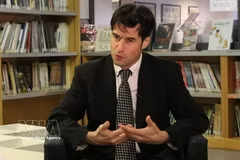
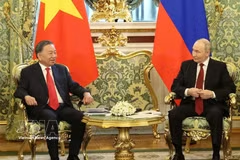
In Russia, the state visit by General Secretary and President Lam was described by Deputy Minister of Foreign Affairs Le Thi Thu Hang as particularly important. It provided an opportunity for leaders of the two countries to hold in-depth discussions on strategic issues, establish a long-term vision and create a new political milestone and momentum to elevate Vietnam-Russia relations, while linking bilateral cooperation with each country's development goals in the new period.
Notably, this direction has been translated into cooperation in areas with increasingly high scientific and technological content and development value. From scientific and technical cooperation, human resources training and technology transfer to high-tech projects, the two countries are seeking to deepen their Comprehensive Strategic Partnership.
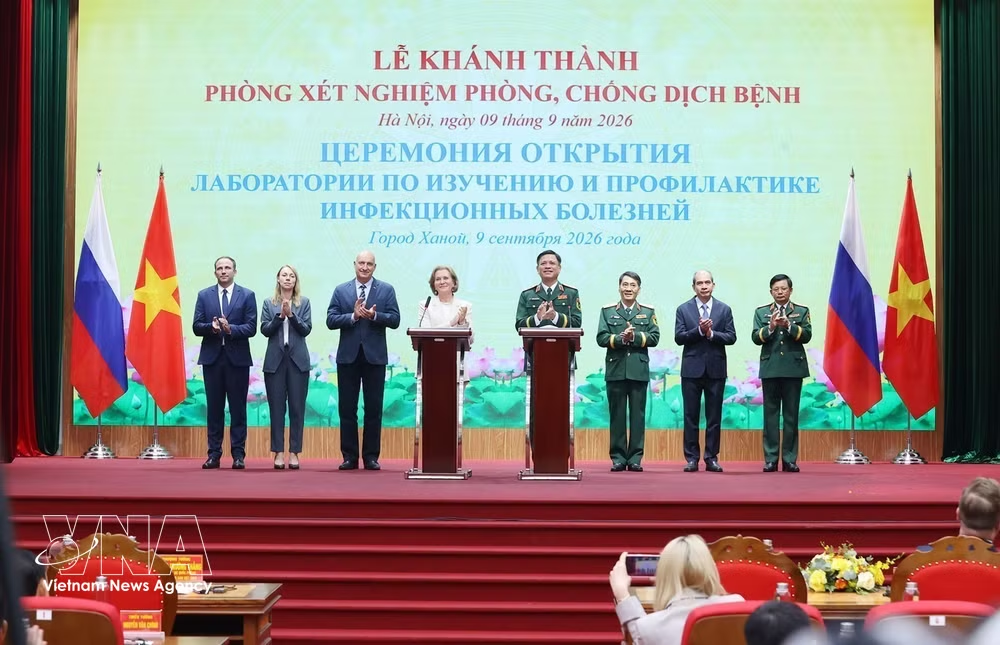
A concrete example is the laboratory for research, surveillance and prevention of infectious diseases under the Vietnam-Russia Tropical Centre, which was recently inaugurated in Hanoi. Russia provided equipment, professional support and staff training for the facility, creating conditions for the two countries to work together in research, disease surveillance, forecasting and response.
General Secretary and President Lam described the facility as a vivid example of the effectiveness of Vietnam-Russia scientific and technological cooperation in preventive medicine and public health.
These tangible results point to an important shift. Building on political ties and traditional friendship, the partners are jointly seeking new areas of cooperation that respond to Vietnam's practical development needs.
Russian President Vladimir Putin expressed his confidence that the Hanoi laboratory will become an important part of the Vietnam-Russia Tropical Centre, contribute effectively to the centre's joint research activities, strengthen Vietnam's scientific capacity and enhance cooperation and capabilities in disease prevention and control.
Opening more doors to technology, energy and knowledge
If the Russia visit demonstrated the depth of the Comprehensive Strategic Partnership, the France visit opened new space for cooperation in strategic technologies and global governance.
Vietnam and France upgraded their relationship to a Comprehensive Strategic Partnership in October 2024. Former Vietnamese Ambassador to France Dinh Toan Thang said the upgrade reflected the strong political will of the two countries' senior leaders and France's recognition of Vietnam's growing position, while also demonstrating the strong and consistent foreign policy of the Vietnamese Party and State. With the new strategic framework and vision in place, the task now is to “lay the foundations for the new house that has been designed”.
Vietnam-France cooperation has already created a substantial foundation. France is currently Vietnam's fourth-largest trading partner in the European Union. Two-way trade reached 6.3 billion USD in 2025, up 16.4% from 2024. In the first six months of 2026, trade stood at 3.66 billion USD, up 26.4% year-on-year. France currently has 746 valid investment projects in Vietnam with total registered capital of about 4 billion USD, ranking 16th among 153 countries and territories investing in the country.
More importantly, the quality of the cooperation space is also expanding. In the energy sector, France continues to implement its commitments under the Just Energy Transition Partnership (JETP), with the French Development Agency (AFD) having disbursed more than two-thirds of its committed funding. The two sides have also discussed prospects for peaceful nuclear energy cooperation and the effective development of Vietnam's strategic minerals.
In transport, France wants to share railway technology, management expertise and high-speed rail systems. In healthcare, a large-scale vaccine manufacturing project between Vietnam Vaccine JSC (VNVC) and Sanofi is opening a new avenue for Vietnam to become more self-reliant in high-quality vaccine supplies.
In security and defence, France has continued to propose working with Vietnam to develop its defence industry and technological capabilities, helping the Southeast Asian country safeguard and strengthen national sovereignty.
Education, science and innovation have also been given an important place. France currently hosts around 6,000-7,000 Vietnamese students. The two countries maintain three centres of excellence and plan to launch the France-Vietnam Hubert Curien Partnership Programme, creating another long-term channel for exchanges among researchers.
In particular, General Secretary and President Lam's participation in the International Space Summit in Paris brought Vietnam-France cooperation into a new sphere: working together to help shape issues of global importance.
According to Deputy Minister of Foreign Affairs Le Thi Thu Hang, space technology is directly linked to the digital economy, telecommunications, Earth observation, resource management, disaster forecasting and security. Vietnam's participation in the summit provided an opportunity for the country to contribute its voice to the development of global rules, standards and governance mechanisms for outer space in a peaceful, safe and equitable direction.
French Ambassador to Vietnam Olivier Brochet also stressed that France was particularly interested in hearing the views of Vietnam and countries of the Global South on equitable access to outer space.
This is a clear expression of Vietnam's proactive approach to international integration: moving from participating in cooperation to helping shape the rules of the game.
Expanding partnerships and development space
Vietnam's diplomatic outreach in the first days of September was not limited to Europe but also extended strongly to Northeast Asia.
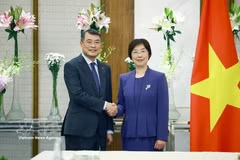
NA President Man's official visit to the RoK took place as the two countries have upgraded their relations to a comprehensive strategic partnership.
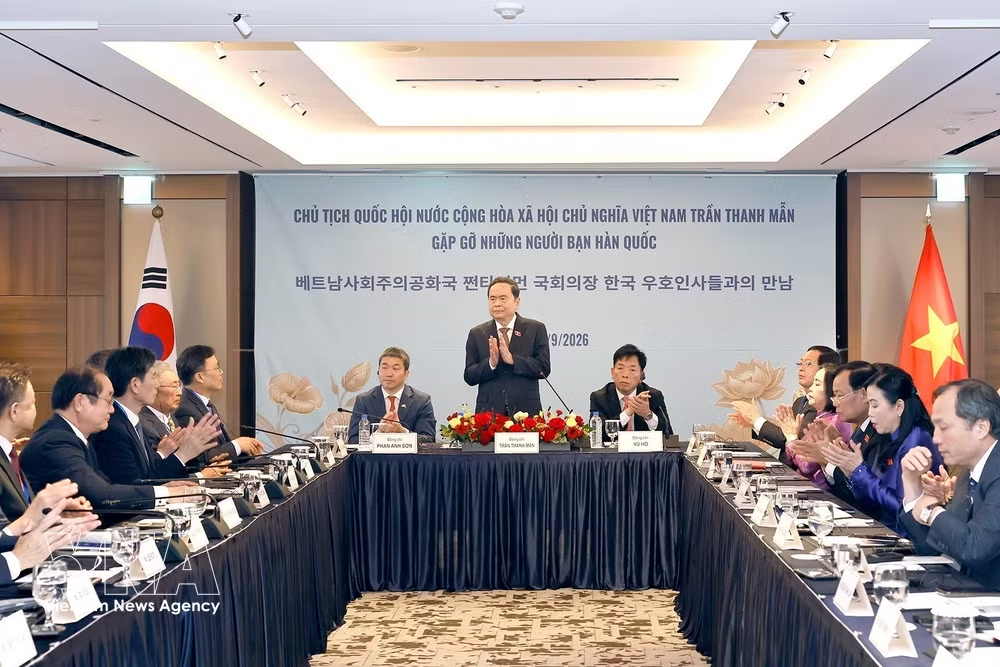
Speaker of the Korean NA Cho Jeong-sik said the visit was particularly important for strengthening political trust, promoting the implementation of high-level agreements and deepening bilateral relations.
One notable goal agreed by the two sides is to raise bilateral trade to 100 billion USD in 2026 and 150 billion USD by 2030. They also seek to make science and technology a driving force for the bilateral relations and expand cooperation in human resources training, culture, tourism and people-to-people exchanges.
These figures show that economic diplomacy is being placed within a longer-term vision. The goal is not simply to increase trade, but to expand cooperation in science and technology, human resources and other areas capable of generating greater added value.
In Mongolia, following the establishment of a comprehensive partnership between the two countries in 2024, cooperation is also expanding in a more substantive direction.
The two sides agreed to work towards raising bilateral trade to 200 million USD at an early date, while promoting cooperation in science and technology, tourism, digital transformation, renewable energy and green energy. The selected areas are closely linked to the new growth drivers that Vietnam is prioritising.
Mongolian Prime Minister Nyam-Osor Uchral spoke highly of Vietnam's identification of science and technology, innovation, digital transformation and green growth as new drivers of growth, while affirming that Vietnam always holds a priority position in Mongolia's foreign policy.
Looking at the four destinations together, a consistent logic can be seen in Vietnam's current high-level diplomacy: consolidating political trust to pave the way for economic cooperation; expanding economic cooperation to create room for science and technology; strengthening scientific and technological cooperation to enhance domestic capabilities; and proactively participating in multilateral mechanisms to help shape a favourable international environment for development.
Vietnamese diplomacy is moving strongly from “expanding relations” to “making effective use of those relations”, from establishing frameworks to turning those frameworks into resources for development. This is a concrete expression of the spirit of Resolutions No. 59 and No. 06.
Former Vietnamese Ambassador to France Dinh Toan Thang said the elevation of Vietnam-France relations reflected the strong political will of the two countries' leaders. However, once a new framework has been established, the important task is to translate it into specific programmes, projects and areas of cooperation.
French Ambassador to Vietnam Olivier Brochet, meanwhile, said that over the past three years, the most important achievement was not only the expansion of cooperation across many fields but also the strengthening of trust between the two countries and their leaders. This trust provides a foundation for the two sides to continue working together for their respective interests while contributing to regional and global peace and stability.
The Vietnamese leaders' visits have opened new spaces for cooperation. The next task is to turn these opportunities into concrete projects, products, technologies, human resources and values that benefit the country and its people./.