Vietnam lifts rooftop solar resale cap to 50%, boosting green transition

The decree raises the share of surplus electricity that can be sold from 20% to 50% and further decentralises administrative procedures, which are expected to give the sector new momentum.

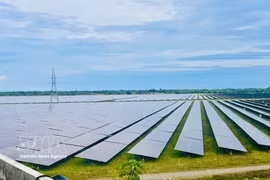
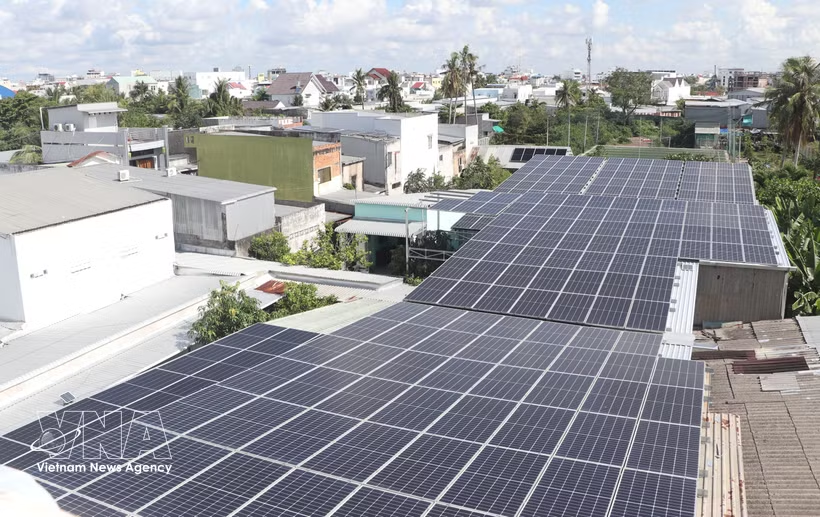
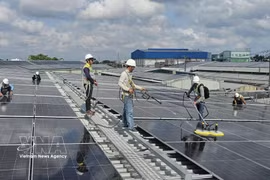
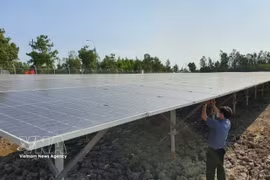
A solar rooftop in Ca Mau province (Photo: VNA)

Hanoi (VNA) - The Government’s Decree 243/2026/ND-CP, dated June 26, 2026, spells out new rules under the Law on Electricity for developing renewable and new energy.

The decree raises the share of surplus electricity that can be sold from 20% to 50% and further decentralises administrative procedures, which are expected to give the sector new momentum.

Growth potential, growing pains

Ho Chi Minh City has allowed rooftop solar systems for self-generation and self-consumption since around 2020, with rules adjusted repeatedly since then to fit real-world conditions. Those changes have built a legal framework letting residents and companies invest in and use their own solar power.

Nguyen Thi Kim Ngoc, Deputy Director of the municipal Department of Industry and Trade, said Ho Chi Minh City still has ample potential to develop rooftop solar power for self-production and self-consumption. The city now hosts more than 22,000 rooftop solar power systems, including around 6,300 for self-production and self-consumption.

According to a report from the Ho Chi Minh City Power Corporation (EVNHCMC), there were 6,241 self-generation, self-consumption rooftop systems as of September 5, with a combined peak capacity of 472 megawatts. The number of systems reported by residents surged by nearly 3,000 in just three months.

Rooftop systems fall under different decrees depending on their type, and using the wrong one risks misapplied procedures, said Nguyen Quang Long from the Electricity Department at the Ministry of Industry and Trade. For systems in industrial parks and clusters, he said, it's also critical to correctly identify who's responsible for managing the grid.

A bigger payoff

Bui Trung Kien, Deputy General Director of the EVNHCMC, said raising the resale cap marks a major change in terms of investment efficiency. Being able to sell more unused, on-site power gives investors a stronger basis to calculate a system's returns — a critical factor since upfront costs, payback periods and how fully installed capacity gets used all shape whether residents and businesses decide to install one.

The decree also lets power companies that own grid infrastructure buy surplus electricity, adding them to the list of eligible buyers.

He said broader decentralisation means commune-level authorities will take on a bigger role in receiving applications, a shift expected to make the process more convenient for residents and businesses.

Still, further policy work is needed for rooftop solar to reach its full potential. A dedicated support mechanism for households building self-generation systems has yet to materialise, and system capacity must still be matched to actual electricity demand and grid conditions. Clearer rules are also needed for pairing energy storage with self-generation, self-consumption power sources./.
VNA

See more

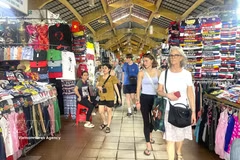
Ben Thanh Market in Ho Chi Minh City attracts a large numbers of domestic and international visitor.( Photo: VNA)

Vietnam targets 50 million international visitors by 2030

The Ministry of Culture, Sports and Tourism has outlined three scenarios for 2027–2030. Under the high-growth scenario, international arrivals would rise 15–18 percent annually to reach 45–50 million, while domestic tourism would reach around 160 million trips. Total tourism revenue is projected at 80–90 billion USD.

Factories and production facilities in the Chu Lai Open Economic Zone, Da Nang city, are equipped with modern production lines. (Photo: VNA)

Ready-built factories gain from new manufacturing FDI wave

Ready-built factories attracted 73% of new manufacturing FDI in northern Vietnam over the past two quarters, as foreign investment continued to surge at the region's industrial hubs during the first eight months of 2026. The trend points to growing demand for premises that can be put into operation quickly.

Vietnamese durian industry pivots from volume to value

Vietnamese durian industry pivots from volume to value

Durian has morphed from a high-value crop into a strategic Vietnamese export. But as output climbs and importing markets tighten rules on quality, food safety and traceability, the industry must pivot from volume growth to sustainable value chains, better quality and diversified markets.

A display area for Mid-Autumn Festival cakes at a supermarket (Photo: VNA)

Mid-Autumn Festival cake market heats up at affordable end

Industry insiders say competition is no longer just about the cake itself. Product quality, packaging, brand reputation, delivery services and personalisation are increasingly shaping consumer choices in a market crowded with both domestic and foreign players.

Minister of Foreign Affairs Le Hoai Trung (Photo published by VNA)

Vietnam, India set 25 billion USD trade goal

Vietnam and India agreed to make better use of complementary strengths, ease market access difficulties and facilitate business activities toward achieving the 25 billion USD bilateral trade target.

Delegates at the meeting between Vietnamese businesses operating in Cambodia and the Council for the Development of Cambodia (CDC) on September 14. (Photo: VNA)

Vietnamese businesses seek to expand investment in Cambodia

Vietnam currently has 223 investment projects in Cambodia with total registered capital of nearly 3.4 billion USD. Vietnamese companies operate in agriculture, particularly large-scale farming, finance and banking, telecommunications, aviation, processing, trade and services.

Children visit President Ho Chi Minh's hometown and learn about his childhood. (Photo: VNA)

Vietnam's tourism sector faces labour shortage

A 2026 survey by Hoteljob.vn found that nearly 90% of tourism businesses planned to recruit. In Ho Chi Minh City alone, 89.7% of businesses were hiring, while 71.8% said recruitment was difficult or very difficult. The biggest shortages were among frontline workers, particularly in housekeeping, engineering, food service, front-office operations, and kitchens.

Vietjet aircraft (Photo courtesy to Vietjet)

Vietjet, Thales ink deals in advanced aviation technology

Vietjet and French technology group Thales have signed agreements covering aircraft maintenance, digital aviation, artificial intelligence and cybersecurity, as Vietnam seeks to deepen economic and technology ties with France.