Hanoi (VNA) – Ho Chi Minh City needs tens of thousands of highly skilled technical workers for urban railway projects that are already under way or taking shape, while the current workforce meets only a very small portion of the demand.
Potential human resources
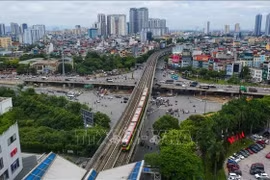
Under the southern metropolis’s urban railway (metro) development plan for the next five years, it aims to complete six metro lines with a combined length of 187km, and by 2035, put 14 lines totalling 462km into operation.
In the immediate future, Metro Line No. 2 (Ben Thanh–Tham Luong) is scheduled for completion and operation in 2030, alongside priority projects including Metro Line No. 1 (the New Binh Duong City–Suoi Tien section), Metro Line No. 2 (Thu Dau Mot City–Ho Chi Minh City section), Metro Line No. 3 (Vung Tau–Ba Ria–Phu My), and Metro Line No. 6 – the inner ring line (Phu Huu–Ba Queo–Phu Lam roundabout–Phu Huu), with a total length of up to 180km.
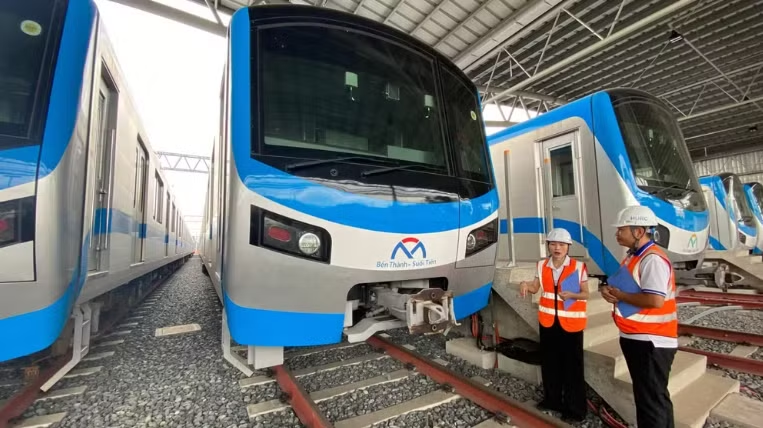
Le Minh Triet, Director of Ho Chi Minh City Urban Railway Company No. 1 (HURC1), said that simply putting the city’s first metro line into operation required hundreds to as many as 1,000 workers across various specialised fields. As the city invests in multiple “backbone” metro lines in the coming period, the demand for human resources will grow exponentially.
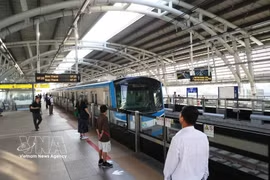
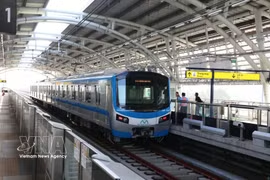
To operate Metro Line No. 1 (Ben Thanh–Suoi Tien), the operator currently employs 700 people to keep nearly 200 train trips running each day. According to HURC1, these personnel work in areas including station operations, station management, train driving, train control and maintenance.
Recently, HURC1 announced the recruitment of personnel to undergo training and receive technology transfer for the operation and maintenance of the Phu Quoc LRT railway line. The company said a total of 168 positions are to be recruited, including 130 operations personnel and 38 maintenance workers. They require university, college or equivalent qualifications in relevant fields.
Cooperation in training, mastering railway technologies
Under the human resources training scheme serving the development of the urban railway network approved by the municipal People’s Committee, the city will need around 70,000 workers by 2030 to support investment in and development of its metro system, including project management personnel, operations and maintenance staff, engineers, technical workers, consultants and designers. Of this total, around 30,000 workers will be needed for operations, maintenance and technical positions, while approximately 12,000 will be required for construction.
The economic hub has also drawn up a training plan for 2030–2045, with nearly twice as many personnel as needed in the 2025–2030 period, in line with plans to develop and invest in a metro network of up to 700km.
These requirements are prompting universities and research institutes to prioritise the training of high-quality specialised engineers, particularly in smart transportation. The aim is to prepare a generation of engineers with systematic thinking capable of anticipating a wave of “billion-dollar” infrastructure projects and addressing the human-resource “thirst” amid major infrastructure developments.
Nguyen Quoc Trung, Deputy General Director of Dai Quang Minh Real Estate Investment JSC under THACO – the general contractor carrying out the Metro Line No. 2 package, said human resources training and standardisation must be prioritised and regarded as a decisive factor as Vietnam cannot remain dependent on foreign contractors for technology and construction solutions.
Therefore, mastering the technologies used to build urban railway lines is a priority for THACO, which is also preparing the necessary conditions to develop the domestic railway industry.
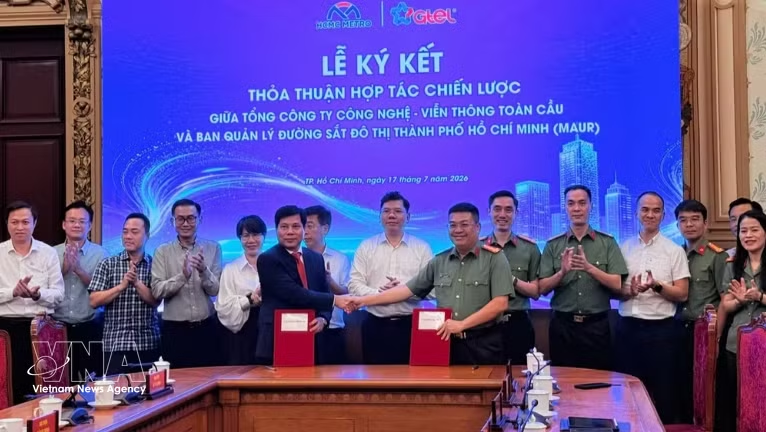
Recently, the local Management Authority for Urban Railways (MAUR) and the Global Technology-Telecommunications Corporation (GTEL) held a ceremony to sign a memorandum of understanding on cooperation in system integration research and technology transfer for the urban railway network.
The immediate focus of the joint work is on research and implementation for Metro Line No. 2 and other urban railway projects to be carried out during 2026–2030. At the same time, the parties will gradually study, receive and master technologies for subsystems including telecommunications, signalling, power, electrical and mechanical (E&M) systems, supervisory control and data acquisition (SCADA), the operations control centre (OCC), automatic fare collection (AFC) systems, and platform screen doors (PSD)./