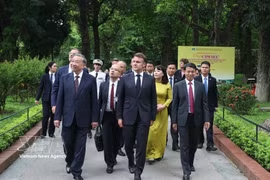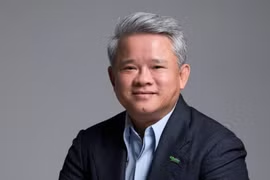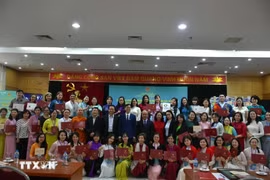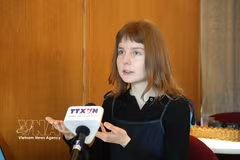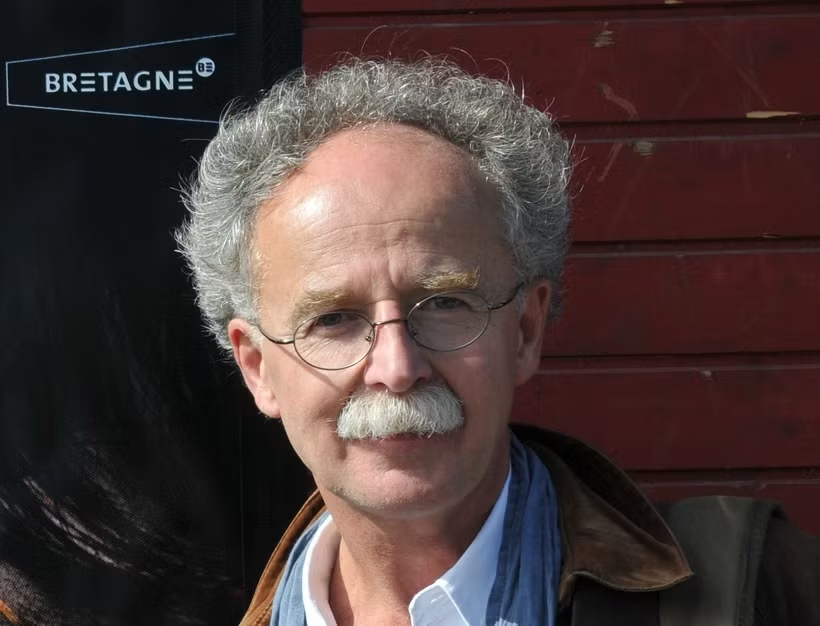
Paris (VNA) – The official visit to France by General Secretary of the Communist Party of Vietnam Central Committee and President To Lam from September 9-12 is expected to provide fresh momentum for practical and sustainable cooperation between Vietnam and France, according to Dr. Gildas Tréguier, Secretary-General of the France-Vietnam Health Federation (FSFV).
Speaking to Vietnam News Agency correspondents in Paris, Tréguier said the visit comes as Vietnam is opening further to the world and entering a new stage of development, creating greater demand for experience sharing and closer cooperation with international partners, including France. After nearly 40 years of involvement in medical cooperation programmes with Vietnam, he said bilateral ties have been built not only through major events and government-level agreements, but also through the contributions of generations of people.
He described these people as “small bricks”, many of whom work quietly and go largely unnoticed , but whose collectives efforts can help build a much larger structure.
Vietnam-France medical cooperation has a history of more than 150 years. The first Pasteur Institute in Vietnam was established in Saigon, now Ho Chi Minh City, in 1891 under Dr. Albert Calmette. The first medical school in Hanoi was established in 1902 under Dr. Alexandre Yersin, while Henriette Bui Quang Chieu became Vietnam’s first female doctor in the 1930s.
Cooperation expanded after 1975 through exchanges involving doctors, midwives, health workers and researchers. A 1993 intergovernmental health agreement enabled more than 3,000 Vietnamese doctors to receive training in France under the FFI programme for foreign medical residents. Since 2015, this has continued through specialised training programmes for foreign doctors (DFMS), linked to cooperation between hospitals in the two countries.
Tréguier highlighted cooperation in respiratory medicine, maternal and neonatal care, mental health and medical imaging, as well as the Ho Chi Minh City Heart Institute, whose development benefited from the contribution of French cardiac surgeon Professor Alain Carpentier in the 1980s.
He noted that cooperation has also expanded through the Pasteur Institute network, the French National Agency for Research on AIDS and Viral Hepatitis (ANRS), the French National Academy of Medicine and various research and training programmes. The French Development Agency (AFD), Research Institute for Development (IRD) and French Agricultural Research Centre for International Development (CIRAD) have also participated in One Health initiatives.
However, Tréguier pointed to challenges, including shrinking funding for institutional cooperation, the declining influence of French in Southeast Asia and generational changes. Vietnam’s growing ties with other dynamic partners in the Indo-Pacific also mean France must offer more relevant and specialised cooperation.
He said future cooperation should be long-term, focusing on training and experience sharing while responding to the actual needs of people and professionals.
In healthcare, he sees potential in advanced medical technology, One Health, mental health, child development, elderly and disability care, disease prevention, clinical research and medical ethics. Digital transformation and artificial intelligence could also support diagnosis, treatment, hospital management and healthcare delivery.
Tréguier called for a clearer and more stable institutional framework, including an update of the 1993 intergovernmental health agreement, as well as stable funding through public programmes, public-private partnerships and stronger local-level cooperation.
He also stressed the importance of the Francophone community in maintaining links between the two countries. He suggested greater support for Vietnamese people trained in France and highlighted the potential for a “Francophone medical community” roundtable on the sidelines of the Francophonie Summit in Cambodia in November 2026.
Beyond healthcare, he said the same approach could strengthen cooperation in the environment, science, education and culture, helping the two countries build a shared, long-term story through research, publications and conferences.
He cited the cooperation between Khanh Hoa province and Lorient city as an example of how local ties can grow from healthcare into marine economy, fisheries, maritime affairs, university education, arts and culture.
After nearly four decades of connecting the two countries, Tréguier said those involved in cooperation were only “small links” in the long history of exchanges between Asia and Europe. The visit by the top Vietnamese leader offers an important opportunity to add fresh momentum to bilateral ties and develop cooperation programmes suited to new needs, he said./.