Shift to data-driven administrative procedures needs acceleration

Under a draft decree replacing Decree 63, authorities will have to proactively pull information from databases and records for informational or technical procedures. Applicants would no longer be required to resubmit documents, and certification or information requests could not be turned into discretionary licensing through an “ask – give” mechanism.

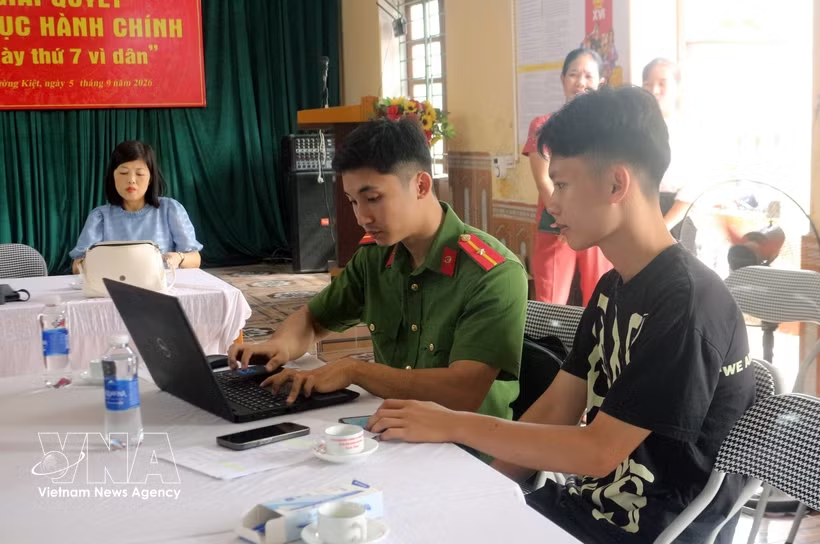
A police officer guides a citizen on how to use VNeID app. (Photo: VNA)

Hanoi (VNA) – Vietnam is accelerating the development of digital government and economy, betting that faster processing, simpler administrative procedures and wider data sharing will make a strong shift toward a modern governance model built around citizens and businesses.

Controlling procedures on paper

Fifteen years after the Government’s Decree No. 63/2010/ND-CP took effect on June 8, 2010, the Ministry of Justice (MOJ) said Vietnam has cut administrative procedures and business conditions considerably. But the system still rewards “form and compliance” over “risk management and effectiveness”. It also lacks an effective way to control pre-approval inspection procedures, licensing requirements and discretionary “ask – give” practices that inflate compliance costs and constrain the business environment.

Reviews remain fragmented and are not designed around the actual lifecycle of a filing or the experience of users, the ministry said. They focus on whether rules are necessary, legal and reasonable while ignoring practical data on processing times, costs, convenience and interoperability. Many procedures end up serving regulators rather than citizens and companies.

In the new landscape, the urgent shift is from controlling paper documents to controlling procedures electronically, using data and interconnected systems.

Local feedback identifies a deeper flaw: the decree did not adopt a modern data governance approach. Without legal rules for reusing data, agencies continue to operate with paper files or disconnected electronic records. Citizens and enterprises must repeatedly submit the same information for different procedures, raising time and compliance costs.

The Vietnam Leather, Footwear and Handbag Association recently asked the Ministry of Industry and Trade to fix delays in certificates of origin (C/O) after responsibility shifted from the Agency of Foreign Trade to provincial-level departments. Companies said they must re-register trader dossiers. a process that can take up to 10 days, and cannot apply for C/Os during that period, disrupting export documentation.

LEFASO wants the ministry to retain trader data already registered in the eCoSys system so companies don’t have to start over.

Resubmitting documents not required

Under a draft decree replacing Decree 63, authorities will have to proactively pull information from databases and records for informational or technical procedures. Applicants would no longer be required to resubmit documents, and certification or information requests could not be turned into discretionary licensing through an “ask – give” mechanism.

Results will have to be delivered electronically, with paper copies available on request. Agencies could not require procedures that haven’t been published in the National Database on Administrative Procedures. Processing would need to run through the single-window system in a connected, data-sharing electronic environment.

Agencies will be required to assign qualified staff with proper ethics and communication skills and provide timely, accurate guidance for applicants, including pregnant women, orphans and others eligible for social protection.

Reviews should identify rules that no longer fit real conditions and weigh their impact on citizens, businesses, investment, production, competition and state management efficiency, the MOJ proposed./.
VNA

See more

Cuban journalist Luis Manuel Arce Isaac, author of the article published in Mexico’s Voces del Periodista magazine. (Photo: Screenshot/VNA)

Mexican journalist praises Vietnam’s profound transformation

According to the article, Vietnam’s progress over the past decades has turned President Ho Chi Minh’s aspiration for a country that would be more dignified and more beautiful into reality in ways that have far exceeded what was initially envisioned.

The Liaison Board of the Vietnamese Community in Singapore organises the annual Mid-Autumn Festival to strengthen community bonds and spread Vietnamese language and culture. (Photo: VNA)

Continued efforts made to nurture love for homeland through mother tongue

From language classrooms and community activities to digital platforms, Vietnamese is being preserved through increasingly diverse approaches. More than a means of communication, the mother tongue carries memories, culture and affection for the homeland. Ensuring that Vietnamese remains naturally present in the daily lives of overseas Vietnamese is therefore an important way to nurture their lasting bond with the Fatherland.

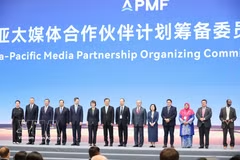
Deputy General Director of the Vietnam News Agency Doan Thi Tuyet Nhung (fifth, right) and representatives of regional news agencies and media organisations attend the launch of the Asia-Pacific Media Partnership Organising Committee at the Asia-Pacific Media Forum. (Photo: VNA)

VNA attends Asia-Pacific Media Forum in Shenzhen

Participants in the forum highlighted the need to increase coverage of the region's rapid opening-up and integration, provide comprehensive information on the progress and achievements of cooperation among economies across various fields, and help create a favourable environment for regional development.

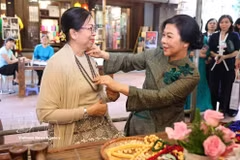
Ngo Phuong Ly (right), the spouse of General Secretary of the Communist Party of Vietnam Central Committee and President To Lam, and Kyu Kyu Hla, the spouse of Myanmar President Min Aung Hlaing, visit Van Phuc silk village on September 5. (Photo: VNA)

First ladies of Vietnam, Myanmar visit Van Phuc silk village

Ngo Phuong Ly, the spouse of General Secretary of the Communist Party of Vietnam Central Committee and President To Lam, said the two countries share similarities in silk weaving and can enrich their cultural heritage through exchanges and experience sharing.

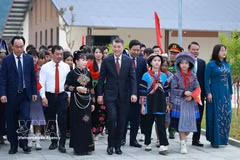
Prime Minister Le Minh Hung join students and teachers of the Muong Khuong Inter-level Primary and Secondary Boarding School, Lao Cai province, in the opening ceremony of the 2026–2027 academic year on September 5. (Photo: VNA)

PM urges substantive education reform in 2026–2027 school year

PM Le Minh Hung called on the education sector to continue making strong changes in management mindset and teaching methods, putting learners at the centre, and viewing schools as the foundation, teachers as the driving force, families as a source of support and society as a resource accompanying education development.

General Secretary of the Communist Party of Vietnam Central Committee and President To Lam (Photo: VNA)

Top leader extends message to education sector on new school year

Party General Secretary and President To Lam expressed confidence that with the nation’s traditional fondness for learning, the dedication of teachers and the aspirations of the younger generation, the 2026–2027 academic year will open a new chapter of progress for the country’s education sector.

Students attend the opening ceremony for the 2026–2027 academic year at the primary school campus of the Gia Quat Primary and Secondary School in Hanoi on September 5, 2026. (Photo: VNA)

Students across Vietnam begin 2026–2027 academic year

This milestone school year marks a pivotal transition from laying the groundwork for reform to delivering substantive changes as the country pushes ahead with implementing Politburo Resolution No. 71-NQ/TW on breakthroughs in education and training development.

Team K91 members depart to carry out their mission. (Photo: VNA)

Search efforts continue for Vietnamese fallen soldiers in Cambodia

During the 2026-2027 dry season, Teams K70, K71, K72 and K73 will continue their search and repatriation mission, striving to fulfil the target based on 185 pieces of information concerning 761 graves. Each team is expected to collect at least 100 sets of remains during each deployment.

Mai Nguyen Tuyet Hoa, First Secretary in charge of education affairs at the Vietnamese Embassy in Russia speaks at the closing ceremony (Phôt: VNA)

AI application boosts Russian language training in Vietnam

The programme introduced updated methods for teaching Russian as a foreign language while focusing on the application of digital technology and AI in lesson design to enhance the professional capacity and adaptability of Russian-language teachers amid changes in modern education.

A resident accesses the iHanoi app. (Photo: VNA)

Hanoi launches real-time flood and rainfall map on iHanoi

The map uses a standard colour scale to provide a visual assessment, enabling residents to gauge the level of danger within seconds. The application is expected to strengthen the capital’s disaster response capacity while helping residents plan safer routes during the rainy and stormy season.