Lawmakers debate bill to support SME development

Presenting the Government’s report, Minister of Finance Ngo Van Tuan said that a decade on, the existing law has laid a legal foundation for enterprise support but many policies have missed their mark. Support mechanisms remain fragmented, spread too thin, and disconnected from actual business needs. Barriers to access persist, and post-support evaluation is ill-defined.

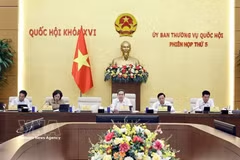
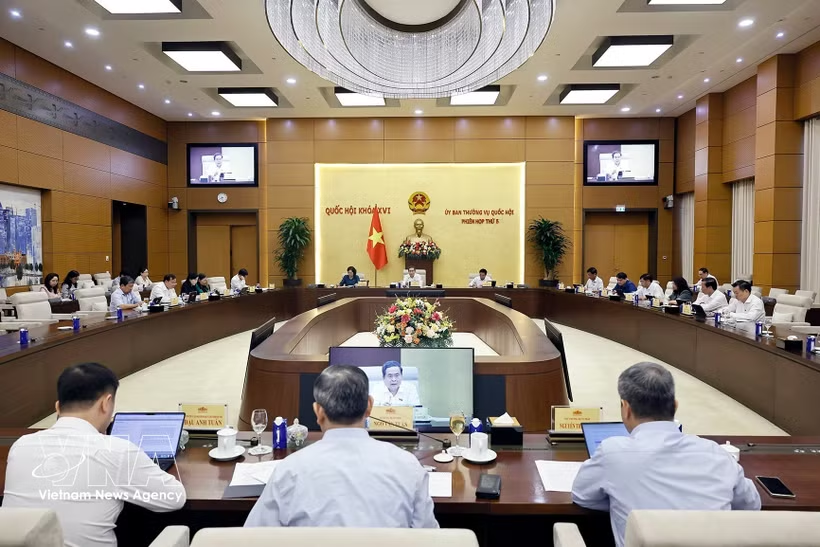
The NA Standing Committee's session on August 28 (Photo: VNA)

Hanoi (VNA) – The National Assembly (NA) Standing Committee on August 28 discussed the draft Law on the Development of Small and Medium-sized Enterprises (SMEs), which is set to replace the 2017 law.

Presenting the Government’s report, Minister of Finance Ngo Van Tuan said that a decade on, the existing law has laid a legal foundation for enterprise support but many policies have missed their mark. Support mechanisms remain fragmented, spread too thin, and disconnected from actual business needs. Barriers to access persist, and post-support evaluation is ill-defined.

The law’s new name signals a policy pivot from “supporting businesses” to “creating conditions for development”, aligning with Party and State directives and international norms, Tuan said.

The five-chapter, 35-article draft introduces fundamental breakthrough policies. It replaces broad-based assistance with targeted, time-bound support tied to measurable outcomes along an upgrade path, from business households to micro, small, medium, and large enterprises. Success will be gauged not by beneficiary headcount but by capacity to absorb support and subsequent growth.

It moves toward data-driven administration, accelerating digitalisation and data sharing through the stages of securing, launching, monitoring and evaluating support. It also shifts from direct State aid to comprehensive ecosystem building, with the State pooling resources, sharing risk, and connecting universities, research institutes, funds, incubators, and large firms. Support will follow demand via vouchers, commissioned services, or assigned tasks.

The draft sets out two policy tracks, including general support clearing bottlenecks in capital, premises, technology, and markets; and targeted support for high-potential groups capable of creating breakthroughts, such as innovative startups, value chain stakeholders, sustainable enterprises, and business households transitioning to formal status.

Chairman of the NA Committee for Economic and Financial Affairs Phan Van Mai backed the bill in a preliminary appraisal.

On tax, accounting, technology, and digital policy, Mai urged that SME incentives be codified under specialised tax law to maximise preferential treatment.

He called for feasibility review of production premises support to ensure alignment with land and public asset rules. For venture capital and startup support, the draft must define fund eligibility and, where State capital is involved, clarify authority, oversight, risk-sharing, and capital protection.

On public procurement, he flagged commissioning and direct contracting mechanisms for SMEs, demanding safeguards against bid-rigging, procurement delays, and breaches of international commitments. For business households formalisng, he supported lower market-entry costs but sought clarity on beneficiary criteria, support duration, and funding sources.

The appraisal agency stressed that the law must enshrine openness and transparency, avoiding new red tape or discretionary “ask-and-give” mechanisms. Responsibilities across ministries, agencies, and localities must be explicit, with data sharing mandatory to prevent firms from resubmitting information the State already holds./.​

VNA

See more

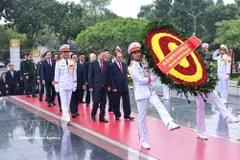
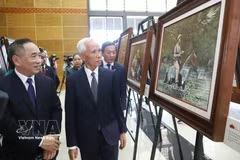
A delegation of the Communist Party of Vietnam (CPV) Central Committee, the State, the National Assembly and the Government pays tribute to fallen heroes at the Monument to Heroes and Martyrs on Bac Son street in Hanoi on August 28. (Photo: VNA)

Party, State leaders pay tribute to President Ho Chi Minh

The delegates expressed their profound gratitude and solemn remembrance of the beloved leader's immense contributions to the revolutionary cause of the Party and the nation. He devoted his entire life to the people and the country, leading the Party and the Vietnamese people to glorious victories.

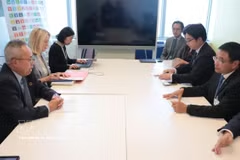
Deputy Prime Minister Nguyen Van Thang (first, right) has a meeting with UN Under-Secretary-General for Economic and Social Affairs Li Junhua. (Photo: VNA)

UN prioritises comprehensive cooperation with Vietnam

Deputy Prime Minister Nguyen Van Thang thanked the UN for its support to Vietnam in pursuing the SDGs and highlighted the substantive and effective cooperation between the two sides. He proposed that the UN and Vietnam soon complete the Strategic Cooperation Framework for 2027-2031, closely aligning it with Vietnam’s major development orientations and strategies.

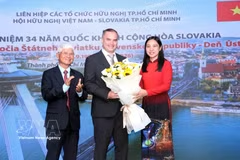
Ha Thanh (right), Chairwoman of the Ho Chi Minh City Union of Friendship Organsations, and Bui Quang Hai (left), Chairman of the Ho Chi Minh City Vietnam–Slovakia Friendship Association, present flowers to Marian Veres, Chargé d’Affaires ad interim of the Embassy of Slovakia in Vietnam at the ceremony on August 27. (Photo: VNA)

Constitution Day of Slovakia celebrated in Ho Chi Minh City

Bui Quang Hai, Chairman of the Ho Chi Minh City Vietnam–Slovakia Friendship Association, said the annual Constitution Day celebration has become a meaningful occasion to look back on the traditional friendship between Vietnam and former Czechoslovakia, as well as between Vietnam and Slovakia today.

NA President Tran Thanh Man (centre) speaks at the meeting. (Photo: VNA)

Law lecturers may qualify as lawyers under proposed revisions

The draft adds requirements for lawyers to have firm political resolve, good ethics and integrity, and undergo annual training in political awareness and professional expertise. It also proposes a national examination for lawyer practising certificates, replacing the current assessment of apprenticeship results.

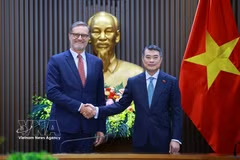
PM Le Minh Hung (R) and French Ambassador Olivier Brochet. (Photo: VNA)

Prime Minister congratulates outgoing French Ambassador on successful term

Affirming that Vietnam always attaches importance to its ties with France, one of its leading partners in Europe and its first Comprehensive Strategic Partner in the European Union (EU), PM Hung expressed delight at the positive development of bilateral relations, with increasingly strong political trust and economic, trade and investment links.

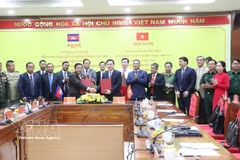
Dak Lak and Mondulkiri sign an MoU on cooperation for 2026–2030 on August 26. (Photo: VNA)

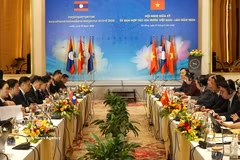
Vietnamese, Cambodian provinces strengthen comprehensive cooperation for 2026-2030

Under the signed MoU, both sides agreed to expand their cooperation to include new areas such as agricultural product traceability, enforcing international deforestation regulations, working together to fight online scams, and enhancing collaboration in developing border regions alongside socio-economic growth and better living standards.

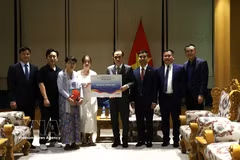
Minister of Foreign Affairs Le Hoai Trung (fourth from right) and representatives of the Vietnamese community and Yangon University of Foreign Languages (Photo: VNA)

Minister of Foreign Affairs presents books, meets with Vietnamese businesses in Myanmar

Vietnam remains among Myanmar’s important foreign investors, with major projects including Mytel in telecommunications and digital infrastructure, HAGL Myanmar Center/THACO, a complex of real estate, hotel, office and commercial facilities in Yangon, and Bank for Investment and Development of Vietnam (BIDV), alongside enterprises in manufacturing, agriculture and animal feed.

Assoc. Prof. Dr. Le Hai Binh, Member of the Party Central Committee and Permanent Vice President of the Ho Chi Minh National Academy of Politics (right) and Silvia Danailov, UNICEF Representative in Vietnam at their meeting on August 27 (Photo: VNA)

Vietnam, UN step up research, policy advice on children's rights

To elevate their partnership, the HCMA and UNICEF agreed on strategic cooperation orientations for 2026–2031, under which they will step up research and policy advice on children's rights amid new development conditions, focusing on practical issues such as the impacts of new growth models, urbanisation, migration and climate change on children and families.