NA Standing Committee examines draft revised law on international agreements

The bill seeks to address shortcomings in the current legislation, expand the entities authorised to sign international agreements, increase decentralisation and delegation of authority, simplify procedures and boost the application of science and technology to improve implementation effectiveness.

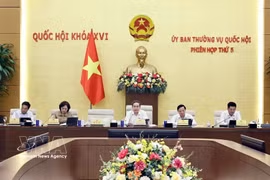
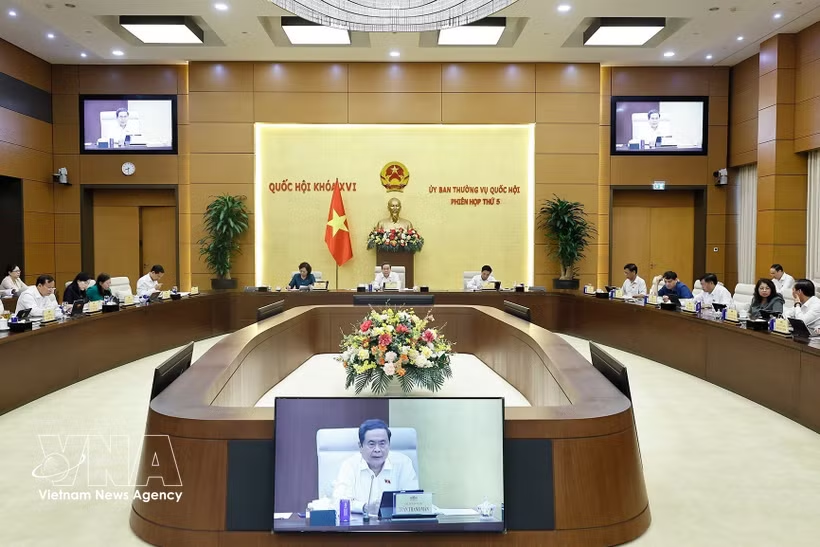
The National Assembly (NA) Standing Committee discusses the draft revised Law on International Agreements at its fifth session on August 28. (Photo: VNA)

Hanoi (VNA) – The National Assembly (NA) Standing Committee discussed the draft revised Law on International Agreements at its fifth session on August 28.

Presenting the Government’s proposal, Minister of Foreign Affairs Le Hoai Trung said the draft law aims to institutionalise the Party’s guidelines set out in the documents of the 14th National Party Congress and the strategic resolutions of the Politburo, particularly Resolution No.59-NQ/TW on international integration in the new situation and Resolution No. 06-NQ/TW on implementing the foreign policy outlined by the 14th National Party Congress.

The draft also reflects Directive No. 56-CT/TW of the Party Central Committee’s Secretariat on strengthening Party leadership over the negotiation and implementation of international commitments, and promoting external relations and international integration in the new era.

It seeks to address shortcomings in the current legislation, expand the entities authorised to sign international agreements, increase decentralisation and delegation of authority, simplify procedures and boost the application of science and technology to improve implementation effectiveness.

The bill comprises six chapters with 48 articles. Notably, it further clarifies the distinction between international agreements and treaties, stating that international agreements do not create, alter or terminate Vietnam’s rights and obligations under international law.

It also adds several Vietnamese entities eligible to sign such agreements, including the management boards of industrial, export-processing and economic zones under the provincial-level People’s Committees; non-business public units under ministries, ministery-level agencies and provincial-level People’s Committees; and special-zone People’s Committees.

At the same time, some entities, including general departments under ministries and district-level People’s Committees, the NA Secretary-General, agencies under the NA Standing Committee and those subordinate to the Government, would be removed from the list as in line with the restructuring of the State apparatus.
vnanet-potal-ubtv-quoc-hoi-cho-y-kien-ve-du-an-luat-phat-trien-doanh-nghiep-nho-va-vua-8988717.jpg
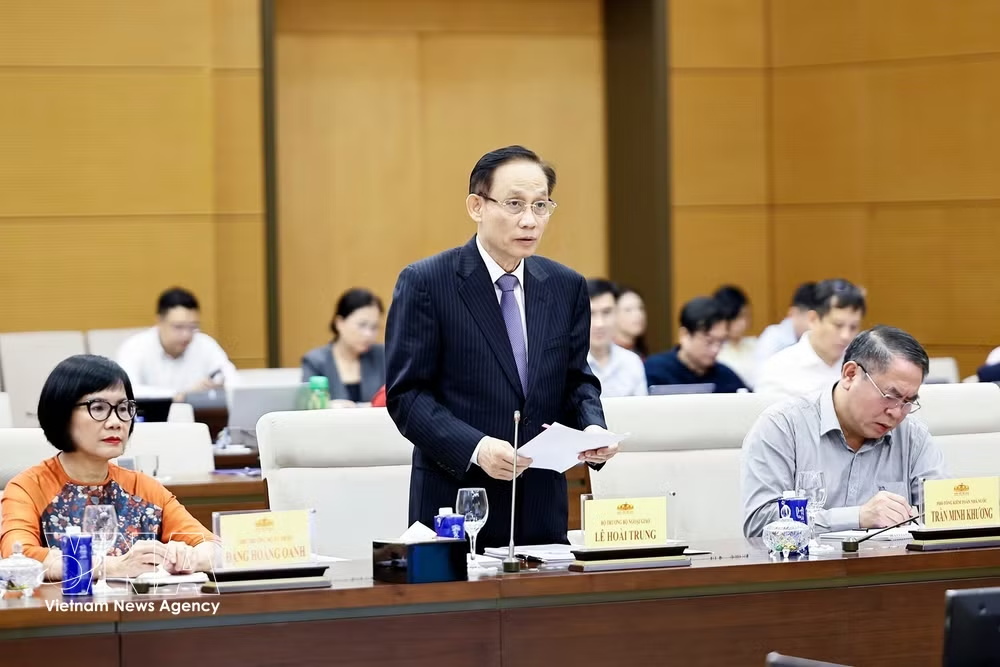
Minister of Foreign Affairs Le Hoai Trung presents the Government’s proposal on the draft revised Law on International Agreements. (Photo: VNA)

The draft provides that the Prime Minister would submit international agreements signed in the name of the State to the President for decision. It also introduces simplified procedures for urgent cases involving national defence and security, emergency relief, natural disaster response and epidemic control.

Other provisions cover electronic signatures, digital transformation and the development of a national database on international commitments.

The Government proposed that the NA consider and pass the revised law, replacing the existing legislation, at the second session under a one-session procedure.

Ensuring decentralisation goes with accountability

Presenting the preliminary verification report, Sen. Lt. Gen. Le Tan Toi, Chairman of the NA Committee for National Defence, Security and External Relations, affirmed the necessity of revising the law and said the bill is qualified for consideration at the NA’s second session.

However, the committee asked the Government to accurately assess the required financial, human-resource and digital-infrastructure capacity of the newly authorised entities.

Given the needs in reality and the new two-tier local administration model, the committee also proposed adding commune-level People’s Committees outside border areas as entities eligible to sign international agreements.

It called for mechanisms to verify foreign partners’ electronic signatures and clarification of why electronic signatures would not be permitted for agreements signed in the name of the State, NA or Government.

Speaking at the session, NA President Tran Thanh Man said revising the Law on International Agreements is necessary to adapt to the two-tier local administration model and meet the requirements of deeper international integration.

He supported expanding the list of entities authorised to sign agreements in a controlled and appropriate manner. However, he stressed that strict oversight mechanisms are needed to prevent fragmented and inconsistent management of external relations, with detailed rules to be set out in guiding decrees.

The NA President noted that border commune-level administrations have limited capacity and resources, and therefore the draft should clearly define the areas in which they may sign agreements or establish approval procedures to minimise legal and political risks.

He also called for a clear distinction between international agreements and treaties, as well as consistency with the 2025 Law on Treaties to prevent overlaps.

On decentralisation, the top legislator stressed that greater authority must go hand in hand with adequate capacity and clear accountability. He warned against agreements being signed without effective implementation or agreements of low quality. The draft law should therefore clearly define the responsibilities of lead agencies, establish mechanisms to withdraw or terminate ineffective agreements, and strengthen the inspection and supervisory role of the Ministry of Foreign Affairs.

Also on August 28, the NA Standing Committee unanimously adopted a resolution on the functions, duties, powers and organisational structure of the NA Office, replacing Resolution No. 74/2025/UBTVQH15. The new resolution takes effect on August 28, 2026./.
VNA

See more

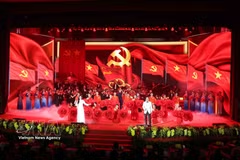
A musical performance at the ceremony held on August 28 to announce the National Assembly’s resolution on the establishment of Quang Ninh as a centrally governed city. (Photo: VNA)

Top leader attends ceremony announcing establishment of Quang Ninh city

Speaking at the ceremony, General Secretary of the Communist Party of Vietnam Central Committee and President To Lam highlighted Quang Ninh’s special role in Vietnam’s history of national construction and defence, stressing that since Quang Ninh province was established in 1963, generations of officials and people have worked together to transform a war-ravaged area into a dynamic locality.

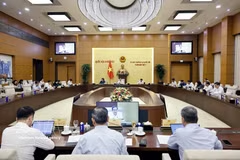
The NA Standing Committee's session on August 28 (Photo: VNA)

Lawmakers debate bill to support SME development

Presenting the Government’s report, Minister of Finance Ngo Van Tuan said that a decade on, the existing law has laid a legal foundation for enterprise support but many policies have missed their mark. Support mechanisms remain fragmented, spread too thin, and disconnected from actual business needs. Barriers to access persist, and post-support evaluation is ill-defined.

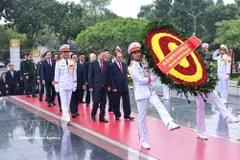
A delegation of the Communist Party of Vietnam (CPV) Central Committee, the State, the National Assembly and the Government pays tribute to fallen heroes at the Monument to Heroes and Martyrs on Bac Son street in Hanoi on August 28. (Photo: VNA)

Party, State leaders pay tribute to President Ho Chi Minh

The delegates expressed their profound gratitude and solemn remembrance of the beloved leader's immense contributions to the revolutionary cause of the Party and the nation. He devoted his entire life to the people and the country, leading the Party and the Vietnamese people to glorious victories.

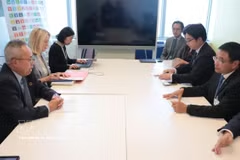
Deputy Prime Minister Nguyen Van Thang (first, right) has a meeting with UN Under-Secretary-General for Economic and Social Affairs Li Junhua. (Photo: VNA)

UN prioritises comprehensive cooperation with Vietnam

Deputy Prime Minister Nguyen Van Thang thanked the UN for its support to Vietnam in pursuing the SDGs and highlighted the substantive and effective cooperation between the two sides. He proposed that the UN and Vietnam soon complete the Strategic Cooperation Framework for 2027-2031, closely aligning it with Vietnam’s major development orientations and strategies.

Ha Thanh (right), Chairwoman of the Ho Chi Minh City Union of Friendship Organsations, and Bui Quang Hai (left), Chairman of the Ho Chi Minh City Vietnam–Slovakia Friendship Association, present flowers to Marian Veres, Chargé d’Affaires ad interim of the Embassy of Slovakia in Vietnam at the ceremony on August 27. (Photo: VNA)

Constitution Day of Slovakia celebrated in Ho Chi Minh City

Bui Quang Hai, Chairman of the Ho Chi Minh City Vietnam–Slovakia Friendship Association, said the annual Constitution Day celebration has become a meaningful occasion to look back on the traditional friendship between Vietnam and former Czechoslovakia, as well as between Vietnam and Slovakia today.

PM Le Minh Hung (R) and French Ambassador Olivier Brochet. (Photo: VNA)

Prime Minister congratulates outgoing French Ambassador on successful term

Affirming that Vietnam always attaches importance to its ties with France, one of its leading partners in Europe and its first Comprehensive Strategic Partner in the European Union (EU), PM Hung expressed delight at the positive development of bilateral relations, with increasingly strong political trust and economic, trade and investment links.

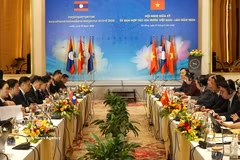
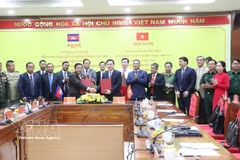
Dak Lak and Mondulkiri sign an MoU on cooperation for 2026–2030 on August 26. (Photo: VNA)

Vietnamese, Cambodian provinces strengthen comprehensive cooperation for 2026-2030

Under the signed MoU, both sides agreed to expand their cooperation to include new areas such as agricultural product traceability, enforcing international deforestation regulations, working together to fight online scams, and enhancing collaboration in developing border regions alongside socio-economic growth and better living standards.

Minister of Foreign Affairs Le Hoai Trung (fourth from right) and representatives of the Vietnamese community and Yangon University of Foreign Languages (Photo: VNA)

Minister of Foreign Affairs presents books, meets with Vietnamese businesses in Myanmar

Vietnam remains among Myanmar’s important foreign investors, with major projects including Mytel in telecommunications and digital infrastructure, HAGL Myanmar Center/THACO, a complex of real estate, hotel, office and commercial facilities in Yangon, and Bank for Investment and Development of Vietnam (BIDV), alongside enterprises in manufacturing, agriculture and animal feed.