Vietnam outpaces regional peers in science: PISA 2025

Vietnam ranked second in Southeast Asia in science on PISA 2025, but a wide reading gap has the Education Ministry calling for a cross-subject literacy push.

PISA 2025 involved approximately 760,000 15-year-old students from 91 countries and economies. (Photo: oecd.org)

Hanoi (VNS/VNA) – Vietnam outscored every Southeast Asian participant except Singapore in science on the OECD's 2025 Programme for International Student Assessment, posting a score of 457 that placed it in a statistical tie with the United Arab Emirates and Malta.

Vietnamese students, 97%, also received supplementary science instruction outside regular classes – the highest rate of any participant in the assessment.

The assessment, known as PISA, tested roughly 760,000 15-year-olds across 91 countries and economies in 2025, measuring performance in science, reading, mathematics and computational problem solving.

Vietnam scored below the OECD average in all four subjects: 457 in science against an average of 482, 443 in mathematics against 463, 461 in computational problem solving against 500, and 392 in reading against 461 – a 69-point gap, the widest of the four.

Vietnam's results also showed a wide spread within its own student population. Just 4.2% of Vietnamese students reached the top two proficiency tiers, less than half the OECD average of 11.9%. About a quarter scored below the baseline level PISA associates with the ability to apply core skills to everyday situations, compared with an OECD average of 19.7%.

The 2025 cycle was the first in which Vietnam administered PISA on computers rather than paper; it had used older paper-based test materials, based on the 2012 framework, in every prior cycle.

The Ministry of Education and Training says that change makes this year's results difficult to compare directly with past ones, and has cautioned against reading any score movement from previous cycles as evidence that education quality has risen or fallen.

The ministry says the results point to two priorities to be pursued together: raising basic competency levels for the broad student population, particularly in reading, while continuing to support students who perform at a high level.

Officials say reading should not be treated as the responsibility of literature teachers alone: solving a math word problem, interpreting a scientific phenomenon, reading a map or chart, and following instructions online all draw on the same underlying skills – identifying relevant information in a text, weighing it and drawing conclusions.

Reading instruction, they say, needs to be incorporated into every subject, not confined to language arts classes.

That guidance comes as Vietnam continues implementing its 2018 General Education Programme, a curriculum revision aimed at shifting classroom instruction from memorisation toward the application of knowledge. The ministry says teaching and assessment methods need to continue moving in that direction.

The ministry is also calling for clearer guidance on how teachers and students use artificial intelligence tools, and for testing methods that can measure student ability independent of AI assistance.

PISA data show Vietnamese students' use of AI chatbots for schoolwork exceeds OECD averages across every task measured: 93.8% report using AI at least occasionally to help them learn generally, compared with an OECD average of 79%; 86.3% use it to summarise texts, against 68% OECD-wide; 88.3% use it to draft assignments, against 68%; and 81.8% use it to research new topics, against 71%.

About 70% of Vietnamese students say they have been taught how to evaluate AI-generated information.

Other measures in the PISA data show support for students has grown in Vietnam even as it declined elsewhere.

An index measuring students' reported support from science teachers rose by 0.31 points between 2015 and 2025, compared with an OECD-average increase of 0.03 points over the same period – one of the largest gains recorded among participating countries.

An index of family support rose by approximately 0.07 points between 2022 and 2025 in Vietnam, while the OECD average fell by roughly 0.18 points over the same period.

Reported access to school-based study support in Vietnam varied widely by type. Just 46.9% of Vietnamese students attend schools that provide dedicated space to complete homework, compared with an OECD average of 73.3%.

But schools offering peer-to-peer tutoring or staff assistance with homework were each reported by about 96% of Vietnamese students, well above OECD averages of 51% to 59%.

Socio-economic status accounts for a larger share of the variation in science performance in Vietnam, 17.5%, than it does across the OECD on average, 11.6%, though the score gap between advantaged and disadvantaged students, 87 points, is close to the OECD average of 85 points.

Gender gaps in Vietnam were smaller than OECD averages in both reading (25 points, versus 30 points OECD-wide) and mathematics (6 points, versus 13 points).

Other survey measures showed a mixed picture. Vietnamese students reported less distraction from digital devices during science lessons than the OECD average, 14.4% versus 28.4%, and lower rates of truancy, with 90.1% reporting little or no truancy compared with 66.1% OECD-wide.

But 51.8% of students showed a growth mindset, an index PISA uses to gauge whether students believe ability can be developed through effort, compared with an OECD average of 69.3%, and 52.3% said they believed their social status could change, compared with 66.4% across the OECD.

Vietnamese students also reported high engagement with environmental issues: 92.8% said they were interested in an environment-related career, compared with 61.6% across the OECD, and 93.5% said they had taken part in at least one pro-environmental activity in the past year, compared with an OECD average of 71.9%./.
VNA

See more

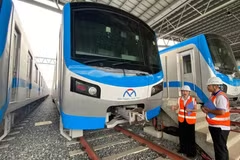
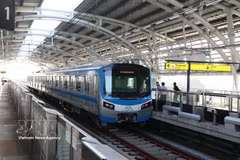
To operate Metro Line No. 1 (Ben Thanh–Suoi Tien), Ho Chi Minh City Urban Railway Company No. 1 (HURC1) currently employs 700 people to keep nearly 200 train trips running each day. (Photo: nhandan.vn)

Ho Chi Minh City addresses manpower shortage for urban railway development

Under the human resources training scheme serving the development of the urban railway network approved by the municipal People’s Committee, the city will need around 70,000 workers by 2030 to support investment in and development of its metro system, including project management personnel, operations and maintenance staff, engineers, technical workers, consultants and designers.

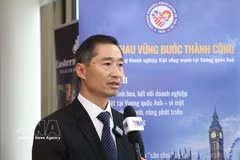
VBUK Vice Chairman Trinh Ngoc Cuong speaks at the ceremony to launch a publication marking VBUK's 20th anniversary,(Photo: VNA)

Resolution No.23: Vietnamese community in UK looks toward homeland

Politburo Resolution No. 23 calls for stronger links among overseas Vietnamese through sustainable networks connecting experts, intellectuals, entrepreneurs and young people. Each entrepreneur and professional can thus become a bridge, ensuring that despite being half a world away, the Vietnamese community remains closely connected to the homeland.

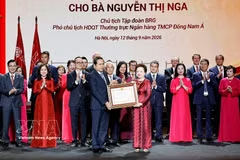
NA President Tran Thanh Man presents the Labour Hero title to BRG Group Chairwoman and Standing Vice Chairwoman of SeABank’s Board of Directors Nguyen Thi Nga (Photo: VNA)

NA President attends ceremony honouring BRG Group, SeABank

As Vietnam enters a new development phase, with a target of double-digit growth and strategic milestones in 2030 and 2045, National Assembly President Tran Thanh Man called on BRG Group and SeABank to build on their established foundations and effectively implement major Party, National Assembly and Government policies on socio-economic development.

Martyrs’ remains are found in Quang Tri province. (Photo: VNA)

Search area expanded to recover more martyrs’ remains in Quang Tri

The continued recovery of martyrs’ remains provides valuable information and further evidence of those who fought and sacrificed their lives for national independence and freedom. It also encourages search teams to persist in locating fallen soldiers still lying on former battlefields, contributing to the effective implementation of the 500-day campaign and reflecting Vietnam’s long-standing tradition of gratitude.

General Secretary of the Communist Party of Vietnam Central Committee and President To Lam (first, left) and French President Emmanuel Macron (first, right) witness the exchange of bilateral cooperation documents and agreements on September 10, 2026 during the former's official visit to France. (Illustrative photo: VNA)

Intellectual cooperation deepens Vietnam–France relations: expert

Dr Frederic Roustan highlighted the importance of scientific and intellectual cooperation, saying that despite ups and downs in bilateral diplomatic, political and economic relations over the decades, connections between French and Vietnamese scientists and intellectuals have been maintained, contributing to exchanges between the two countries.

Illustrative Image (Photo: VNA)

Ministry proposes seven-day 2027 Lunar New Year holiday

Under the Ministry of Home Affairs' proposal, civil servants and public employees in Vietnam would receive five statutory days off, including two days before and three days after the Lunar New Year. As two of those days fall on the weekend, they would receive two additional compensatory days off, bringing the total holiday to seven consecutive days.

The September 11 launch of the national programme for 2026–2030 on strengthening child protection and preventing and minimising illegal child labour (Photo: VNA)

National programme aims to strengthen child protection, reduce illegal child labour

The programme aims to ensure all children live in safe and healthy environments, minimise child abuse nationwide, and create opportunities for children suffering violence, sexual abuse or illegal child labour, those at risk of violence, exploitation or neglect, as well as the ones with other special circumstances, to integrate into society and develop comprehensively.

Harnessing overseas Vietnamese resources in new era

Harnessing overseas Vietnamese resources in new era

After more than two decades of implementing Politburo Resolution No. 36-NQ/TW, dated March 26, 2004, on overseas Vietnamese affairs, the Politburo adopted Resolution No. 23-NQ/TW on the same matter on August 2, 2026. The resolution ushers in a new phase with a more comprehensive approach, focusing on creating mechanisms to unlock and make effective use of the vast potential of the Vietnamese community abroad.

Nguyen Huy Ngoc, Vice Chairman of the Phu Tho provincial People’s Committee, former Director of the provincial Department of Health and the provincial General Hospital (Photo: the Ministry of Public Security)

Phu Tho province's official prosecuted for bribery

According to the Ministry of Public Security, its Police Investigation Agency for Corruption, Economic and Smuggling Crimes (C03) is investigating a case involving violations of accounting regulations causing serious consequences, smuggling and receiving bribes at Viet My Medical Investment JSC and related agencies and localities.

A jobseeker applies at Hue city's employment service centre. (Photo: VNA)

Vietnam’s hiring outlook to see strong growth in Q4

In Vietnam, among 285 businesses surveyed, 52% expected to increase hiring in Q4, 16% planned to reduce hiring, while 32% intended to maintain their current workforce levels, according to the latest ManpowerGroup Employment Outlook Survey.