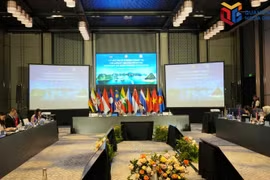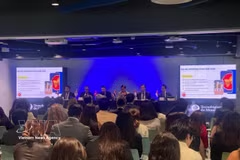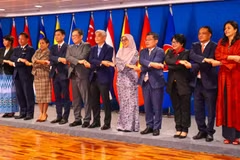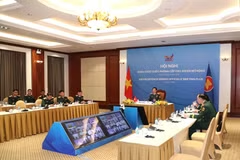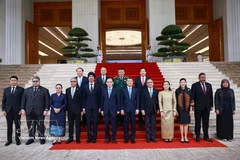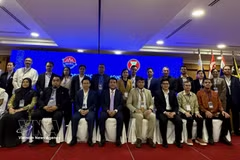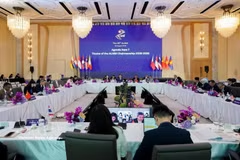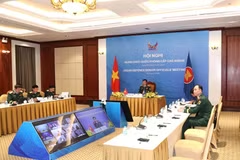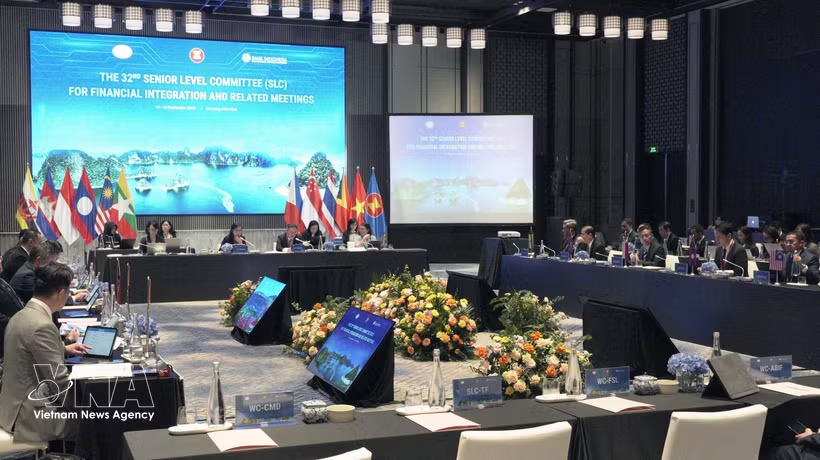
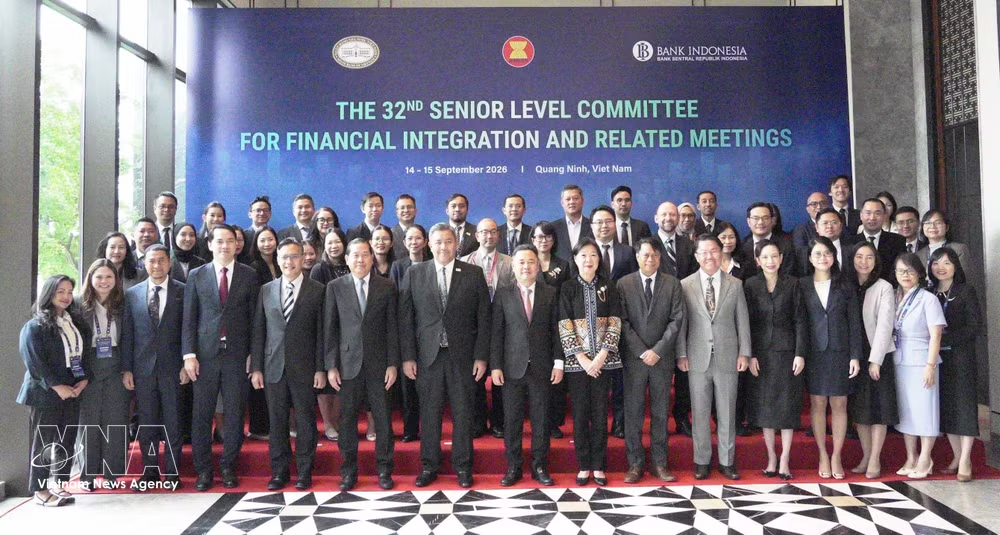
Quang Ninh (VNA) – The 32nd meeting of the ASEAN Senior-Level Committee on Financial Integration (SLC) and related events were held by the State Bank of Vietnam (SBV) and Bank Indonesia in Quang Ninh city on September 14–15.
The meeting was co-chaired by SBV Deputy Governor Nguyen Ngoc Canh and Bank Indonesia Deputy Governor Filianingsih Hendarta, with the participation of ASEAN central bank deputy governors, co-chairs of ASEAN working groups on banking cooperation, the ASEAN Secretariat, and representatives of international institutions, including the Bank for International Settlements (BIS) and the ASEAN+3 Macroeconomic Research Office (AMRO).
Established in 2011, the SLC directs and coordinates the implementation of important financial and banking integration initiatives in ASEAN. Its members are deputy governors of ASEAN central banks, with the co-chairmanship rotating between a central bank from the ASEAN-5 group (the five founding members of ASEAN – Indonesia, Malaysia, the Philippines, Singapore, and Thailand) and one from the BCLMV group (Brunei, Cambodia, Laos, Myanmar, and Vietnam) for two-year terms.
Canh said that after more than a decade of operation, the SLC has become an important forum for in-depth financial and banking cooperation and a key channel connecting the deputy governors of ASEAN central banks.
Through the SLC, member central banks have strengthened policy dialogue and consultation while expanding cooperation with international financial institutions, thereby contributing to regional financial – banking integration and cooperation. The common goal is to promote greater, sustainable, inclusive, and deeper connectivity across the banking system, he said.
Hendarta said the 2024–2026 period marks the SLC co-chairmanship by the SBV and Bank Indonesia. During the term, the two central banks have promoted policy exchanges and consultations on financial and banking issues, contributing to closer cooperation and regional financial stability.
BIS Deputy Head of Department James Yetman highlighted four challenges that central banks in the region will face in the coming years: ongoing or rising inflation, the potential for artificial intelligence (AI) to reshape the economic landscape, growing financial risks and vulnerabilities—some linked to AI, and mounting fiscal pressures.
The 32nd SLC meeting focused on macroeconomic and financial developments and key issues in ASEAN financial integration.
Representatives of BIS and AMRO provided updates on global and regional economic and financial developments, along with issues affecting central bank operations.
The ASEAN Secretariat reported on outcomes of relevant ASEAN meetings and progress in implementing the ASEAN Finance Sectoral Plan 2026–2030, including the ASEAN Economic Community’s Monitoring, Evaluation, Accountability and Learning Framework 2045 (AEC MEAL Framework 2045).
The meeting also reviewed a consolidated report on macroeconomic and financial risks in the region, based on information provided by ASEAN financial working groups. It considered progress in banking integration, capital account liberalisation, capital market development, financial inclusion, financial services liberalisation, payment systems and capacity building to support ASEAN financial integration.
Participants also discussed sustainable finance initiatives and the next direction of the SLC Task Force on Sustainable Finance (SLC-TF), activities under the ASEAN Cyber Resilience and Information Sharing Platform (CRISP), and progress in re-establishing the ASEAN Swap Arrangement (ASA) and signing a new ASA agreement.
A key agenda item was Project Revive, which aims to reform ASEAN’s financial cooperation mechanism, with a new structure to be implemented from 2027. The project seeks to streamline and improve the efficiency of ASEAN financial and banking cooperation, reduce overlaps, strengthen coordination, and focus resources on priority areas.
The meeting also reviewed the Philippines’ economic priorities during its 2026 ASEAN Chairmanship and discussed Singapore’s priorities for the ASEAN Finance Channel under its 2027 chairmanship.
It is the second time the SBV has hosted the SLC meeting during the 2024–2026 co-chairmanship, following the first meeting in Da Nang in September 2024. On September 14, the Steering Committee for Capacity Building Initiatives to Support ASEAN Financial Integration (SCCB) and the 11th meeting of the SLC Task Force on Sustainable Finance took place as the task force gears up for a new phase under the Project Revive framework./.