Vietnam reaffirms commitment to building resilient, inclusive and integrated ASEAN Labour Market

To this end, Vietnam proposed three strategic priorities for ASEAN cooperation. First, ASEAN should expand and harmonise mutual recognition mechanisms by increasing the scope and number of Mutual Recognition Arrangements (MRAs) in the region; and promote the role of the ASEAN TVET Council (ATC) in connecting national skills certification systems with regional and global standards, based on national occupational skills qualification frameworks and regional references.

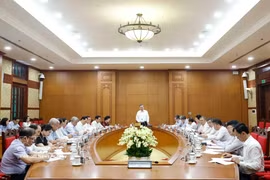
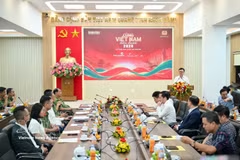
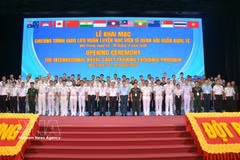
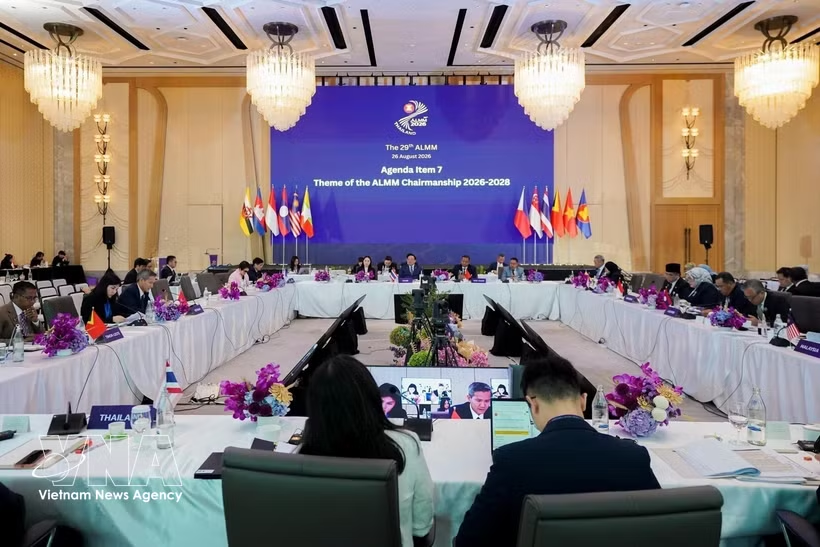
An overview of the 29th ASEAN Labour Ministers Meeting (Photo: VNA)

Bangkok (VNA) – Deputy Minister of Home Affairs Cao Huy has reaffirmed Vietnam’s strong commitment to working with ASEAN member states to build a resilient, inclusive and integrated regional labour market, with skills recognition identified as a key driver of sustainable employment and workforce competitiveness.

Huy made the remarks at the 29th ASEAN Labour Ministers Meeting (ALMM) held in Bangkok, Thailand, on August 26 under the theme “Advancing ASEAN Human Capital: Skills Certification towards Global Recognition.”

He spoke highly of Thailand’s organisation of the event and the timeliness of its theme, stressing that establishing internationally recognised skills certification systems and promoting mutual recognition mechanisms are a strategic “key” to opening up sustainable employment opportunities and enhancing the competitiveness of workers across the region.

To this end, Vietnam proposed three strategic priorities for ASEAN cooperation. First, ASEAN should expand and harmonise mutual recognition mechanisms by increasing the scope and number of Mutual Recognition Arrangements (MRAs) in the region; and promote the role of the ASEAN TVET Council (ATC) in connecting national skills certification systems with regional and global standards, based on national occupational skills qualification frameworks and regional references.

Second, digital infrastructure should be developed as a trusted foundation for cross-border skills recognition. Vietnam proposed applying artificial intelligence (AI) and digital technologies to digitise, authenticate and enable the cross-border verification of skills certificates among member states. National skills databases should also be developed based on the principles of accuracy, completeness and interoperability, enabling ASEAN countries to recognise each other’s skills transparently and quickly without requiring workers to undergo assessments from scratch.

Third, skills recognition must deliver tangible benefits to workers. That recognition should be linked to improved working conditions, fairer wage policies and comprehensive social protection, ensuring that a recognised certificate translates into sustainable employment and commensurate income.

Participants focused on measures to strengthen ASEAN human resources in response to rapid technological change, the green transition, digitalisation and evolving labour markets. ASEAN members reaffirmed their commitment to decent and inclusive employment, a more adaptable workforce and lifelong learning opportunities, ensuring that no one is left behind.

They also endorsed the ASEAN Labour Ministers’ Work (ALMM) Programme for 2026-2030 and sectoral plans to guide cooperation over the next five years, and adopted the ASEAN Declaration on Fair, Ethical and Sustainable Recruitment of Migrant Workers and the ASEAN Declaration on Strengthening Labour Market and Social Resilience, which will be submitted to the 49th ASEAN Summit.

The meeting also approved guidelines on occupational safety and health in the informal sector and labour inspection in the fisheries sector, aimed at better protecting vulnerable workers.

The Vietnamese representative reaffirmed that Vietnam will work closely with member states to effectively implement the ALMM Work Programme for 2026-2030, contributing to a labour market that is resilient, inclusive and integrated./.

VNA

See more

A view of a workshop on advancing gender equality in the public sector amid the restructuring and streamlining of the political system in Hanoi on September 15 (Photo: VNA)

Vietnam seeks to advance gender equality amid public-sector reform

Organisational restructuring presents an opportunity to review personnel standards, procedures and working methods. If gender considerations are integrated into the process, it can help remove long-standing barriers, make better use of female talent and build a fairer and more accountable working environment.

Some of the suspects arrested in the case (Photo: Quang Ninh city's Public Security Department)

Quang Ninh police bust 38.4 million USD transnational cybercrime ring

Quang Ninh city's Public Security Department warned individuals, agencies and businesses not to publicly disclose or provide personal information or bank account details on social media, and urged organisations and businesses to strictly comply with regulations on protecting customers’ personal data.

Teachers and children at Hoa Hong Kindergarten in Ha Giang 2 ward, Tuyen Quang province (Photo: VNA)

Vietnam to provide tuition support for preschoolers

Eligible children will be entitled to tuition exemptions, reductions or support, assistance with learning costs and other benefits in accordance with laws on education, children, people with disabilities, ethnic affairs and social assistance.

More than 100 delegates, including nearly 30 delegates from countries in Asia and Africa, attend the event. (Photo courtesy of the ActionAid)

Ecological agriculture for sustainable future

The workshop “Ecological agriculture for a sustainable future”, organised by ActionAid International in Vietnam, emphasised that women and young people must be the subjects and leaders of change, rather than merely participants or beneficiaries.

International delegates attend the 7th national congress of the Vietnam Union of Friendship Organisations in Hanoi on September 14. (Photo: VNA)

Phan Anh Son re-elected VUFO president

For the 2026–2031 term, the Vietnam Union of Friendship Organisations (VUFO) will follow the motto “Proactive adaptation, creative breakthroughs, practical effectiveness”.

Deputy Prime Minister Pham Thi Thanh Tra encourages the staff of the Centre for DNA Identification. (Photo: VNA)

Identifying martyrs’ remains requires whole political system’s efforts: Deputy PM

Deputy Prime Minister Pham Thi Thanh Tra inspected the practical implementation of DNA identification technology at the Centre for DNA Identification under the Institute of Biology of the Vietnam Academy of Science and Technology, and the Military Institute of Forensic Medicine under the Military Medical Department of the Ministry of National Defence on September 14.

Doan Duc Hao, Director of the Department of Youth Affairs and Gender Equality under the Ministry of Home Affairs, speaks at a working session with a 16-member delegation of young Korean civil servants in Hanoi on September 14, 2026. (Photo: VNA)

Vietnam, RoK promote cooperation, youth’s role

Le Thi Viet Lam, Deputy Director of the Department of International Cooperation under the Ministry of Science and Technology, said Vietnam wishes to continue building an ecosystem that connects the State, research institutes, universities and businesses, enabling them to share resources and create value. This is also an area in which Vietnam is interested in learning from Korean experience.

To operate Metro Line No. 1 (Ben Thanh–Suoi Tien), Ho Chi Minh City Urban Railway Company No. 1 (HURC1) currently employs 700 people to keep nearly 200 train trips running each day. (Photo: nhandan.vn)

Ho Chi Minh City addresses manpower shortage for urban railway development

Under the human resources training scheme serving the development of the urban railway network approved by the municipal People’s Committee, the city will need around 70,000 workers by 2030 to support investment in and development of its metro system, including project management personnel, operations and maintenance staff, engineers, technical workers, consultants and designers.