National Defence Academy must become top military think-tank: PM

The National Defence Academy must track global and regional developments closely, accurately size up partners and rivals, and stay ahead of changes in the international security environment. It should produce practical output, such as strategic forecasts, early warning and policy proposals, and absorb global military advances and technology without copying foreign models outright.

Prime Minister Le Minh Hung attends the opening of the 2026-2027 academic year at the National Defence Academy in Hanoi on September 15. (Photo: VNA)

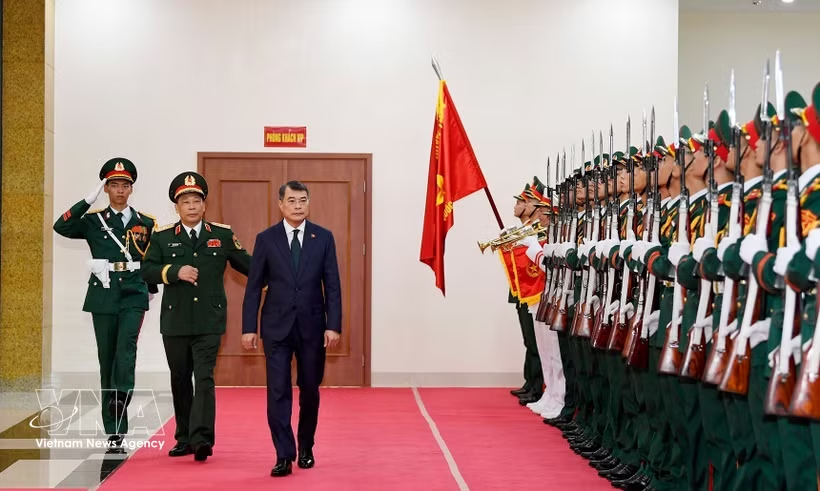
Hanoi (VNA) - Prime Minister Le Minh Hung attended the opening of the 2026-2027 academic year at the National Defence Academy in Hanoi on September 15, as the school prepares to mark the 50th anniversary of its Traditional Day.

For 50 years, the academy has closely followed the Party guidelines, policies and viewpoints, State laws, and orders from the Central Military Commission and Ministry of National Defence. That record, PM Hung said, has let it fulfill all assigned tasks and build a distinct reputation and tradition.

The academy has trained tens of thousands of senior Party, State and military officials, and its studies have shaped Vietnam's military and national defence theory and policy, feeding into key strategic decisions and building trust with other countries, he added.

The PM said safeguarding the Fatherland now carries tougher, more complex demands, requiring a peaceful and stable environment for development, firm protection of national interests, and zero tolerance for passivity and surprise in strategy. National defence no longer means just guarding territory, borders, seas and islands, but it extends to political, economic, cultural and ideological security, data, digital sovereignty and the country's strategic autonomy.

He urged turning those directives into concrete schemes, curricula, thematic studies, research projects, training scenarios and advisory products.

The leader called for major improvements in training for operational and strategic-level officers, as well as senior Party, State, and military officials, along with stronger scientific research. He said the academy should aim to be the nation’s top centre for strategic military and defence advice.

The academy must track global and regional developments closely, accurately size up partners and rivals, and stay ahead of changes in the international security environment. It should produce practical output, such as strategic forecasts, early warning and policy proposals, and absorb global military advances and technology without copying foreign models outright, while avoiding isolation, conservatism and slow adaptation to change.

According to him, the academy should remain Vietnam's research hub on all-people national defence, link defence policy with socio-economic development, and bolster the country's strategic autonomy. It should also develop theories, criteria and models for a modern all-people defence system suited to the country's new development model, its two-tier local administration and its evolving development space.

It should propose ways to fold defence and security requirements into regional and local development strategies, master plans, urban development and strategic infrastructure projects. That includes pairing marine economic development with protection of maritime sovereignty, ensuring the country can keep operating and recover quickly in a crisis, and converting economic and scientific resources into defence potential.

The Government leader also pressed for faster progress on science, technology, innovation and digital transformation, and building both a smart, modern academy and a corps of politically steadfast officials, lecturers and scientists with strategic thinking, practical skills, and a strong aspiration to contribute.
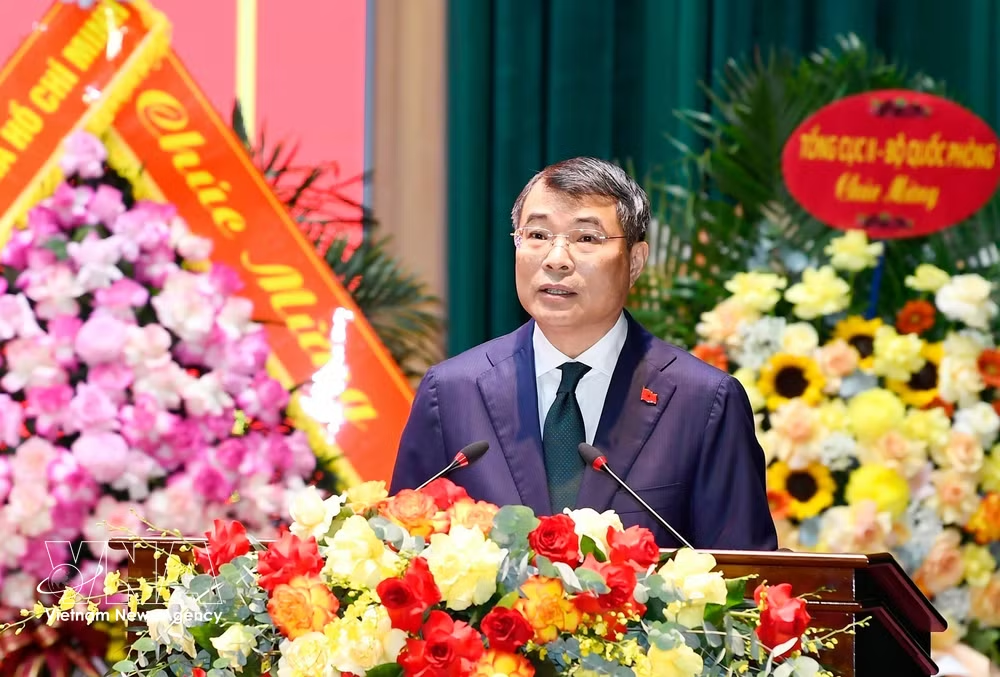
vnanet-k.jpg
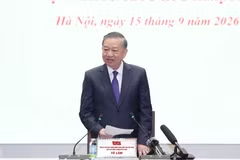
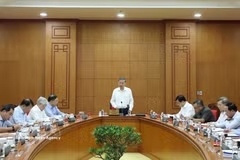
PM Le Minh Hung speaks at the opening of the National Defence Academy's 2026-2027 academic year (Photo: VNA)

The academy should become a model for digital transformation and technology use, and a strategic-level knowledge and innovation hub, he said. That means building a modern ecosystem spanning training, research, simulation models and decision-support systems, backed by integrated digital infrastructure, databases and a military-and-defence knowledge repository. He called for wider use of artificial intelligence in research and forecasting, plus more hands-on training environments.

It should also help design a self-reliant, resilient, dual-use defence industry with real competitiveness. Focus should be placed on defence economy, pooling scientific and technological resources, building an innovation ecosystem, and linking the army with research institutes, universities and companies.

He said the academy should build a contingent of officials and lecturers who model political and ethical standards, combine strategic thinking with in-depth theoretical knowledge, understand real-world conditions, master Vietnamese military art, and absorb the best global knowledge and practice.

Given its role in defence diplomacy, the academy should expand substantive and effective international cooperation to raise its own standing and that of the army and country as a whole, he said.

Earlier, the PM offered incense at the academy's memorial site for President Ho Chi Minh and toured its traditional hall, library and a model showcasing digital transformation in training./.
VNA

See more

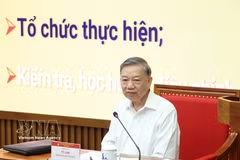
General Secretary of the Communist Party of Vietnam Central Committee and President To Lam speaks at the meeting with the 7th-term Executive Committee the Vietnam Union of Friendship Organisations (VUFO) on September 15. (Photo: VNA)

VUFO must focus on building networks for mobilising resources: Top leader

General Secretary and President To Lam expressed his confidence that VUFO will truly become a sharp and effective spearhead, proactively building trust, turning trust into resources and, through concrete actions, contributing to the country’s breakthrough development in the new era of national rise

Politburo Member and Permanent Member of the Party Central Committee’s Secretariat Dr Tran Cam Tu delivers a thematic presentation on the Party building on September 15. (Photo: VNA)

Key leader highlights important tasks in Party building

The Party building covers four key areas: political, ideological and ethical work, and organisation and personnel. These areas are closely interconnected and together form a unified whole that determines the Party’s strength and its ability to lead the revolutionary cause.

Lao Deputy Prime Minister and Minister of Foreign Affairs Thongsavanh Phomvihane (right) hosts a reception for Vietnamese Deputy Minister of Foreign Affairs Nguyen Thi Hoang Van in Vientiane on September 14. (Photo: VNA)

Vietnam seeks deeper cooperation with regional countries, partners

Vietnamese Deputy Minister of Foreign Affairs Nguyen Thi Hoang Van held bilateral meetings with Lao, Cambodian and Timor-Leste officials and representatives of the Mines Advisory Group (MAG) in Vientiane on September 14 on the sidelines of the Third Review Conference (3RC) of the Convention on Cluster Munitions 2026 in Vientiane, Laos, to deepen cooperation with regional countries and partners.

Prime Minister Le Minh Hung (first, right) and his Slovak counterpart Robert Fico (first, left) witness the signing of an MoU between the Commission for Standards, Metrology and Quality of Vietnam (STAMEQ) and the Office of Standards, Metrology and Testing (UNMS) of Slovakia in Hanoi on April 13, 2026. (Photo: VNA)

Vietnam-Slovakia strategic partnership ushers in new chapter

With strong political determination, complementary economies and concrete mechanisms of action, the Vietnam-Slovakia strategic partnership is expected to generate substantive progress, particularly in economy, science, technology and innovation, contributing to peace, stability and prosperity in the region and the world.

Vietnamese Ambassador to Algeria Vu Duy Long presents his credentials to Algerian President Abdelmadjid Tebboune on September 14. (Photo: VNA)

Vietnamese ambassador presents credentials to Algerian President

Vietnam and Algeria, despite their geographical distance, share longstanding ties, particularly during their struggles for national independence. Vietnam was among the first countries to establish diplomatic relations with Algeria on October 28, 1962, shortly after Algeria gained independence.

Politburo member and Minister of Foreign Affairs Le Hoai Trung (File Photo: VNA)

Vietnam, India seek stronger Party-to-Party ties

Vietnam and India enjoy a special relationship based on traditional friendship, solidarity, mutual support and high political trust. The elevation of bilateral ties to an Enhanced Comprehensive Strategic Partnership during General Secretary of the Communist Party of Vietnam Central Committee and President To Lam’s visit to India in May 2026 was an important milestone.

King of Thailand Maha Vajiralongkorn Phra Vajiraklaochaoyuhua and Queen Suthida Bajrasudhabimalalakshana arrive in Hanoi on September 14. (Photo: VNA)

Thai King, Queen arrive in Hanoi for State visit to Vietnam

The State visit to Vietnam by King of Thailand Maha Vajiralongkorn Phra Vajiraklaochaoyuhua and Queen Suthida Bajrasudhabimalalakshana holds not only political significance but also serves as a continuation of the friendship and close ties between the Thai Royal Family, Government and people and the Vietnamese Government and people.

☕ Afternoon briefing on September 14

☕ Afternoon briefing on September 14

PM Le Minh Hung's meetings with foreign leaders on the sidelines of the 18th BRICS Summit, Vietnam and the US signing a five-year MoU on health cooperation, and the 32nd meeting of the ASEAN Senior Level Committee on Financial Integration are among news highlights on September 14.

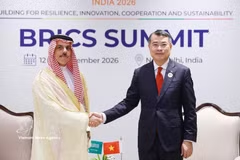
Prime Minister Le Minh Hung (R) receives Saudi Arabian Minister Foreign Affairs Prince Faisal bin Farhan Al Saud on September 13 on the sidelines of the 18th BRICS Summit in New Delhi, India. (Photo: VNA)

Vietnam seeks effective, substantive ties with Saudi Arabia

Affirming that Saudi Arabia is one of Vietnam’s most important partners in the Middle East, PM Hung expressed his pleasure at the positive development of bilateral relations in recent years, and voiced his wish to work with Saudi Arabia to further develop the bilateral relationship in a more effective and substantive manner, for the benefit of the two countries' people.