Ho Chi Minh City (VNA) - To meet Party Central Committee Resolution No. 20-NQ/TW’s target of cutting logistics costs to below 12% of GDP by 2030, Vietnam needs to restructure its logistics network, strengthen multimodal connectivity and digitalise supply chains to turn its maritime advantages into greater competitiveness, said insiders.
High logistics costs erode competitiveness
For exporters, logistics costs directly affect delivery capacity, customer satisfaction and the competitiveness of Vietnamese goods in international markets.
Pham Thi Bich Phuong, Chief Executive Officer of Noval Engineering, said road transport, delivery times, loading and unloading, and other logistics services account for a significant share of total costs. Small- and medium-sized enterprises also face difficulties in negotiating logistics fees with their partners, while dependence on road transport and delays in consolidating shipments can affect delivery schedules.
This situation not only imposes additional costs on businesses for storage, labour and delayed goods circulation, but also puts them at risk of failing to meet their partners’ commitments and requirements, she said.
Dang Thi Minh Phuong, President of the Logistics and Sea Ports Association of Ho Chi Minh City (HLA), said Vietnam’s logistics costs currently account for around 18% of GDP, higher than in some regional countries such as Thailand and Singapore.
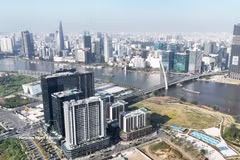
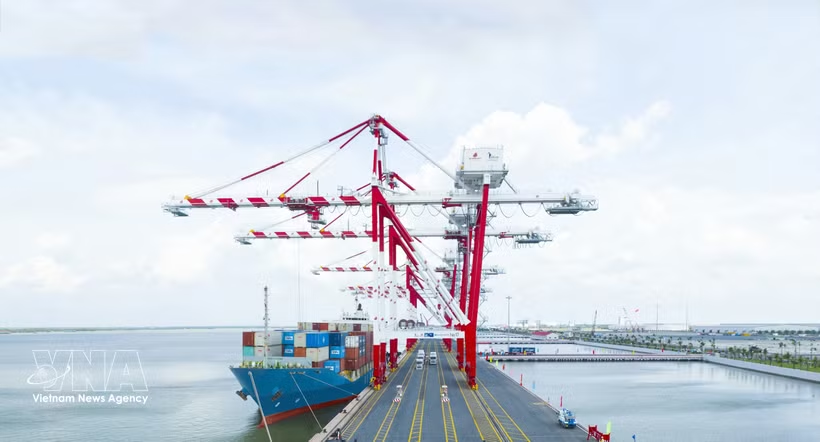
In Ho Chi Minh City, whose seaport system handles about 65% of the country’s container throughput, high logistics costs limit the city’s ability to capitalise on its maritime gateway advantage, she said.
She attributed this partly to inadequate connectivity across the southern economic region, heavy reliance on road transport, and congestion.
Sharing this view, Le Quang Trung, Deputy General Director of Vietnam Maritime Corporation and Chairman of the Board of Directors of Cai Mep International Port, said bottlenecks in infrastructure, fees and surcharges, policies, connectivity and information technology continue to drive up costs. He noted that multiple intermediaries and traditional, fuel-intensive transport methods also add to expenses, while waiting time at any stage of the supply chain becomes an additional cost.
At the recent third Ho Chi Minh City Friendship Dialogue 2026, international experts noted that high logistics costs are a global challenge facing major cities worldwide, requiring coordinated efforts in policy, infrastructure and international cooperation.
Building an integrated logistics ecosystem
Vietnam’s logistics market is estimated at around 42-45 billion USD annually, with annual growth of 16-18%. As import-export activities expand and Vietnam becomes more deeply integrated into global supply chains, logistics is expected to play a greater role in enhancing the competitiveness of Vietnamese goods.
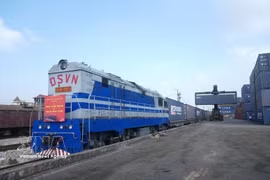
Trung said the Government is implementing measures to improve policies, infrastructure and connectivity, including rail links with China, highways and support for maritime and inland waterway transport. Green transport, shorter delivery times and fewer intermediaries are also expected to help reduce costs.
Vietnam’s logistics development strategy demonstrates the Government’s determination to facilitate the flow of goods and create favourable conditions for import-export businesses, he noted.
Truong Tan Loc, Chairman of the Members' Council of Tan Cang-Cai Mep International Port Co., Ltd., and Vice President of HLA, said stronger road, rail and waterway connectivity would give goods from the Mekong Delta and southeastern localities more transport options, helping shorten delivery times and lower costs, thus increasing the competitiveness of Vietnamese goods.
However, he stressed that hard infrastructure is only part of the solution. Trade facilitation, data connectivity, customs procedures, interoperability among ports and digital transformation are equally important in enhancing the effectiveness of logistics chains. Logistics planning should therefore be based on actual cargo flows rather than simply replicating foreign models.
Loc also highlighted Ho Chi Minh City’s major development plans, ranging from a free trade zone linked to its seaports to large-scale logistics hubs. He stressed that the key is to have a clear implementation roadmap and, most importantly, ensure that the plans deliver the targeted reduction in logistics costs.
According to Anthony Tay, co-founder and consultant at Singapore-based Cargonomics, restructuring the logistics network should involve a multi-node system linking production clusters, logistics hubs, gateway ports, international shipping and urban distribution. The focus should be on optimising the entire cargo journey rather than individual links.
Logistics efficiency should be measured by end-to-end cargo transit speed, reliability and total logistics costs, rather than the productivity of individual assets alone, he stressed.
Experts said achieving the 2030 target requires an integrated logistics ecosystem, stronger coordination among localities and real-time data sharing among customs authorities, ports, transport and logistics firms and cargo owners.
With deep-water ports, a prime spot on international shipping routes, and a growing production network, Vietnam is well-positioned to make its maritime economy a key engine of growth and boost the global competitiveness of its goods./.