Cao Bang, China’s Baise city eye to boost all-around cooperation

Cao Bang province of Vietnam and Baise city in the Guangxi Zhuang Autonomous Region of China are exploring a “red tourism” route linking Pac Bo and Meng Mo (China) to promote revolutionary tradition education and strengthen bilateral friendship. They are also stepping up cooperation in human resource development through training exchanges and efforts to improve workforce quality.

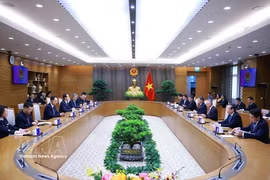
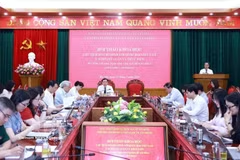
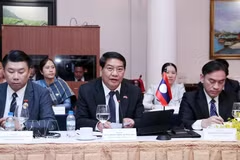
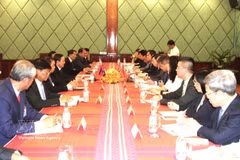
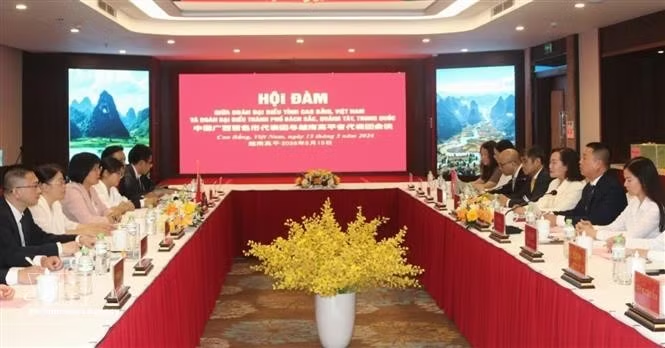
Officials from Cao Bang province of Vietnam and Baise city in the Guangxi Zhuang Autonomous Region of China hold talks on May 15. (Photo: VNA)

Cao Bang (VNA) – Officials from Cao Bang province of Vietnam and Baise city in the Guangxi Zhuang Autonomous Region of China held talks on May 15 to advance comprehensive cooperation across sectors, with a focus on border trade, health care, education and infrastructure connectivity.

The Vietnamese and Chinese localities share a long border and longstanding people-to-people exchanges, as well as cultural similarities - factors seen as favourable conditions for expanding bilateral cooperation.

In 2025, Cao Bang organised 20 working delegations to visit and engage with Baise, while also hosting many delegations from Baise’s agencies and businesses. Cross-border import-export activities remained stable, with total turnover exceeding 360 million USD.

​The two sides are exploring a “red tourism” route linking Pac Bo and Meng Mo (China) to promote revolutionary tradition education and strengthen bilateral friendship. They are also stepping up cooperation in human resource development through training exchanges and efforts to improve workforce quality.

Efforts are underway to build a “smart early warning platform” in health care, alongside enhanced information sharing to manage food safety risks, trace product origins and handle cases involving unsafe food. The two sides also agreed to strengthen coordination in monitoring and controlling cross-border public health risks.

Vice Chairwoman of the Cao Bang provincial People’s Committee Ha Nhat Le called for maintaining regular dialogue and expanding delegation exchanges, alongside stronger cooperation in health care and food safety, especially in cross-border disease control, data sharing, and emergency response.

She also urged enhanced border-gate economic cooperation, smoother customs clearance, and upgrades to border crossings and transport infrastructure to boost connectivity.

The two localities agreed to further enhance cooperation in education and training, expand cross-border tourism and strengthen coordination in border management to maintain security and order, towards building a peaceful, friendly, and stable border area with sustainable development.

For her part, Vice Mayor of Baise city Huang Caixue called for closer cooperation in food safety management, including building cross-border monitoring systems, improving business registration and product traceability at border markets, and recognising business licences.

She also proposed sharing rapid food testing technologies, developing cross-border culinary corridors, and organising food showcases at key border gates such as Tra Linh–Longbang and Soc Giang–Longbang.

In health care, Huang urged stronger coordination in preventing and controlling cross-border infectious diseases, enhancing data sharing and risk assessment, and conducting regular joint emergency drills. She also suggested expanding cross-border emergency medical corridors, establishing rapid-response transport for critical patients, and improving cross-border healthcare services.

Regarding education, the two sides agreed to expand cooperation in training officials, step up youth exchanges, and organise regular summer camps and study programmes, while exploring “friendship schools,” promoting online Vietnamese–Chinese language learning, and facilitating teacher exchanges.

The localities expressed interest in exploring the application of artificial intelligence and smart monitoring technologies to address shared challenges, particularly in food safety control, health care and education./.​

VNA

See more

Deputy Minister of Foreign Affairs Le Thi Thu Hang speaks at the panel discussion titled “Russia – APEC: Broad Cooperation Prospects on the Horizon until 2035”. (Photo: VNA)

Vietnam shares vision, preparations for APEC 2027

Deputy Foreign Minister Le Thi Thu Hang underlined the importance of stronger coordination between APEC and other regional and global mechanisms in order to improve efficiency and optimise resources in addressing common challenges.

General Secretary of the Central Committee of the Communist Party of Vietnam and President of Vietnam To Lam delivers a keynote address at the opening of the 23rd Shangri-La Dialogue in Singapore on May 29. (Photo: VNA)

Singaporean FM highlights shared strategic outlook with Vietnam

Singapore and Vietnam remain committed to supporting a rules-based international order, strengthening ASEAN integration, and enhancing the bloc’s resilience. The two countries upgraded their ties to a Comprehensive Strategic Partnership (CSP) last year, marking Singapore’s first CSP with an ASEAN member state.

Deputy Minister of Foreign Affairs Nguyen Manh Cuong (Photo: VNA)

ASEAN Future Forum 2026 to advance ASEAN community-building process

Vietnam hopes the forum will continue to demonstrate its role as an active and responsible member of the Association of Southeast Asian Nations (ASEAN), contributing to regional affairs and advancing the Party and State’s foreign policy and international integration strategy.

General Secretary of the Communist Party of Vietnam Central Committee and State President To Lam speaks at the 23rd Shangri-La Dialogue on May 29, 2026. (Photo: VNA)

Vietnam contributes to shaping regional agenda at 23rd Shangri-La Dialogue: Indian expert

Speaking to Vietnam News Agency correspondents in New Delhi, Pradhan noted that, drawing on his extensive experience in national security and international relations, as well as his deep knowledge of international law, the top Vietnamese leader identified three closely interrelated crises facing the world today: a crisis of the international order, a crisis of the development model, and a crisis of strategic trust.

Administrative procedures cut and simplified will be publishedNational Public Service Portal (Photo: VNA)

Administrative procedures cut, simplified to be published online

The dispatch states that in implementing Conclusion No. 18-KL/TW dated April 2, 2026 of the 14th Party Central Committee on the 2026–2030 socio-economic development plan, national finance, public debt management and medium-term public investment, linked to the goal of achieving double-digit economic growth, the Government on April 29 issued 11 resolutions on cutting, decentralising and simplifying administrative procedures, business conditions, and conditional business lines. The Prime Minister subsequently directed ministries, agencies and localities to implement these resolutions.

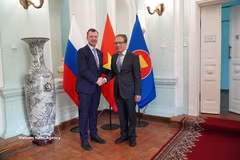
Minister of Foreign Affairs Le Hoai Trung (R) welcomes visiting Angolan Minister of External Relations Téte António in Hanoi on June 4 (Photo: VNA)

Vietnamese, Angolan foreign ministers hold talks in Hanoi

The Vietnamese FM proposed that the two sides strengthen political trust through high-level exchanges, while maintaining existing cooperation mechanisms, particularly the Vietnam–Angola Intergovernmental Committee and Political Consultations between the two foreign ministries.