China, Vietnam see broad scope for high-tech agricultural cooperation: scholar

China and Vietnam are geographically close, sharing mountains and rivers, as well as many cultural similarities and complementary agricultural resources.

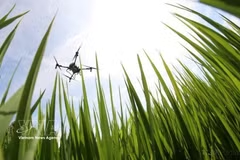
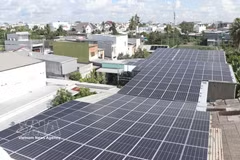
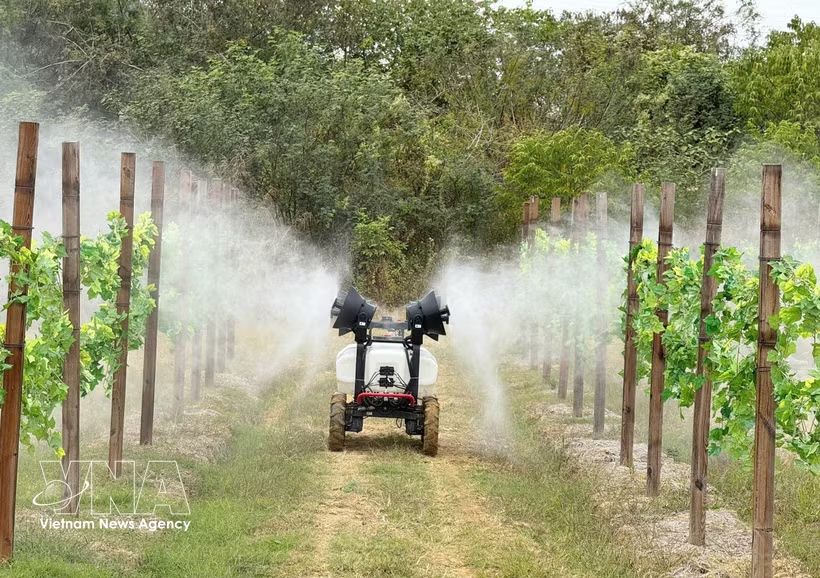
A high-tech agricultural model in China's Guangdong province (Photo: VNA)

Hanoi (VNA) – Prof. Wei Longbao, Vice Chair of the United Nations Academic Impact Sustainable Development Goals Hub 1 and Director of the Institute of Food and Agribusiness Management at Zhejiang University, has said that agricultural cooperation has always been an important pillar of Vietnam-China relations.

China and Vietnam are geographically close, sharing mountains and rivers, as well as many cultural similarities and complementary agricultural resources, he told Vietnam News Agency correspondents in Beijing.

China is currently Vietnam’s largest agricultural export market, while Vietnam is China’s largest agricultural trading partner in ASEAN. The two sides have established mechanisms including the China-Vietnam Joint Committee on Agricultural Cooperation and a conference between agricultural authorities of China’s Guangxi Zhuang Autonomous Region and Vietnam’s four border provinces. They also leverage the Regional Comprehensive Economic Partnership (RCEP) and the China-ASEAN Free Trade Area to promote high-tech agriculture, agricultural market access and cross-border cooperation.

Vietnam is now at a critical stage of agricultural digital transformation. Despite abundant resources and favourable climate conditions, fragmented small-scale farming and a shortage of digital talent have created demand for advanced, practical technologies. China, meanwhile, has developed comprehensive systems for smart agricultural equipment, digital farming and crop breeding. Similar agricultural conditions in the two countries also offer considerable potential for technology adaptation.

The Chinese scholar identified four major challenges: difficulties in localising technologies amid differences in infrastructure and ecological conditions; limited mutual recognition of standards and customs facilitation, resulting in repeated inspections and higher trade costs; shortages of talent, particularly in AI and digital skills among Vietnamese farmers, alongside a lack of personnel in China combining technical expertise with knowledge of Vietnam; and competition from countries such as Israel and the Netherlands, as well as cross-border risks involving exchange rates, land and disease.
vnanet-china2.jpg
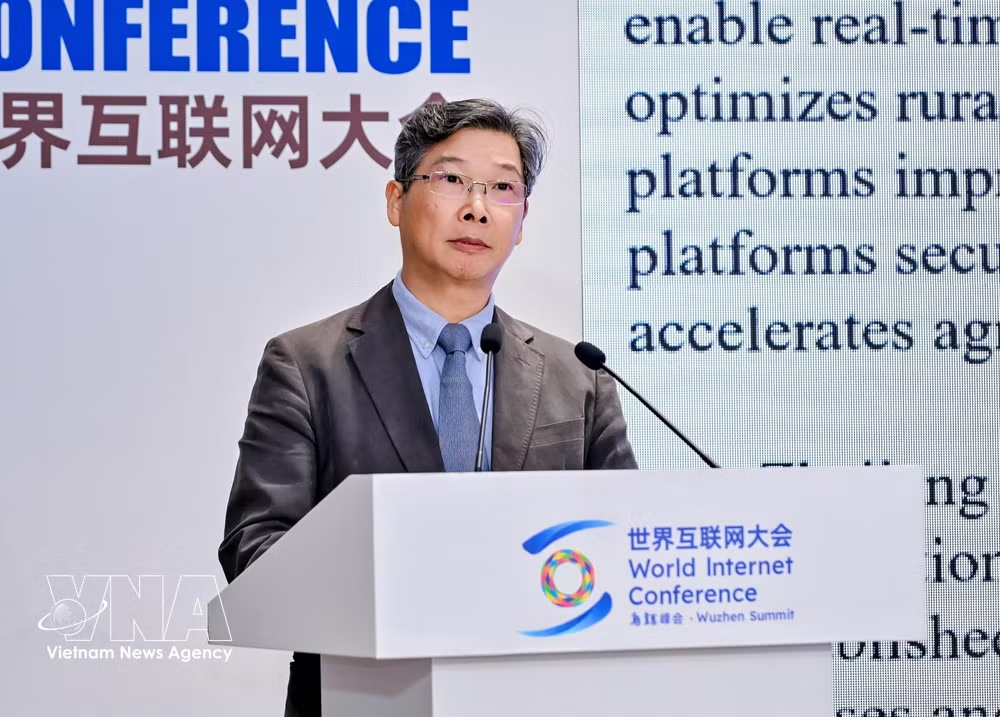
Prof. Wei Longbao, Vice Chair of the United Nations Academic Impact Sustainable Development Goals Hub 1 and Director of the Institute of Food and Agribusiness Management at Zhejiang University (Photo: VNA)

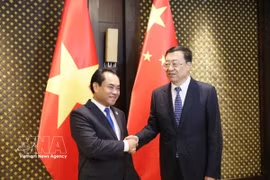
Regarding prospects for cooperation, Wei noted that China and Vietnam issued a joint statement in April 2026 on building a China-Vietnam community with a shared future that carries strategic significance and deepening their comprehensive strategic cooperative partnership. He said this provides a high-level framework for cooperation across the high-tech agricultural value chain and regional food security.

Agricultural science and technology cooperation is therefore shifting from product trade towards deeper integration of technology, capital, talent and standards.

He highlighted three Chinese models that could provide useful references. The first integrates multiple technologies around specific production needs. Smart farms combine satellite remote sensing, sensors and intelligent machinery for precision field management, while automated environmental monitoring improves resource efficiency in livestock and aquaculture.

The second involves multi-party cooperation, demonstration and promotion. Research institutes provide technologies, enterprises commercialise them, cooperatives and farmers apply them, and demonstration bases promote scalable solutions. For international cooperation, joint research and development, and small-scale trials can precede local adaptation and gradual expansion.

The third is socialised services and shared use. Instead of requiring individual farmers to purchase sophisticated machinery, drones and digital systems, cooperatives or service centres can provide equipment through leasing and other services, lowering entry barriers and addressing operational training through professional teams.

Among China’s notable applications is the “BeiDou+Smart Agriculture Maize Large-Area Yield Improvement Pilot” in Datong, Shanxi province. Integrating autonomous equipment, weather stations and soil-moisture monitoring, the system increased planting density by 33% and average yields by 15.5%, while reducing irrigation by 40% and fertiliser use by 15%.

In Shunchang, Fujian province, IoT and AI technologies are being used across 6,667ha of citrus orchards for real-time monitoring and precision fertilisation and pest control.

Meanwhile, a smart shrimp-farming model in Jiangsu province uses underwater sensors and automated feeding and environmental controls. It has increased output by about 20% and cut farming costs by more than 15%, Wei said./.
VNA

See more

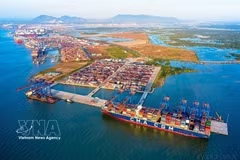
Gemalink International Port in Ho Chi Minh City is one of the strategic seaports for industry, trade and global integration. (Photo: VNA)

Vietnam deepens global supply-chain integration

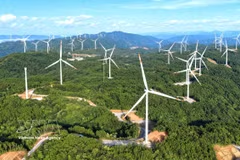
Deputy Minister of Industry and Trade Phan Thi Thang said Vietnam remains a top priority for international corporations and buyers seeking new sources of supply, thanks to its 17 FTAs, stable investment environment, improving production capacity and strategic location in Southeast Asia.

Illustrative image (Photo: VNA)

Vietravel Airlines resumes Hanoi – Da Lat route

Resuming the route is part of the carrier's year-end operating plan. It's a concrete step toward optimising the airline's domestic network, and a sign of its commitment to helping Lam Dong province revitalise tourism following the airport upgrades, its representative said.

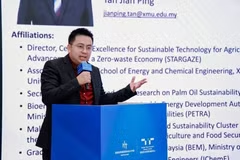
Prof. Tan Jian Ping, Director of the Centre of Excellence for Sustainable Technologies for Agricultural Advancement and a Zero-Waste Economy (STARGAZE) at Xiamen University Malaysia (Photo published by VNA)

Vietnam, Malaysia see potential for smart agriculture cooperation

Prof. Tan Jian Ping, Director of the Centre of Excellence for Sustainable Technologies for Agricultural Advancement and a Zero-Waste Economy (STARGAZE) at Xiamen University Malaysia (XMUM), said NAP 2.0 focuses on applying Industry 4.0 technologies, including the Internet of Things (IoT), unmanned aerial vehicles, artificial intelligence (AI), automation and biotechnology.

The 30th Export Day draws representatives from various organisations and businesses in Argentina. (Photo: VNA)

Vietnam, Argentina eye broader Mercosur access amid free trade push

During the 30th Export Day, organised on September 15 in Buenos Aires by the Chamber of Exporters of the Argentine Republic (CERA) under the theme "New Export Frontier: The Transformation Underway," Vietnamese Ambassador to Argentina Ngo Minh Nguyet highlighted that Vietnam considers Argentina and Mercosur important partners in South America and sees broad potential to deepen trade and investment ties.

Drone is used in seeding, fertilising and pesticide spraying (Photo: VNA)

Greening agriculture through low-emission crop production

The scheme to sustainably develop 1 million ha of high-quality, low-emission rice in the Mekong Delta by 2030 is advancing, said Nguyen Quoc Manh, Deputy Director of the Department of Plant Production and Protection at the Ministry of Agriculture and Environment.

DACE launches organic spice processing, preservation and export plant in Cao Bang (Photo: VNA)

Cao Bang develops organic farming zones linked to European markets

Around 2,353ha of farmland in the province meets organic standards, including more than 2,332ha of spice-growing areas cultivating cinnamon, star anise and ginger that have obtained internationally recognised certifications such as USDA (US), EU and JAS (Japan).

Electronic components are produced at a factory in Hanoi. (Photo: VNA)

Hanoi's imports surge 41% in first eight months of 2026

Hanoi aims to achieve average annual export growth of at least 12% during 2026-30, with the city seeking to diversify export markets, boost high-tech and value-added products and reduce reliance on traditional markets.

Ben Thanh Market in Ho Chi Minh City attracts a large numbers of domestic and international visitor.( Photo: VNA)

Vietnam targets 50 million international visitors by 2030

The Ministry of Culture, Sports and Tourism has outlined three scenarios for 2027–2030. Under the high-growth scenario, international arrivals would rise 15–18 percent annually to reach 45–50 million, while domestic tourism would reach around 160 million trips. Total tourism revenue is projected at 80–90 billion USD.

Factories and production facilities in the Chu Lai Open Economic Zone, Da Nang city, are equipped with modern production lines. (Photo: VNA)

Ready-built factories gain from new manufacturing FDI wave

Ready-built factories attracted 73% of new manufacturing FDI in northern Vietnam over the past two quarters, as foreign investment continued to surge at the region's industrial hubs during the first eight months of 2026. The trend points to growing demand for premises that can be put into operation quickly.