Hanoi (VNA) – Vietnam is leveraging its 17 free trade agreements, growing production capacity and expanding international market access to strengthen its position in global value chains, but exporters face mounting pressure to meet higher technological, green and traceability standards.
Opportunities come with challenges
Non-food consumer goods remain a key export group, with electronics taking the lead, according to experts. In 2025, electronics exports reached nearly 165 billion USD, making a major contribution to total export turnover of more than 475 billion USD.
In the first eight months of 2026, exports value stood at nearly 375 billion USD, up 22.4% year-on-year. Key export groups included electronics at nearly 150 billion USD, textiles and garments at nearly 27 billion USD, and footwear at more than 16 billion USD.
However, exporters are increasingly affected by global economic uncertainty and intensifying trade competition. Tighter regulations, particularly on green standards and sustainable development, are also becoming significant barriers.
International Business Development Director at Tan Phu Vietnam JSC Nguyen Dang Khoa said green production has become a prerequisite for entering high-standard markets such as the EU and US.
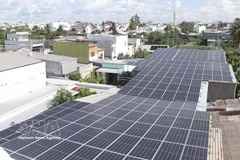
To improve transparency and fulfill social responsibility, the company is standardising recycled plastic materials, optimising operations to cut emissions and save energy, and adopting international certifications, including ISO 14001, BSCI, FSC and Higg FEM. He described green transformation as a long-term strategic investment and a vital factor in working with global partners.
Cha Ji-ho, Director of Samsung Vietnam's Procurement Centre, said global supply-chain standards are changing rapidly. Major companies now require not only competitive prices but also stable delivery, consistent quality, timely technical support, transparent data management and sustainable development.
Enhancing competitiveness
Deputy Minister of Industry and Trade Phan Thi Thang said Vietnam remains a top priority for international corporations and buyers seeking new sources of supply, thanks to its 17 FTAs, stable investment environment, improving production capacity and strategic location in Southeast Asia.
The Government has set a 2026 export growth target of 15-16%, aiming for turnover of 546-550 billion USD.
Do Quoc Hung, Acting Director of the Ministry of Industry and Trade's Department of Foreign Market Development, said producing quality goods alone is no longer enough for Vietnamese businesses to establish deeper positions in global value chains. They need to enhance competitiveness, restructure production and business plans to meet increasingly stringent sustainability and traceability requirements, while responding to consumer trends and exploiting modern distribution channels, he added.
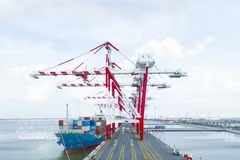
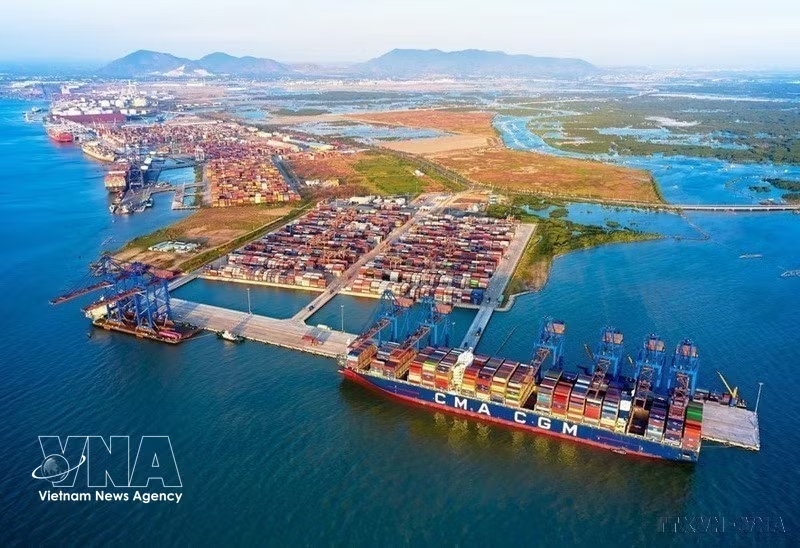
Tran Phu Lu, Deputy Director of the Ho Chi Minh City Investment and Trade Promotion Centre (ITPC), said the city is restructuring its industrial and agricultural sectors toward modern, circular models linked with digital and green transformation. It is also investing in logistics infrastructure, developing new-generation free trade zones with smart logistics centres, international transshipment ports and cargo airports, and reorganising ports and inland container depots to strengthen regional connectivity.
He added that the city is also improving the business environment and simplifying administrative procedures to help firms address tariffs, technical barriers and sustainability requirements in major markets, while promoting green and digital transformation, technological innovation, stronger brands and e-commerce to expand globally./.