Greening agriculture through low-emission crop production

The scheme to sustainably develop 1 million ha of high-quality, low-emission rice in the Mekong Delta by 2030 is advancing, said Nguyen Quoc Manh, Deputy Director of the Department of Plant Production and Protection at the Ministry of Agriculture and Environment.

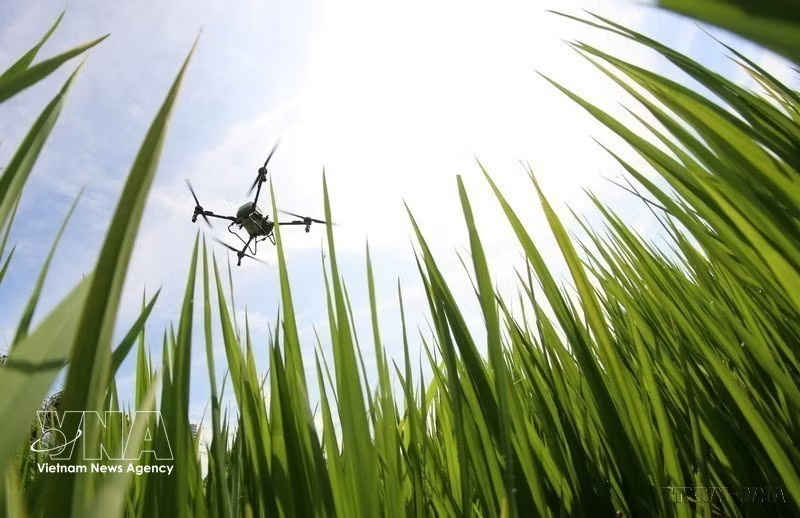
Drone is used in seeding, fertilising and pesticide spraying (Photo: VNA)

Hanoi (VNA) – Vietnam's low-emission farming models are delivering, and farmers are buying in. The results are strong enough that the cultivation sector is now moving to standardise practices, clear regulatory bottlenecks and pool investment as it pushes toward a fully "green" system.

A rapid scale-up

The scheme to sustainably develop 1 million ha of high-quality, low-emission rice in the Mekong Delta by 2030 is advancing, said Nguyen Quoc Manh, Deputy Director of the Department of Plant Production and Protection at the Ministry of Agriculture and Environment.

The 2025 target was 180,000 ha. By year-end, cultivated area already topped 379,000 ha, more than double the goal. That figure climbed to almost 421,000 ha by August 2026, with roughly 68,000 ha meeting every criterion, as more than 175,000 farming households joined the scheme.

An Giang is leading the region with 159,667ha, followed by Dong Thap (97,053), Can Tho (76,000), Tay Ninh (69,390), Vinh Long (13,703) and Ca Mau (5,000).

Northern provinces are following suit, with low-emission rice models underway in Hung Yen, Ninh Binh and Hai Phong. Hai Phong alone is targeting 10,000 ha this year, said Luong Thi Kiem, Deputy Director of the municipal Department of Agriculture and Environment.

She said some 5,000ha are already in the final tillering and panicle-initiation stages, with early encouraging results. That puts Hai Phong on track to cut total greenhouse gas emissions 10-15% by 2035 from a 2020 baseline.
vnanet-f.png
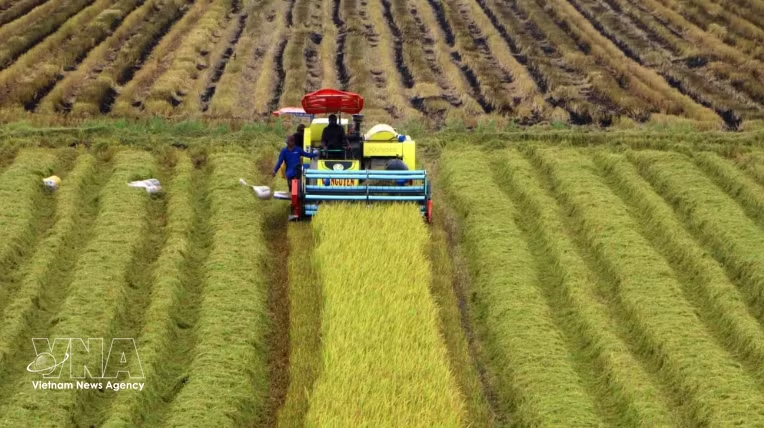
Harvesting high-quality, low-emission rice in Can Tho city (Photo: VNA)

The ministry is not stopping at rice. It is drafting similar low-emission processes for coffee, cassava and other key crops as it looks to green the entire cultivation sector. It is a concrete step toward fulfilling Vietnam's international climate commitments - a foundation for a greener, responsible and higher-value agricultural sector.

Toward concentrated farming areas

According to local authorities, mechanism and policy coordination still falls short of what the scheme needs. Irrigation, farm roads, drying and storage facilities, and logistics remain inadequate in many areas.

Mechanisation is patchy in some areas, especially precision seeding and water management. Digital and technology adoption remains fragmented as well.

The measurement, reporting and verification (MRV) system, along with certification standards and carbon-credit mechanisms, remains unfinished. Unclear rules on managing and sharing emission-reduction revenue add another bottleneck. Some cooperatives also lack the management and service capacity to link farmers into the supply chain.

The sector's near-term focus is clearing those obstacles. Priorities include standardising the MRV system, building value chains and markets for low-emission products, and creating dedicated production zones by commodity and ecological region, Manh said.

The sector wants international donors to shift funding away from one-off pilot projects and toward standardisation and large-scale replication. That means prioritising research, testing and technical packages tailored to different ecological zones and growing seasons.

Core techniques include certified seeds, precision seeding to cut seed use, and alternate wetting-and-drying irrigation. Better nutrient management, including lower nitrogen use, improved soil health and integrated pest control, is also a priority.

Straw treatment and reuse, full-cycle mechanisation and coordinated drying and storage are next in line to cut losses. That will require new investment in irrigation, farm roads, storage infrastructure and logistics networks, Manh said./.

VNA

See more

DACE launches organic spice processing, preservation and export plant in Cao Bang (Photo: VNA)

Cao Bang develops organic farming zones linked to European markets

Around 2,353ha of farmland in the province meets organic standards, including more than 2,332ha of spice-growing areas cultivating cinnamon, star anise and ginger that have obtained internationally recognised certifications such as USDA (US), EU and JAS (Japan).

Electronic components are produced at a factory in Hanoi. (Photo: VNA)

Hanoi's imports surge 41% in first eight months of 2026

Hanoi aims to achieve average annual export growth of at least 12% during 2026-30, with the city seeking to diversify export markets, boost high-tech and value-added products and reduce reliance on traditional markets.

Ben Thanh Market in Ho Chi Minh City attracts a large numbers of domestic and international visitor.( Photo: VNA)

Vietnam targets 50 million international visitors by 2030

The Ministry of Culture, Sports and Tourism has outlined three scenarios for 2027–2030. Under the high-growth scenario, international arrivals would rise 15–18 percent annually to reach 45–50 million, while domestic tourism would reach around 160 million trips. Total tourism revenue is projected at 80–90 billion USD.

Factories and production facilities in the Chu Lai Open Economic Zone, Da Nang city, are equipped with modern production lines. (Photo: VNA)

Ready-built factories gain from new manufacturing FDI wave

Ready-built factories attracted 73% of new manufacturing FDI in northern Vietnam over the past two quarters, as foreign investment continued to surge at the region's industrial hubs during the first eight months of 2026. The trend points to growing demand for premises that can be put into operation quickly.

Vietnamese durian industry pivots from volume to value

Vietnamese durian industry pivots from volume to value

Durian has morphed from a high-value crop into a strategic Vietnamese export. But as output climbs and importing markets tighten rules on quality, food safety and traceability, the industry must pivot from volume growth to sustainable value chains, better quality and diversified markets.

A display area for Mid-Autumn Festival cakes at a supermarket (Photo: VNA)

Mid-Autumn Festival cake market heats up at affordable end

Industry insiders say competition is no longer just about the cake itself. Product quality, packaging, brand reputation, delivery services and personalisation are increasingly shaping consumer choices in a market crowded with both domestic and foreign players.

Minister of Foreign Affairs Le Hoai Trung (Photo published by VNA)

Vietnam, India set 25 billion USD trade goal

Vietnam and India agreed to make better use of complementary strengths, ease market access difficulties and facilitate business activities toward achieving the 25 billion USD bilateral trade target.

Delegates at the meeting between Vietnamese businesses operating in Cambodia and the Council for the Development of Cambodia (CDC) on September 14. (Photo: VNA)

Vietnamese businesses seek to expand investment in Cambodia

Vietnam currently has 223 investment projects in Cambodia with total registered capital of nearly 3.4 billion USD. Vietnamese companies operate in agriculture, particularly large-scale farming, finance and banking, telecommunications, aviation, processing, trade and services.