National credibility – investment advantage for ASEAN’s Fabulous Five: expert

Investors are drawing a clearer distinction between economies driven by cyclical growth and those capable of converting growth momentum into sustainable, risk-adjusted returns.

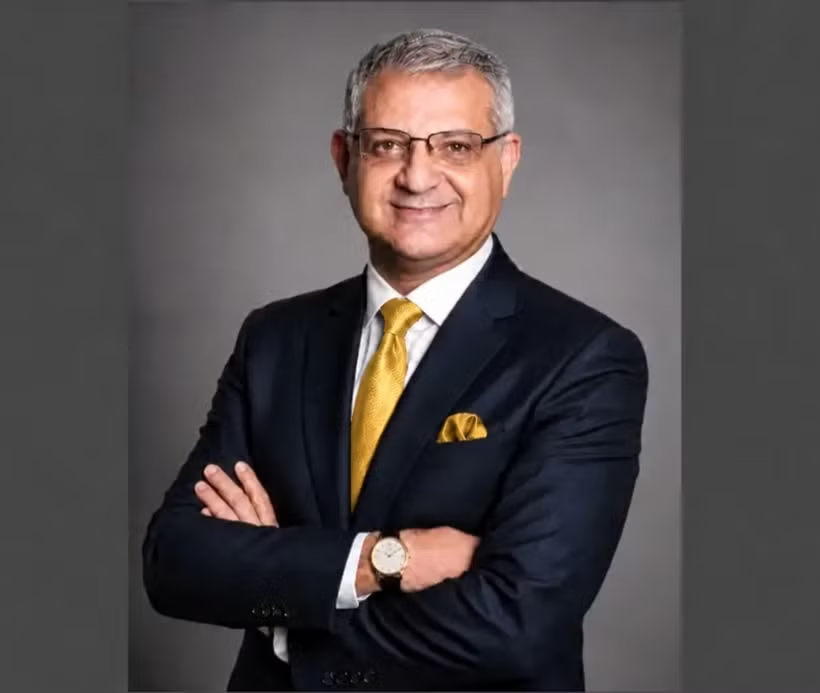
Shan Saeed, Global Chief Economist at Malaysian proptech group IQI Juwai (Photo published by VNA)

Kuala Lumpur (VNA) – Fiscal credibility, adequate foreign-exchange reserves, currency resilience and institutional implementation capacity are core factors in the framework of ASEAN’s “Fabulous Five” economies, said Shan Saeed, Global Chief Economist at Malaysian proptech group IQI Juwai.

For professional investors, growth is increasingly seen as a “ticket” to enter a market rather than the ultimate destination for investment. Investors are drawing a clearer distinction between economies driven by cyclical growth and those capable of converting growth momentum into sustainable, risk-adjusted returns.

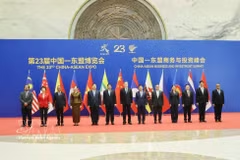
The concept of ASEAN’s “Fabulous Five”, also referred to by Saeed as the ITPV group, comprises Malaysia, Indonesia, Thailand, the Philippines and Vietnam. Together, they represent more than 611 million people and a combined nominal GDP of approximately 3.5–3.6 trillion USD.

Talking to the Vietnam News Agency, Saeed said the 2026 growth rankings highlight both the scale and differences among these economies. Malaysia grew 6.0% in the second quarter, bringing first-half growth to 5.7%, driven by manufacturing, services and trade. Indonesia expanded 5.29%, underpinned by domestic demand, investment and downstream industrial development.

Thailand grew 1.9% while the Philippines recorded 2.3%, highlighting the need to improve productivity and accelerate the implementation of investment projects.

Vietnam provides the clearest example of how economic growth can be translated into institutional credibility. Its GDP grew 8.39% in the second quarter and 8.18% in the first half of 2026 while manufacturing expanded 10.23%. Total registered foreign investment during January–July reached 38.06 billion USD, up 58%, and disbursed FDI increased 11.8% to 15.2 billion USD.

The country's foreign trade turnover reached 770.1 billion USD in the first eight months of 2026, up 28.7% year on year. Capital goods and production inputs accounted for 94.1% of total imports, demonstrating strong demand for machinery, equipment, materials and industrial inputs as the economy expands its production capacity.

The expert noted that the next major institutional milestone is expected on September 21, when FTSE Russell is scheduled to reclassify Vietnam from Frontier Market to Secondary Emerging Market following reforms to market accessibility and trading infrastructure.

More than simply an index reclassification, the upgrade will indicate that Vietnam’s capital market structure is moving closer to international institutional standards, he opined.

Overall, Saeed said, the prospects for the “Fabulous Five” remain highly attractive. Malaysia offers financial depth, semiconductor capabilities and increasingly advanced digital infrastructure. Indonesia brings economic scale, strategic resources and the capacity to develop downstream industries. Thailand contributes well-established manufacturing ecosystems and strong integration into regional supply chains. The Philippines offers demographic advantages, a deep services sector and potential for digital economy development. Vietnam combines export-oriented manufacturing, infrastructure development, FDI attraction and capital market reforms.

These five economies are neither growing at the same pace nor exposed to the same level of risk. It is precisely these differences that make the framework useful to global investors, he noted.

Risks remain, ranging from trade fragmentation and exchange-rate volatility to credit pressures and uneven policy implementation. At the same time, capital is increasingly focused on the quality of growth rather than growth rates alone, according to the economist.

Saeed concluded that ASEAN has abundant growth potential. However, substantive and reliable growth is scarcer and therefore more valuable. Growth attracts capital, but national credibility ultimately determines the cost, maturity and sustainability of that capital./.

VNA
See more

VinFast electric cars are gathered at Hai Phong Port, ready to be loaded onto a ship for export. (Photo: VNA)

Going global: The competition challenge for "Made in Vietnam" cars

The growing number of exporters shows that Vietnam’s automobile industry is entering a new stage of development. However, international markets also present major challenges related to localisation, supporting industries, technological capabilities, human resources and country-specific technical standards.

Ports in Ho Chi Minh City are always bustling with ships loading and unloading cargo (Photo: VNA)

Ho Chi Minh City helps businesses effectively leverage FTAs

Ho Chi Minh City will implement a range of tasks and solutions to enhance business competitiveness, promote sustainable exports, expand markets, and enable local businesses to engage more deeply in global value and supply chains. The move is also expected to contribute to the development of Ho Chi Minh City as a regional hub for trade, logistics and international economic integration.

Illustrative image (Photo: VNA)

Livestreaming helps Vietnamese goods break past local markets

Once a product goes digital, it can transcend geography entirely. Consumers no longer need to visit a store or craft village in person to learn where a product comes from, how it's made, or whether it's worth buying. They can do all of that, and decide to buy, from a screen.

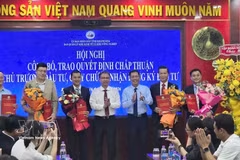
The south-central province of Khanh Hoa on September 16 announces investment approval decisions and investment registration certificates for five projects worth nearly 10.82 trillion VND (415.96 million USD). (Photo: VNA)

Khanh Hoa approves industrial projects with investment of 10.8 trillion VND

The south-central province of Khanh Hoa on September 16 announced investment approval decisions and investment registration certificates for five projects worth nearly 10.82 trillion VND (415.96 million USD), including three industrial park infrastructure projects and two foreign-invested ones.

A view of a ceremony to kick off the Northern Industry and Trade Fair - Bac Ninh 2026 on September 16, 2026 (Photo: VNA)

Northern industry-trade fair 2026 opens in Bac Ninh

The Northern Industry and Trade Fair - Bac Ninh 2026 features more than 222 booths with over 200 participating organisations and businesses, showcasing and introducing industrial and trade products from provinces and cities in the region, One Commune One Product (OCOP) items, typical rural industrial products, traditional craft village products, signature products of businesses, as well as regional trade, tourism and food products.

Delegates share information during the livestream programme. (Photo: VNA)

Bac Ninh promotes agricultural products through livestream

More than 300 products from Bac Ninh, Hanoi, Hung Yen, Son La, Thai Nguyen and Phu Tho were showcased during a livestream session held by the Bac Ninh Farmers' Union, ranging from traditional foods, agricultural products and medicinal herbs to natural products, OCOP goods, handicrafts and craft village products.

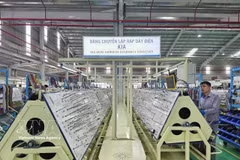
An automobile assembly line of THACO Truong Hai Group. (Photo: VNA)

Flexible fiscal policy helps drive economic growth

According to the Ministry of Finance, State budget revenue in the first eight months of 2026 was estimated at 2.02 quadrillion VND (77.7 billion USD), equivalent to 80% of the annual estimate and up 16% year-on-year. Domestic revenue reached 1.75 quadrillion VND, accounting for 86.6% of total revenue and rising 16.6%.

Visitors explore Vietnamese products at WorldFood Moscow 2026. (Photo: VNA)

Vietnamese goods step up market expansion in Russia

The Vietnamese participants are showcasing a wide range of products, including beverages, fresh and dried fruit, processed foods, instant foods and dipping sauces, while seeking distribution partners, expanding their market presence and increasing brand recognition in the country.

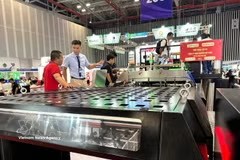
A Vietnamese manufacturer showcases a modern production line at VietnamPrintPack 2026. (Photo: VNA)

VietnamPrintPack 2026 kicks off in Ho Chi Minh City

VietnamPrintPack 2026 serves as a hub connecting the supply chain, showcasing breakthrough solutions in automation, digital printing, radio-frequency identification (RFID)-integrated smart packaging, and eco-friendly materials across Vietnam's industrial landscape.

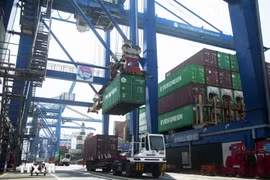
Gemalink International Port in Ho Chi Minh City is one of the strategic seaports for industry, trade and global integration. (Photo: VNA)

Vietnam deepens global supply-chain integration

Deputy Minister of Industry and Trade Phan Thi Thang said Vietnam remains a top priority for international corporations and buyers seeking new sources of supply, thanks to its 17 FTAs, stable investment environment, improving production capacity and strategic location in Southeast Asia.