Malaysia leads ASEAN in post-quantum security readiness

The ranking reflects the country’s preparations to protect government data, financial transactions, digital identities, communications systems and essential services from future cybersecurity threats posed by advances in quantum computing.

Kuala Lumpur (VNA) – Malaysia is the only ASEAN country placed in Group 1, the highest of five tiers, for readiness to transition to post-quantum cryptography (PQC), according to the “ASEAN Post-Quantum Cryptography Readiness 2026: An Empirical Assessment of ASEAN-10” report released by SITG-Consulting on September 1.

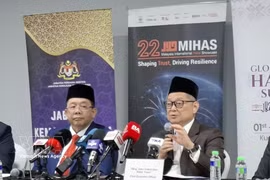
The Malaysian National Security Council (MKN) said the ranking reflects the country’s preparations to protect government data, financial transactions, digital identities, communications systems and essential services from future cybersecurity threats posed by advances in quantum computing, BusinessToday.com.my reported on September 15.

Malaysia’s preparations include a national PQC migration plan, PQC technology pilot programmes and awareness initiatives for agencies involved in the country’s National Critical Information Infrastructure (NCII).

The MKN said the government will continue strengthening the national PQC migration plan to ensure critical infrastructure remains secure and resilient as quantum technology advances. The next phase will focus on closer cooperation with NCII lead agencies, NCII operators and industry stakeholders.

PQC refers to cryptographic methods designed to protect information against the risk that future quantum computers could break some widely used encryption algorithms. Transitioning to PQC is therefore considered an important part of long-term cybersecurity planning./.

VNA

See more

Prime Minister Le Minh Hung attends and delivers a speech at the working lunch session of the 18th BRICS Summit 2026, themed “Resilience, Innovation, Cooperation and Sustainable Development: Shaping the Future of Inclusive Global Growth” in New Delhi on September 13, 2026. (Photo: VNA)

Vietnam needs to transform BRICS into strategic autonomy, expansion: Indian expert

According to S.D Pradhan, former Deputy National Security Advisor of India, the active participation and practical contributions of partner countries, including Vietnam, played a role in the overall success of the 18th BRICS summit. For Vietnam, its status as partner country offers an opportunity to diversify external ties and better align with emerging drivers of growth.

King Maha Vajiralongkorn (Photo: VNA)

Thai media highlights significance of King Maha Vajiralongkorn’s Vietnam visit

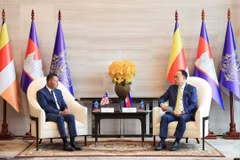
Matichon daily newspaper reported that the visit took place as the two countries celebrate five decades of diplomatic ties, with the aim of further strengthening relations between the two close and friendly neighbours. Its September 15 reports covered the official welcome ceremony at the National Assembly House and the meeting between the Thai King and Queen and General Secretary of the Communist Party of Vietnam Central Committee and President To Lam and his spouse.

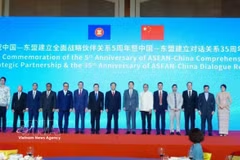
Delegates attend the ceremony in Beijing on September 15 marking the fifth anniversary of the ASEAN-China Comprehensive Strategic Partnership and the 35th anniversary of ASEAN-China Dialogue Relations. (Photo: VNA)

ASEAN, China seek more substantive, effective cooperation

Vice Chairman of the Standing Committee of the National People’s Congress Peng Qinghua said China and ASEAN are good neighbours, friends and partners sharing a common future. Since the establishment of dialogue relations in 1991, ties have developed strongly and become one of ASEAN’s most substantive and dynamic dialogue partnerships.

The BRICS Summit in New Delhi, India, on September 12, 2026. (Photo: ANI/VNA)

ASEAN reaffirms role at BRICS Summit

The seat accorded to ASEAN at the 18th BRICS Summit is a statement to the stature, credibility, and convening power of the organisation. It affirms ASEAN’s indispensable role in the wider global economic dialogue, Philippine President Ferdinand Marcos Jr. has affirmed.

A view of Kuala Lumpur, the capital of Malaysia (Photo: AFP/VNA)

Malaysia's exports projected to moderate next year

Malaysia's exports in the first seven months of 2026 rose 29.2% year-on-year to 290 billion USD. Total trade increased by 24.7% to nearly 540 billion USD, while the trade surplus more than doubled to 42 billion USD.

At a supermarket in Bangkok, Thailand (Photo: Xinhua/VNA)

Thai economy under pressure from weak purchasing power

The Kasikorn Research Centre anticipates that the Thai economy will slow down in the second half of the year compared to the first half, with the "Thai Chuay Thai Plus" initiative offering some support to consumption in Q3 2026.

Consumers select goods at a supermarket in Kuala Lumpur. (Photo: VNA)

Malaysian consumers tighten non-essential spending

CIMB Securities Sdn Bhd analyst Walter Aw Lik Hsin said shoppers are increasingly seeking cheaper products, convenience and value, while cutting back on clothing, lifestyle goods and other non-essentials.

Cambodian Chamber of Commerce president Kith Meng (right) meets with Malaysian ambassador to Cambodia Shaharuddin Onn on September 14. (Photo: phnompenhpost.com)

Cambodia, Malaysia pledge increased trade, investment cooperation

The General Department of Customs and Excise (GDCE) reported that Cambodia-Malaysia trade totaled 1.07 billion USD from January to August 2026, up 55.5% from the same period last year. Cambodia exported 151.76 million USD worth of goods to Malaysia, up 71.8%, while imports reached 921.19 million USD, an increase of 53.1%.

Smoke rises from a land fire in South Sumatra, Indonesia (Photo: Xinhua/VNA)

Indonesia: Thick smoke from forest fires disrupts flights

In a written statement on September 14, the Indonesian Ministry of Forestry said the latest monitoring data shows a significant decrease in so-called “high-confidence” hot spots, strongly suspected to be caused by forest fires, in Central Kalimantan and West Kalimantan.

Thailand upgrades GDP growth to 2.5% in 2026

Thailand upgrades GDP growth to 2.5% in 2026

Thailand's economic recovery will follow a K-shaped model, with growth concentrated in high-tech industries and large companies, according to the Centre for Economic and Business Forecasting at the University of the Thai Chamber of Commerce (UTCC).