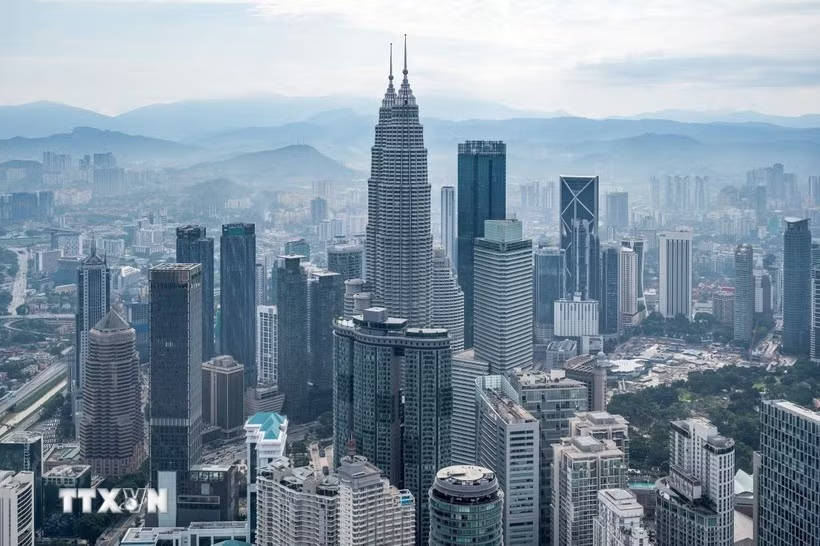
Kuala Lumpur (VNA) – Following a period of stronger-than-expected growth this year, Malaysia's exports are projected to slow in 2027 due to a high base and increased external risks, particularly US tariff policies and trade scrutiny.
Data from the Malaysian External Trade Development Corporation (Matrade) shows that the country's exports in the first seven months of 2026 rose 29.2% year-on-year to 290 billion USD. Total trade increased by 24.7% to nearly 540 billion USD, while the trade surplus more than doubled to 42 billion USD. In July alone, exports reached a record monthly high of 48 billion USD, a 38% increase year-on-year, driven by strong performance from electrical and electronic products, especially semiconductors, along with contributions from basic goods.
However, economists predict that this growth momentum will moderate to high single-digit or low double-digit growth in 2027. Lee Heng Guie, Executive Director of the Socio-Economic Research Centre (SERC) of the Associated Chinese Chambers of Commerce and Industry of Malaysia, said that while the outlook for the technology sector remains positive, with orders extending into 2027, export growth is likely to moderate next year.
The World Semiconductor Trade Statistics Organisation forecasts global chip sales to increase by 27% to 1.9 trillion USD by 2027, following a 90% increase in 2026 driven by artificial intelligence (AI) and computing infrastructure.
Furthermore, Professor Yeah Kim Leng of Sunway University said that the "China+1" strategy is also helping Malaysia attract global corporations seeking to diversify their supply chains, expand production, and export to major markets such as the US, China and other Asian countries.
However, analysts warn that Malaysia needs to be cautious about geopolitical challenges and US trade policies. Washington is currently intensifying its scrutiny of the production and export processes of its trading partners, including through two investigations under Section 301 concerning forced labour and excess energy production.
In the excess energy investigation, Malaysia is among 17 economies placed in the lowest-tier tariff bracket of 10%, compared with 12.5% for 43 other economies. In addition, Malaysia's semiconductor export industry faces potential risks from expanded US measures under Section 232 amid ongoing US-China technology tensions.
To maintain competitiveness, experts expect the Malaysian government's 2027 budget to prioritise support for strategic sectors such as semiconductors, AI, digital services and logistics. SERC proposes increasing the Matrade Market Development Grant limit for small and medium-sized enterprises (SMEs) from 75,000 USD to 125,000 USD to support overseas expansion./.