Vietnam needs to transform BRICS into strategic autonomy, expansion: Indian expert

According to S.D Pradhan, former Deputy National Security Advisor of India, the active participation and practical contributions of partner countries, including Vietnam, played a role in the overall success of the 18th BRICS summit. For Vietnam, its status as partner country offers an opportunity to diversify external ties and better align with emerging drivers of growth.

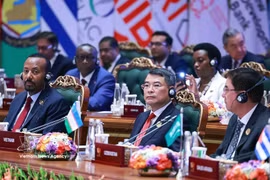
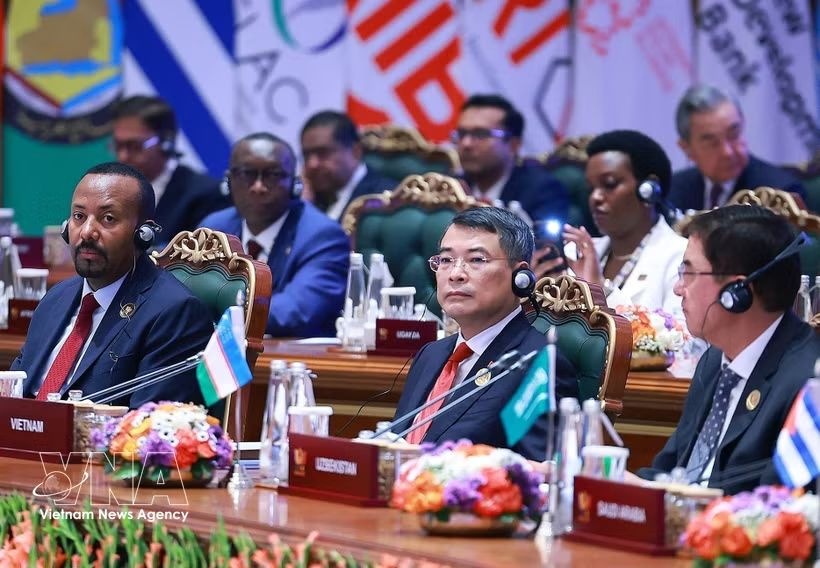
Prime Minister Le Minh Hung attends and delivers a speech at the working lunch session of the 18th BRICS Summit 2026, themed “Resilience, Innovation, Cooperation and Sustainable Development: Shaping the Future of Inclusive Global Growth” in New Delhi on September 13, 2026. (Photo: VNA)

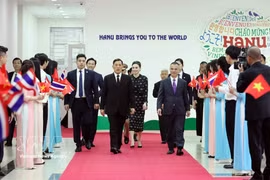
New Delhi (VNA) - Vietnam’s participation in the 18th BRICS Summit in New Delhi, India, last weekend as a partner country has opened up more space for itself to diversify its relationships, enhance its strategic autonomy and connect more deeply with new drivers of development.

The assessment was made by S.D Pradhan, former Deputy National Security Advisor of India, in an interview with Vietnam News Agency’s correspondent in New Delhi on the significance of PM Hung and the high-level Vietnamese delegation attending the most important diplomatic event of the year in host country India.

According to the Indian expert, the active participation and practical contributions of partner countries, including Vietnam, played a role in the overall success of the 18th BRICS summit. For Vietnam, its status as partner country offers an opportunity to diversify external ties and better align with emerging drivers of growth.

He emphasised that for Vietnam, the BRICS partnership should view as an instrument of strategic diversification. Vietnam could use the 11-nation bloc to expand markets, attract technology and investment, strengthen supply-chain resilience and amplify its voice in global governance, while simultaneously remaining firmly anchored in Association of Southest Asian Nations (ASEAN) and maintaining its partnerships with the US, Japan, Europe and other countries.

Citing India’s approach at the New Delhi Summit as an example, the expert noted that BRICS should be used to enlarge strategic space, not to narrow it. India worked to keep BRICS focused on multipolarity, development and practical cooperation.

Economically, he said Vietnam can do a number of strategies such as using BRICS to diversify economic partnerships, attract investment and technology, make critical minerals and supply-chain resilience a priority, participate actively in BRICS digital and AI initiatives, make the BRICS partner status an extension of ASEAN; deepen India - Vietnam cooperation through BRICS and work together to enhance their influence in the Global South.

Besides, he highlighted that the significance of the Prime Minister Narendra Modi and the Vietnamese Prime Minister Le Minh Hung meeting lies in the fact that India–Vietnam relations are moving from “strategic trust” to “strategic capacity”.

Defence and security, rare earths, energy, space and the proposed 2+2 mechanism indicate a partnership increasingly focused on areas of long-term strategic importance, he added.

At the same time, Vietnam's participation in the 18th BRICS Summit as a partner country provides a new multilateral dimension. India and Vietnam can therefore become an important bridge between South Asia, ASEAN and the wider Global South, while both retain their strategic autonomy./.

VNA
See more

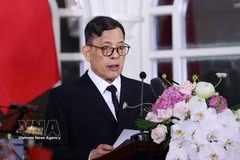
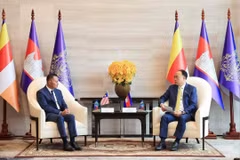
King Maha Vajiralongkorn (Photo: VNA)

Thai media highlights significance of King Maha Vajiralongkorn’s Vietnam visit

Matichon daily newspaper reported that the visit took place as the two countries celebrate five decades of diplomatic ties, with the aim of further strengthening relations between the two close and friendly neighbours. Its September 15 reports covered the official welcome ceremony at the National Assembly House and the meeting between the Thai King and Queen and General Secretary of the Communist Party of Vietnam Central Committee and President To Lam and his spouse.

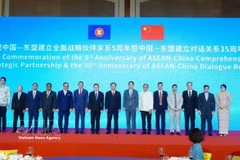
Delegates attend the ceremony in Beijing on September 15 marking the fifth anniversary of the ASEAN-China Comprehensive Strategic Partnership and the 35th anniversary of ASEAN-China Dialogue Relations. (Photo: VNA)

ASEAN, China seek more substantive, effective cooperation

Vice Chairman of the Standing Committee of the National People’s Congress Peng Qinghua said China and ASEAN are good neighbours, friends and partners sharing a common future. Since the establishment of dialogue relations in 1991, ties have developed strongly and become one of ASEAN’s most substantive and dynamic dialogue partnerships.

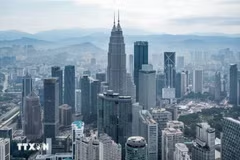
A view of Kuala Lumpur, the capital of Malaysia (Photo: AFP/VNA)

Malaysia's exports projected to moderate next year

Malaysia's exports in the first seven months of 2026 rose 29.2% year-on-year to 290 billion USD. Total trade increased by 24.7% to nearly 540 billion USD, while the trade surplus more than doubled to 42 billion USD.

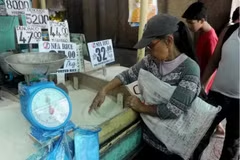
At a supermarket in Bangkok, Thailand (Photo: Xinhua/VNA)

Thai economy under pressure from weak purchasing power

The Kasikorn Research Centre anticipates that the Thai economy will slow down in the second half of the year compared to the first half, with the "Thai Chuay Thai Plus" initiative offering some support to consumption in Q3 2026.

Malaysia tightens scrutiny of data centres

Malaysia tightens scrutiny of data centres

The Data Centre Task Force (DCTF) evaluates applications not only based on investment value but also on their requirements for energy, water and connectivity, as well as their potential contributions to Malaysia's long-term economic and digital goals.

Consumers select goods at a supermarket in Kuala Lumpur. (Photo: VNA)

Malaysian consumers tighten non-essential spending

CIMB Securities Sdn Bhd analyst Walter Aw Lik Hsin said shoppers are increasingly seeking cheaper products, convenience and value, while cutting back on clothing, lifestyle goods and other non-essentials.

Cambodian Chamber of Commerce president Kith Meng (right) meets with Malaysian ambassador to Cambodia Shaharuddin Onn on September 14. (Photo: phnompenhpost.com)

Cambodia, Malaysia pledge increased trade, investment cooperation

The General Department of Customs and Excise (GDCE) reported that Cambodia-Malaysia trade totaled 1.07 billion USD from January to August 2026, up 55.5% from the same period last year. Cambodia exported 151.76 million USD worth of goods to Malaysia, up 71.8%, while imports reached 921.19 million USD, an increase of 53.1%.

Smoke rises from a land fire in South Sumatra, Indonesia (Photo: Xinhua/VNA)

Indonesia: Thick smoke from forest fires disrupts flights

In a written statement on September 14, the Indonesian Ministry of Forestry said the latest monitoring data shows a significant decrease in so-called “high-confidence” hot spots, strongly suspected to be caused by forest fires, in Central Kalimantan and West Kalimantan.

Thailand upgrades GDP growth to 2.5% in 2026

Thailand upgrades GDP growth to 2.5% in 2026

Thailand's economic recovery will follow a K-shaped model, with growth concentrated in high-tech industries and large companies, according to the Centre for Economic and Business Forecasting at the University of the Thai Chamber of Commerce (UTCC).

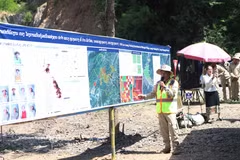
A pepresentatives of UXO Lao programme briefs on mine survey and clearance in Luang Prabang province (Photo: VNA)

International delegates inspect UXO clearance efforts in Laos

To realise the Convention on Cluster Munitions’s goals, the Lao Government has incorporated all international targets into its “Safe Path Forward III 2021–2030” national strategy and stayed committed to its national Sustainable Development Goal 18 – “Lives Safe from UXO”.

The forum on ASEAN's role in the Indo-Pacific region and prospects for cooperation with Argentina takes place on September 10 (Photo: VNA)

ASEAN highlights its central role in Indo-Pacific

The Ambassador of Indonesia, the country holding the rotating chairmanship of ASEAN in Argentina, stressed that maintaining peace and stability, along with an open, transparent regional environment based on mutual respect, are fundamental conditions for a peaceful, inclusive, and prosperous Indo-Pacific.