Vietnam, Laos, Cambodia discuss strategic infrastructure connectivity

Strengthening connectivity among the three countries would help them better leverage their respective advantages and expand links with broader regional frameworks, including the Greater Mekong Subregion (GMS) and ASEAN, said Prof. Dr. Le Van Loi, VASS President.

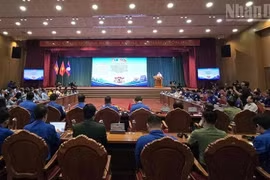
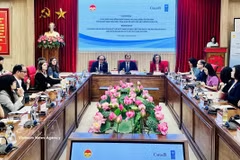
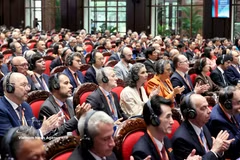
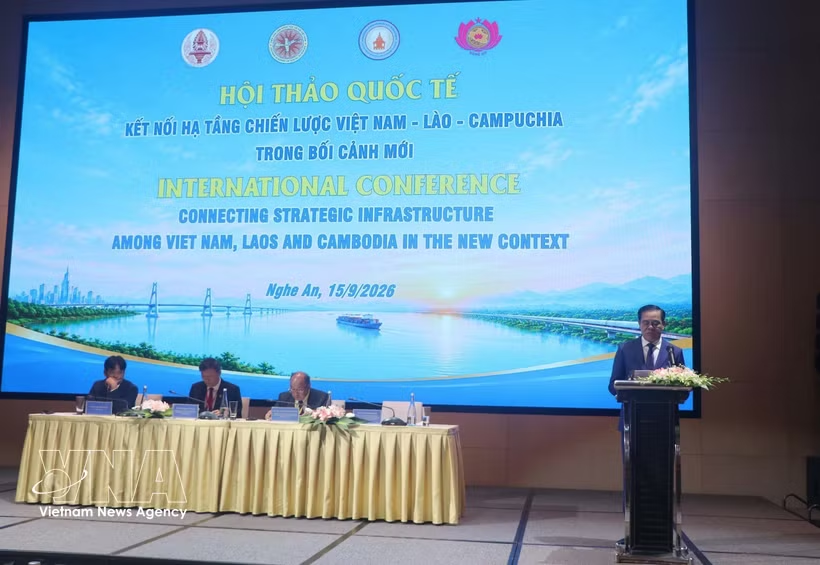
A view of the international conference in Nghe An province on September 15 to discuss strategic infrastructure connectivity among Vietnam, Laos, Cambodia. (Photo: VNA)

Nghe An (VNA) – The Vietnam Academy of Social Sciences (VASS), in coordination with the Lao National Institute for Economic and Social Sciences and the Royal Academy of Cambodia, held an international conference in Nghe An province on September 15 to discuss strategic infrastructure connectivity among the three countries in the new context.

More than 120 delegates attended the conference, including leaders of central ministries and agencies, local officials, scientists, policy experts, diplomatic representatives, international organisations and businesses from Vietnam, Laos, and Cambodia.

Speaking at the event, Prof. Dr. Le Van Loi, VASS President, said the traditional friendship and comprehensive cooperation among Vietnam, Laos and Cambodia are invaluable assets shared by the three nations.

Strengthening connectivity among the three countries would help them better leverage their respective advantages and expand links with broader regional frameworks, including the Greater Mekong Subregion (GMS) and ASEAN, he said.

Loi noted that the Fourth Industrial Revolution, digital transformation and sustainable development are changing the concept of strategic infrastructure. It now extends beyond physical infrastructure such as transport and energy to include institutional, digital and green infrastructure, such as data systems, telecommunications, smart power grids, renewable energy and green logistics.

The restructuring of supply chains and emerging non-traditional security challenges also require infrastructure systems that are more adaptable and resilient, he said.

Lao National Institute for Economic and Social Sciences President Leeber Leebouapao and Royal Academy of Cambodia President Sok Touch shared the view that upgrading and synchronising infrastructure networks among the three countries is key to promoting sustainable development, narrowing development gaps, improving regional competitiveness and strengthening ASEAN centrality in Mekong subregional cooperation.

The Nghe An Provincial People’s Committee Chairman Vo Trong Hai said the province holds a strategic position on the East-West Economic Corridor and shares the longest land border with Laos among Vietnam’s localities. It also has seaports and transport infrastructure linking it with other regions.

Nghe An sees stronger connectivity with localities in Laos and Cambodia as an important way to expand its development space, promote trade and deepen regional cooperation, Hai said.

He highlighted infrastructure connectivity plans, including the Vinh-Thanh Thuy expressway, as well as “soft connectivity” through cooperation in education and training, human resources development, science and technology, cultural exchanges and local-level partnerships.

The conference featured three specialised sessions with 10 scientific presentations and extensive discussions. Participants examined global and regional trends and the current state of connectivity, while discussing long-term development models and solutions to mobilise resources for major infrastructure projects./.

VNA
See more

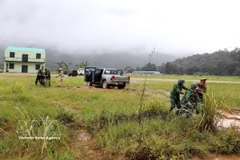
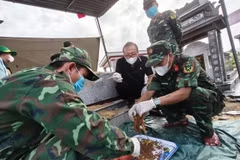
Joint exercise to arrest armed drug trafficking and transportation offenders crossing the Vietnam–Laos border. (Photo: VNA)

Vietnam, Laos coordinate efforts to combat drug crime

In recent years, the Vietnam Border Guard and Laos's law enforcement forces have effectively maintained mechanisms for information exchange and coordinated patrols, inspections and efforts to combat various types of crime, helping maintain stability along the border and creating favourable conditions for people on both sides to develop their socio-economic activities.

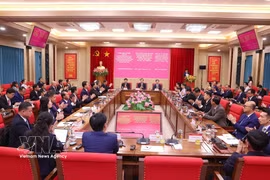
A view of a workshop on advancing gender equality in the public sector amid the restructuring and streamlining of the political system in Hanoi on September 15 (Photo: VNA)

Vietnam seeks to advance gender equality amid public-sector reform

Organisational restructuring presents an opportunity to review personnel standards, procedures and working methods. If gender considerations are integrated into the process, it can help remove long-standing barriers, make better use of female talent and build a fairer and more accountable working environment.

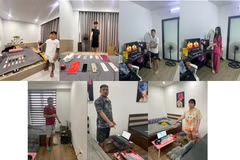
Some of the suspects arrested in the case (Photo: Quang Ninh city's Public Security Department)

Quang Ninh police bust 38.4 million USD transnational cybercrime ring

Quang Ninh city's Public Security Department warned individuals, agencies and businesses not to publicly disclose or provide personal information or bank account details on social media, and urged organisations and businesses to strictly comply with regulations on protecting customers’ personal data.

Teachers and children at Hoa Hong Kindergarten in Ha Giang 2 ward, Tuyen Quang province (Photo: VNA)

Vietnam to provide tuition support for preschoolers

Eligible children will be entitled to tuition exemptions, reductions or support, assistance with learning costs and other benefits in accordance with laws on education, children, people with disabilities, ethnic affairs and social assistance.

More than 100 delegates, including nearly 30 delegates from countries in Asia and Africa, attend the event. (Photo courtesy of the ActionAid)

Ecological agriculture for sustainable future

The workshop “Ecological agriculture for a sustainable future”, organised by ActionAid International in Vietnam, emphasised that women and young people must be the subjects and leaders of change, rather than merely participants or beneficiaries.

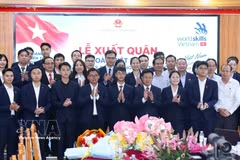
International delegates attend the 7th national congress of the Vietnam Union of Friendship Organisations in Hanoi on September 14. (Photo: VNA)

Phan Anh Son re-elected VUFO president

For the 2026–2031 term, the Vietnam Union of Friendship Organisations (VUFO) will follow the motto “Proactive adaptation, creative breakthroughs, practical effectiveness”.

Deputy Prime Minister Pham Thi Thanh Tra encourages the staff of the Centre for DNA Identification. (Photo: VNA)

Identifying martyrs’ remains requires whole political system’s efforts: Deputy PM

Deputy Prime Minister Pham Thi Thanh Tra inspected the practical implementation of DNA identification technology at the Centre for DNA Identification under the Institute of Biology of the Vietnam Academy of Science and Technology, and the Military Institute of Forensic Medicine under the Military Medical Department of the Ministry of National Defence on September 14.

Doan Duc Hao, Director of the Department of Youth Affairs and Gender Equality under the Ministry of Home Affairs, speaks at a working session with a 16-member delegation of young Korean civil servants in Hanoi on September 14, 2026. (Photo: VNA)

Vietnam, RoK promote cooperation, youth’s role

Le Thi Viet Lam, Deputy Director of the Department of International Cooperation under the Ministry of Science and Technology, said Vietnam wishes to continue building an ecosystem that connects the State, research institutes, universities and businesses, enabling them to share resources and create value. This is also an area in which Vietnam is interested in learning from Korean experience.

To operate Metro Line No. 1 (Ben Thanh–Suoi Tien), Ho Chi Minh City Urban Railway Company No. 1 (HURC1) currently employs 700 people to keep nearly 200 train trips running each day. (Photo: nhandan.vn)

Ho Chi Minh City addresses manpower shortage for urban railway development

Under the human resources training scheme serving the development of the urban railway network approved by the municipal People’s Committee, the city will need around 70,000 workers by 2030 to support investment in and development of its metro system, including project management personnel, operations and maintenance staff, engineers, technical workers, consultants and designers.